Print subscription includes a free wall-size coloured map.Special offer: Subscribe Now (Print) and Get Free Wall Size Coloured Map!Subscribe Now
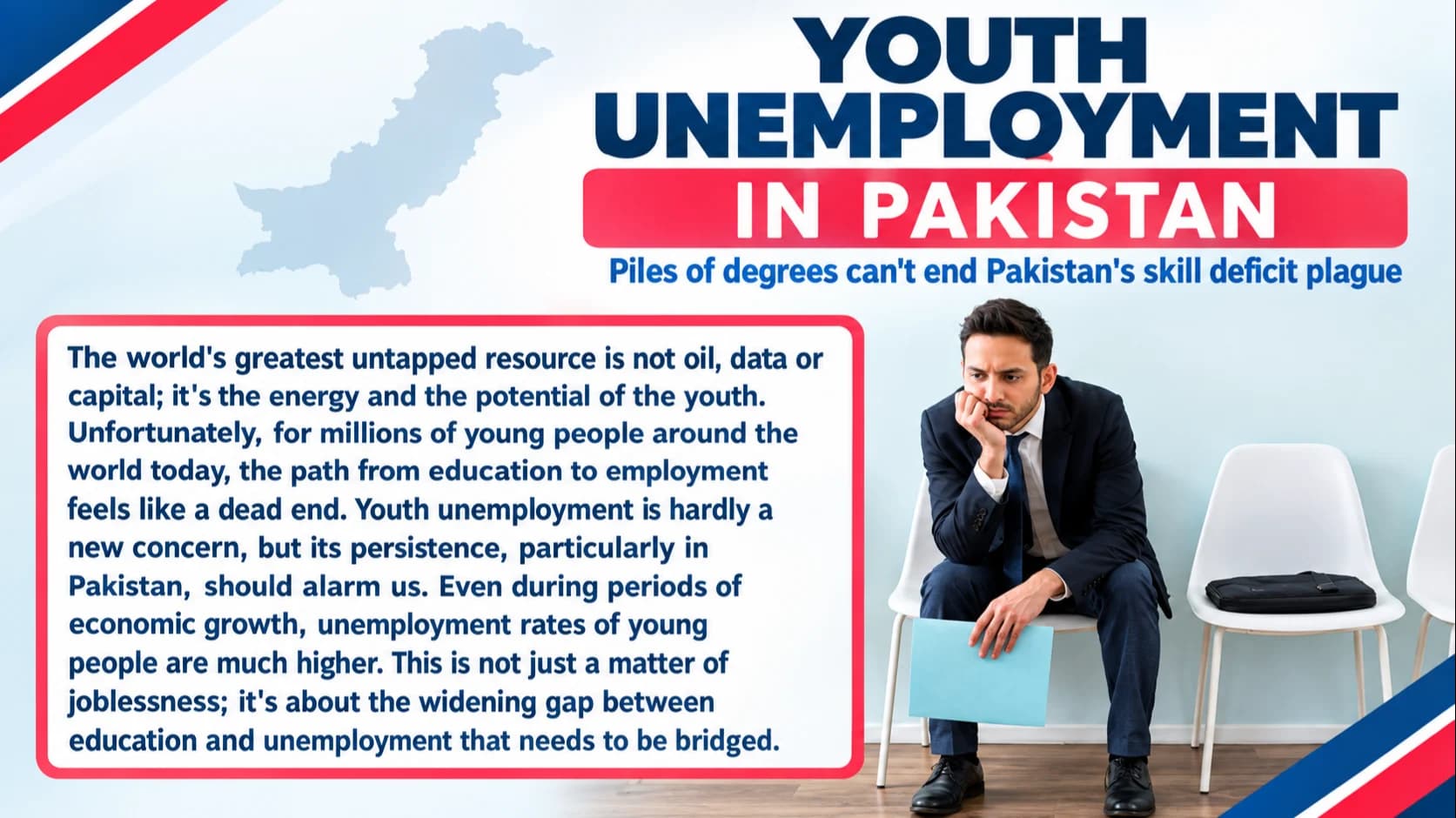
Summary. Piles of degrees can't end Pakistan's skill deficit plague
The world's greatest untapped resource is not oil, data or capital; it's the energy and the potential of the youth. Unfortunately, for millions of young people around the world today, the path from education to employment feels like a dead end. Youth unemployment is hardly a new concern, but its persistence, particularly in Pakistan, should alarm us. Even during periods of economic growth, unemployment rates of young people are much higher. This is not just a matter of joblessness; it's about the widening gap between education and unemployment that needs to be bridged.
Pakistan's inability to create adequate opportunities for its young population has moved far beyond an economic concern. It represents a significant social and political challenge for the country. Persistent and high rates of youth unemployment expose deep structural weaknesses in an economy that has failed to translate its growth into more jobs. Instead of benefitting from the country's development gains, hundreds of thousands of young people find themselves excluded from productive work, which creates frustration and undermines social cohesion. If this disconnect continues, it will jeopardize our long-term development trajectory and erode the very demographic dividend that should have been one of our greatest strengths.
The statistics paint a starker picture of the employment situation. According to recent data, Pakistan's youth unemployment rate stands at approximately 9.86 percent for ages 15-24, with millions of graduates entering a job market where skill mismatches leave them unemployable or underemployed.
As per the Labour Force Survey (LFS) 2024-25, conducted by the Pakistan Bureau of Statistics (PBS):
Pakistan's unemployed population surged by a staggering 31%, or 1.4 million people, rising from 4.5 million in 2020-21 to 5.9 million in 2024-25.
The unemployment rate also showed an upward trend across all age groups.
For the prime age group of 15-24 years, it was estimated at 12.6% in 2024-25, up from 11.1% in 2020-21.
Among individuals aged 15-29, the rate rose to 11.5% from 10.3%, reflecting growing joblessness among the youth.
Overall, the average unemployment rate increased to 6.9%, compared to 6.3% in the previous LFS.
Among males, the unemployment rate climbed from 5.5% to 5.9%.
For females, it increased more sharply from 8.9% to 9.7%.
In rural areas, unemployment rose from 5.8% to 6.3%
In urban areas, it edged up from 7.3% to 8%.
The proportion of people aged 10 and above, who are either employed or actively seeking employment, increased from 44.9% in 2020-21 to 47.7% in 2024-25.
A sex-disaggregated analysis showed increases in participation rates for both males and females.
Male participation rose from 67.9% to 69.8%
Female participation increased from 21.4% to 24.4%.
Rural participation rose from 48.6% to 52.3% while urban participation from 38.8% to 40.8%
The labour force, encompassing all persons aged 10 and above who are employed (including own-use producers) or unemployed, increased from 71.8m in 2020-21 to 85.6m in 2024-25, adding roughly 3.5m people per year.
As for the estimates of gig-economy labour supply:
For primary jobs, 2.9% of workers are engaged in gig-based work
For secondary jobs, gig (short-term) work rises to 10.6%, with women playing a more prominent role — 15% of women with secondary jobs rely on gig work, compared to 9.8% of men.
The share of agricultural employment declined from 37.4% in 2020-21 to 33.1% in 2024-25
The services sector grew from 37.2% to 41.2%.
Industry's share declined slightly to 24.9% from 25.4%.
The share of own-account workers increased from 35.5% to 36.1%, driven largely by women.
Female entrepreneurship rose sharply from 19% in 2020-21 to 25.2%, while the share of contributing family workers — predominantly unpaid women — declined from 21.1% to 19%, reflecting greater female entry into paid labour.
Pakistan, having a substantial domestic labour force of 71.8 million, holds the sixth largest workforce globally. Each year, approximately 2 million young Pakistanis join the labour market, contributing to an expanding talent pool. There is a significant gap between the demand and supply of workers, especially, a serious mismatch between the jobs demanded and the supply of skills and trained manpower in the country. Pakistan's labour market faces significant challenges, particularly concerning youth unemployment, gender disparities, and the need for skill development. Below are some reasons behind rampant unemployment in Pakistan:
The roots of Pakistan's youth unemployment crisis lie in a longstanding mismatch between education and labour-market needs. The education system continues to emphasize degrees rather than practical, job-ready skills, which leaves many graduates without the competencies employers expect. Employers often report a shortage of candidates with technical abilities, digital literacy or industry-specific training. Technical and vocational institutes, which should fill this gap, remain underfunded, outdated and weakly linked to industry. As a result, young people are unprepared for emerging opportunities in a changing economy.
With unemployment jumping by 31 percent—from 4.5 million in 2020–21 to 5.9 million in 2024–25—clinging to outdated curricula is not mere negligence; it is a direct assault on the future of 240 million people. In fact, if one factors in underemployment, the true number of wasted human potential is many times higher than these already alarming figures.
There is no denying that Pakistan does not suffer from a shortage of talent; it suffers from a shortage of skills. This distinction matters, because while talent is innate, skills are built. Nations that understand this delicate difference are the ones that rise. For decades, we have focused exclusively on degrees while neglecting competencies, producing graduates but not technicians, certificates but not capabilities, and aspirations but not employability. As a result, millions of young Pakistanis stand at the edge of opportunity yet remain locked out of the modern economy. This is not a failure of youth, it is a failure of the system.
Another critical issue is the immense pressure on public-sector employment. For many young men and women, government jobs are considered the only viable route to stability, recognition and social prestige. Moreover, the private sector has not been able to generate enough high-quality jobs to absorb new entrants since private investment remained stagnant for over a decade due to various policy and regulatory shortcomings. Most youth who find work end up in informal, low-paying, insecure employment.
As per the LFS, out of 179.6 million working-age individuals in 2024-25, 117.4 million are engaged in unpaid domestic and care activities. Among 92 million men, 50.7 million (55%) perform unpaid work, while among 87.6 million women, 66.7 million (76%) are engaged in unpaid domestic and care responsibilities.
Employees constitute the largest group (43.5%), followed by own-account workers (36.1%), contributing family workers (19.1%), and employers (1.3%). Nearly half of female workers are contributing family workers (49.7%), while almost half of male workers are employees (49%). Between the two surveys, the share of employees rose from 42% to 43.5%, and own-account workers from 35.5% to 36.1%, while contributing family workers declined from 21.1% to 19.1%, and employers from 1.4% to 1.3%.
In non-agricultural work, the informal sector continues to dominate, accounting for 72.1% of jobs — 75.5% in rural areas and 68.3% in urban areas. Formal sector work is more common in cities, reaching 31.7%.
Thus, most young men and women earn too little to build a future, and receive none of the benefits or protections that come with formal work. High informality, weak social protection, gender disparities and significant rural-urban inequality hamper our labour market. Young women face additional structural barriers related to mobility, social norms and unpaid care responsibilities.
Global changes in the nature of work also complicate the situation. Automation, digitization and artificial intelligence are reshaping labour markets everywhere. Globally, employers struggle to find workers with the right technical skills, even though large numbers of young people remain unemployed. Though Pakistan is far behind in technological advancement, some industries are moving quickly to adopt technology in their workplace. The 2025 trends from the World Economic Forum emphasize emerging technologies like engineered living therapeutics, osmotic power, AI-generated content watermarking and structural battery composites, alongside Deloitte's insights on agentic AI and quantum computing that demand immediate curriculum integration.
Without a significant shift in skills upgradation, not only will the existing jobs be lost, but employers will find it challenging to find a technologically equipped workforce.
Unfortunately, the government has failed our youth as it has not been able to introduce any meaningful employment programs, increase investment in skill development or redesign the vocational training system. The absence of a proactive, visible change in the approach to youth employment reflects the government's reluctance and lack of urgency in addressing this pressing issue.
However, if the country is to harness its demographic dividend, it must change its approach to youth employment. Here are some actionable strategies to make a paradigm shift:
Make technical and vocational education and training (TVET) central to Pakistan's skills strategy. Learn from Germany's apprenticeship model, where over half of young people complete apprenticeships and youth unemployment is far lower than the EU average.
Remove social stigma around vocational education by treating it as equal to academic pathways.
Design training programmes jointly with industry and employers rather than academics alone.
Scale short, modular training programmes of three to six months.
Focus on high-demand sectors such as textiles, construction, renewable energy, IT services, cybersecurity and agri-processing.
Ensure skills are nationally recognized, stackable and portable.
Promote government-supported, employer-led apprenticeships, especially for SMEs.
Share training and stipend costs to incentivize firms to hire and retain local talent.
Treat skills development as a lifelong process rather than one-time training.
Draw lessons from Singapore's SkillsFuture and the UK's Lifelong Learning Entitlement.
Introduce national skills credits for adults to fund approved courses.
Develop portable micro-credentials and digital badges.
Institutionalize reskilling every 3–5 years through labour policy.
Address widening digital skills gaps driven by global digital transformation.
Cover the full spectrum from basic digital literacy to advanced software, data analytics and AI-assisted services.
Embed digital skills from primary education onwards.
Expand access to rural areas and women through flexible and online learning models.
Link training to industry via partnerships with tech firms and the diaspora.
Expand successful initiatives like Bano Qabil nationwide.
Use public–private partnerships to scale free, industry-aligned IT training.
Emphasize mentorship and real-world skills that lead directly to employment or entrepreneurship.
Establish a National Skills and Apprenticeship Framework.
Introduce digital skills passports so credentials are recognized nationwide.
Promote labour mobility and dignity through credential portability.
Integrate AI literacy across all sectors, not just IT.
Close the gap between business demand for AI skills and actual upskilling efforts.
Focus on women's participation to raise household and national economic outcomes.
Provide flexible training schedules, childcare support and targeted outreach.
Deliver training to rural areas through mobile units, community centres and online platforms.
Reforms within public-sector hiring are equally urgent.
Recruitment must be strictly merit-based, transparent and completed on predictable timelines so people can trust the system.
A credible and fair process would ease frustration, restore confidence in state institutions and significantly improve government service delivery.
It will ensure that qualified and competent individuals, rather than political favourites, occupy important administrative and technical positions.
The private sector needs to play a much larger role in creating jobs for young people.
Of course, this will only happen if the government makes it easier and more attractive for firms to hire and train youth.
Tax incentives can lower recruitment costs, while subsidized apprenticeship programs would allow companies to train fresh graduates without bearing the full financial burden.
While the government will be a major supporter, it may approach development partners and bilateral agencies to fund skills and employment initiatives.
In parallel, youth entrepreneurship should be nurtured to generate employment.
This requires accessible and affordable financing for young innovators, business incubators that provide technical and strategic support, mentorship networks connecting new entrepreneurs with experienced professionals, and structured access to domestic and export markets.
These initiatives can help young people build their own enterprises, create jobs for others and participate more productively in the economy.
Pakistan must commit to evidence-based policymaking, especially regarding youth employment.
Reliable labour market data, regular outcome evaluations and continuous monitoring are essential for understanding which programs actually create jobs for young people and which do not.
Without accurate information, policies become fragmented, resources are wasted and well-intentioned initiatives fail to reach the youth who need them most.
Effective data systems would enable the government to identify emerging skills shortages, track employment trends, design targeted training programs and adjust interventions based on real results.
The youth bulge in Pakistan is not going to be eternal. When millions of youths continue to be under-skilled and under-employed, the payoff will reverse to slow down growth, state budgets and societal unity. The future of Pakistan will not be decided by the number of young people it has. It will depend on the productivity of such youths that they will be permitted to attain.
The writer is a London-based academic.
Topics
The writer is a London-based academic.