Print subscription includes a free wall-size coloured map.Special offer: Subscribe Now (Print) and Get Free Wall Size Coloured Map!Subscribe Now
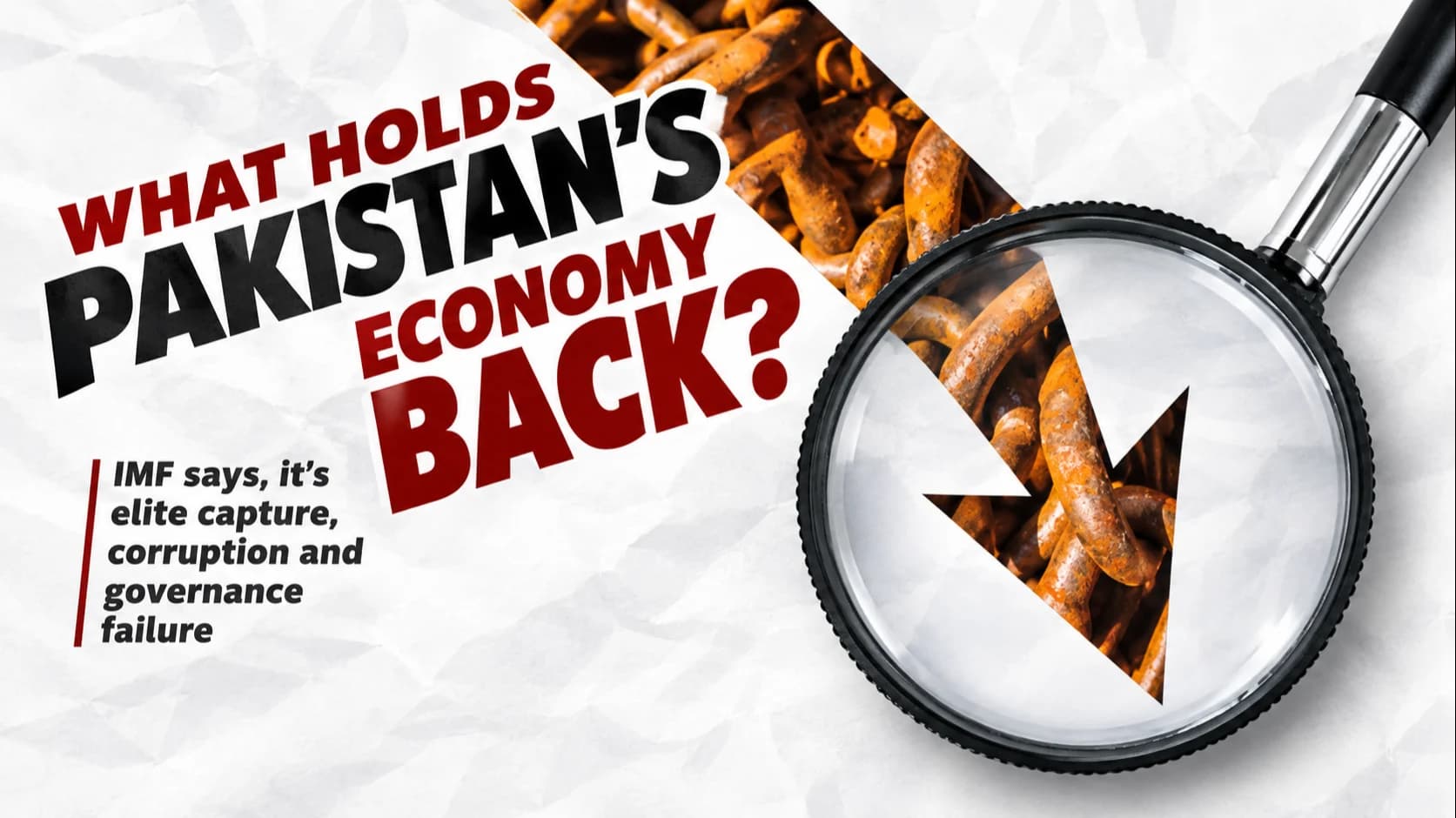
After months of delays, the IMF Governance and Corruption Diagnostic Assessment (GCDA) on Pakistan has finally been released, and its diagnosis is quite grim. The report is damning, and would surprise no one with the Fund observing that “while corruption vulnerabilities are present at all levels of government, the most economically damaging manifestations involve privileged entities that exert influence over key economic sectors, including those owned by or affiliated with the state.” The report finds that institutional weaknesses, lack of transparency in state functions, preferential treatment for select businesses and inefficiencies in public-sector transactions are major constraints to growth.
On November 20, the Finance Division released an IMF report which offers the most detailed assessment in years of how fragmented regulation, opaque budgeting and elite capture are curbing investment and weakening revenue. Titled “Pakistan Governance and Corruption Diagnostic Assessment, the 186-page scathing report presents a grim analysis of Pakistan's persistent corruption challenge. exposes the scale of elite capture across Pakistan's most influential sectors, warning that entrenched interests in key sectors, including sugar, real estate, agriculture and energy, continue to undermine the country's reform trajectory. It singles out the sugar industry as a textbook example of how the intertwined relationship between economic elites and state regulators captures public benefits at a deep cost to the overall public. The authors of the report have predicted that Pakistan could lift its gross domestic product (GDP) between 5% and 6.5% over five years if the country tackles corruption and deep-rooted governance failures.
This Governance and Corruption Diagnostic Assessment (GCDA) was conducted at the request and with the support of the Government of Pakistan to identify and analyze governance weaknesses and corruption vulnerabilities that undermine economic performance and reform efforts. The diagnostic focused on federal-level governance in five core state functions: fiscal governance, market regulation, financial sector oversight, anti-money laundering and combating the financing of terrorism (AML/CFT), and rule of law, and also considered the strength and effectiveness of anticorruption institutions and approaches to address corruption risks. The findings reveal persistent and widespread corruption risks embedded in a heavily state-dominated economy that operates with complex regulatory environments, weak institutional capacities, fragmented oversight, with ineffective and inconsistent accountability and constrained rule of law. These factors collectively constrain private sector development and public sector effectiveness. The report provides an integrated set of recommendations aimed at achieving concrete and visible progress through strengthening institutional integrity, enhancing transparency, improving consistency and reliability of the enforcement of rules, and fostering coordination across agencies to support sustainable economic growth and public trust.
The report is based on information gathered before and during April 2025 and does not capture reforms introduced after that date. Publication of the GCDA by the end of August 2025 was also a structural benchmark under the 37-month, $7 billion EFF approved on September 25, 2024.
· Corruption is a persistent and corrosive feature of Pakistan's governance and it continues to hinder Pakistan's macroeconomic and social development by diverting public funds, distorting markets, impeding fair competition, eroding public trust and constraining domestic and foreign investment.
· From 2015 to 2024, Pakistan's WJP score on control of corruption remained constant (0.38 to 0.39 out of 1.00), which places it among the bottom performers globally, and 5 out of 6 in the South Asian region.
· The National Accountability Bureau recoveries during the period between January 2023 and December 2024, totalled PRs 5.310 trillion.
· Pakistan's tax-to-GDP ratio is low and falling; weak control of corruption, as reflected in lower WGI scores, is associated with lower tax-to GDP ratios.
· Discretionary allocations are skewed towards districts represented in the government or the senior bureaucracy, reflecting the vulnerability of the system to political influence.
· The return on public investment is low and undermined by issues in the control and oversight of public investment, as well as a public procurement system that lacks effectiveness and integrity.
· Export industries have suffered from domestic policies that serve to restrict competition to the benefit of politically protected firms. Exports have fallen as a share of GDP from 16 percent in 1990 to 9 percent today.
· From 2021 to 2023, the judiciary has been consistently identified as one of the three most corrupt sectors in the National Anti-Corruption Perception Survey (others sectors include police and tender and contracting).
· The three primary anti-corruption agencies – NAB, the FIA and the provincial Anti-Corruption Establishments (ACEs) – are viewed as having poor coordination.
· The state's role as the largest buyer in the economy, through public procurement and other forms of state contracting, expands its economic footprint.
· Politically connected firms in Pakistan borrow 45 percent more and have a 50 percent higher default rate.
· State domination extends to employment, where the state employs 72 percent of individuals with formal jobs.
· Pakistan's institutions consistently perform poorly across a range of global indicators, regardless of whether the institution is involved in fiscal governance, market regulation or enforcement of economic rights.
· Parliamentary oversight of spending is weakened by substantial differences between approved budgets and actual expenditures. For example, the National Assembly approved PRs 9.4 trillion in expenditure overruns in FY2024–25, five times higher than the previous year.
· The absence of a policy to guide where and when the state regulates the economy, allows individual regulatory authorities significant opportunities to generate burdensome rules, while their role as both enforcer of regulations and adjudicator of regulator disputes insulates them from effective oversight.
· Until recently, agricultural income has not been taxed, while real estate, manufacturing and the energy sector continue to benefit from favourable taxation arrangements.
· The revenue loss from such tax expenditures is substantial, with the government itself estimating costs at 4.61 percent of GDP in FY 2023.
· The selective and arbitrary enforcement of laws and policies enables power forces to shape economic decisions, and influence economic possibilities for both public and private parties.
· A 2020 UNDP report estimated that the "elite privilege” (access to subsidies, tax relief and lucrative state contracts) amounted to US$4.7 billion for the corporate sector alone, with another US$1.7 billion. For example, a 2020 CCP inquiry found that cement manufacturers colluded to increase prices by Rs 45 to Rs 50 per bag, costing consumers Rs 40 billion, despite the companies benefiting from a 25 percent reduction in the federal excise duty.
· Firms in the sugar sector benefited from favorable government policies, subsidies and regulatory loopholes for decades, mainly due to the nexus between industry magnates and political leaders.
· Sugar mill owners, many of whom hold government positions, have ensured highly 'recommended' prices for sugarcane and protective tariffs, keeping their operations profitable at the expense of competitiveness.
· A high-profile investigation, led by the FIA, found that leading sugar mill owners colluded to create artificial shortages and manipulate prices despite ample warehouse stocks.
· Despite damning revelations, accountability has been limited. Occasional crackdowns have occurred, but the cartel remains.
· While corruption can happen through individual acts, corruption has the most significant consequences when it encompasses control over entire markets, when the power of the state is captured and policies and laws are designed to benefit specific groups and individuals. Termed “state capture”, in such situations, corruption no longer operates as a distortion of governance but as the foundation of governance, corruption has de jure become legalized, disempowering citizens and concentrating power in a small elite. It is the de jure institutionalization of benefits to a limited group that constrains Pakistan's economic and social development.
In human societies, the drama of glory and destruction has played out since eternity. Beneath all splendor and success, a silent and deadly disease continued to grow which ultimately caused devastation and destruction of empires and once-mighty world powers. This is the disease history has named as corruption. Like a termite, this menace eats walls of a society not from the outside but from within. It is a poison that slowly seeps into the veins and then, all at once, stops the heartbeat.
Look into the fractured mirrors of history: that final evening of the Roman Empire, when the ruling class squandered public wealth on luxuries while clouds of barbarism thundered at the borders. The conscience of every senator had been sold; every decision was the product of bribery wrapped in silk. The law was a sword only for the weak and a mere scrap of paper for the powerful. Those buildings and highways—once masterpieces of Roman engineering—were built with substandard materials due to corruption and collapsed long before their time.
Europe too has witnessed similar eras.
In the seventeenth century, France's system had become unbearably burdened by corruption. The privileges of the aristocracy and financial irregularities in centres of power grew so severe that the entire fiscal structure crumbled. Tax collection had been outsourced to private contractors who squeezed the poor while the elite enjoyed exemptions. This inequality and corruption ultimately became fuel for the fire of the French Revolution. Though the system changed after the revolution, the shadow of corruption could not be fully erased because the psychological decay had grown too deep.
In contrast, some nations recognized this termite in their darkest hours and chose to uproot it completely. Take the example of Singapore. In the 1960s, it was a poor and deeply corrupt country. Its founder, Lee Kuan Yew, adopted the principle that national survival required strict accountability and the supremacy of the constitution. He not only treated corruption as a financial crime but considered it an act of national betrayal. Judges and civil servants were paid market-level salaries to keep them away from temptation, and the accountability institutions were granted full independence. This gradually restored societal trust, and today Singapore is among the least corrupt nations in the world.
Similarly, corruption has been central in China's recent history. When the Chinese Communist Party realized that corruption was destroying governance and eroding public support, it launched a wide-ranging campaign against “tigers and flies,” bringing both powerful leaders and minor officials into the dock of accountability. This campaign was not merely for the rule of law but to restore public trust in the government. China's economic miracle owes much to this strict governance and relentless battle against corruption.
Pakistan, unfortunately, stands on a similar path of silent decay. The GCDA report sheds a harsh yet truthful light on the entire institutional, economic and administrative structure of the country. It is not a technical document but a comprehensive charge sheet. According to the report, the crisis of governance has deepened so severely that transparency, rule of law and basic principles of accountability exist only in name. Industrial contraction has become an economic disaster; the industrial base—especially large-scale manufacturing—has shrunk by nearly 50 percent.
Corruption raises the cost of public services many times over. When government contracts are not awarded transparently, roads, hospitals and schools are either not completed on time or are built with poor-quality materials, the burden of which ultimately falls on ordinary citizens. Investment decisions are driven by political gain rather than economic need. This is why Pakistan's energy sector circular debt has become an incurable disease—its roots lie in corrupt contracts and institutional weakness.
The terms used in the report regarding corruption are not those of an ordinary citizen or a newspaper columnist; they are the words of an international institution. Here it is essential to understand a key distinction: petty corruption, which occurs at the level of clerks and junior officials, and grand corruption, which occurs at the policy-making level. Pakistan's real problem is not petty corruption but grand corruption.
Corruption breaks the “covenant of trust” between the state and the citizen. It is not merely an economic loss; it shakes the very foundation of democratic trust upon which a state stands. When the state fails to ensure the fair distribution of resources, public trust evaporates. This creates a culture of despair—where people stop expecting anything from the state and start running only for their own personal gain.
A deep look into history teaches us that nations do not develop unless they possess the courage to listen to the voice of their conscience. Reforms are possible, but they will succeed only when built upon ethical integrity and collective dignity.
As Pakistan stands at a crossroads, the IMF report not only paints a detailed picture of the challenges but also provides a roadmap towards a more transparent, competitive and sustainable governance model. The report has pointed out governance weaknesses in Pakistani state institutions and urged prioritizing a 15-point set of recommendations to address these issues tied to a heightened risk of corruption. Whether Pakistan seizes or loses this opportunity will shape not only the economic performance but also the broader social contract between the state and its citizens. The difficulty is that Pakistan's power centres as well as policy and business elites do not yet appear ready to give up their privileges and embrace the change even though time is fast running out for crucial, make-or-break decisions. Can the IMF diagnostic change that?
The writer is an Assistant Editor of JWT.
Topics
The writer is an Assistant Editor of JWT.