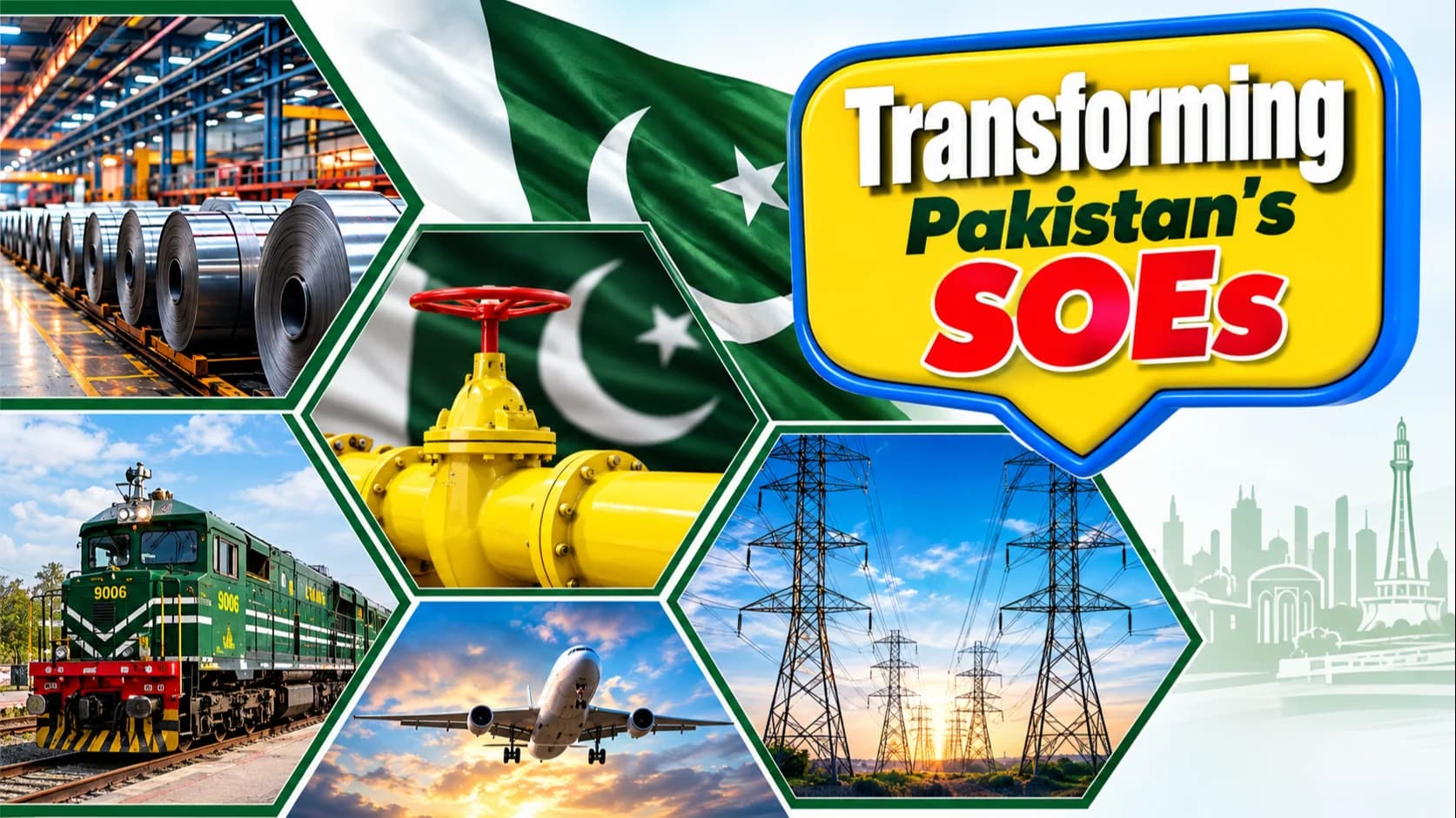
State-Owned Enterprises (SOEs) play a pivotal role in economic development, infrastructure growth, public service delivery and national competitiveness of a country. But, in Pakistan, they are making huge losses. Almost all SOEs here have been draining public finances since forever because governance standards are weak and because opaque structures create opportunities that do not align with public interest. As per a recent report, an amount of about Rs1.9 billion a day is being squandered to keep the SOEs alive. The scale of the losses should generate outrage because Pakistan cannot thrive if the billions needed to improve health and education are instead being set on fire to keep SOEs afloat.
Across the globe, state-owned enterprises (SOEs) often serve as engines of economic growth and promote strategic national assets. Countries like Norway with Equinor and China with the State Grid Corporation, show how SOEs can thrive when managed effectively.
On a global scale, SOEs hold considerable economic significance; the OECD notes that their share in the top 500 global companies by revenue has tripled between 2000 and 2023, now representing 12% of global market capitalization. This demonstrates the crucial role that well-functioning SOEs can play in driving national economies. However, in Pakistan, the reality is quite different. Many of its SOEs are burdened by chronic inefficiencies and financial losses, which are symptoms of a deeper, persistent governance crisis that also hinders the attraction and retention of professional talent. According to a special chapter on SOE reforms in the State Bank of Pakistan’s (SBP) Annual Report FY24 on the State of Pakistan's Economy, bailout packages and subsidies to SOEs have surged to a staggering Rs5.7 trillion, or 1.4% of GDP, over eight years (FY16 to FY23). A large chunk of the financial aid, directed mainly toward sectors such as power, infrastructure, transport and information and communication technology (ICT), has exacerbated the financial burden on the government.
PIA, Pakistan Railways (PR) and the National Highway Authority (NHA) remain among the top companies discussed whenever there is debate on loss-making SOEs.
The loss-making companies consume so many financial resources from the state that they offset the profits earned by profitable SOEs like the State Bank of Pakistan (SBP), oil and gas exploration companies such as OGDC, PPL, POL, and the oil marketing company Pakistan State Oil (PSO), among others.
The ever-increasing financial burden on the government signals a strong call for long-overdue SOE reforms that the ruling coalition has already initiated recently. The concern is that reforms have been launched many times in the past but have never reached a successful conclusion.
The IMF Review and SOEs
In its staff report on the Second Review under the Extended Fund Facility, the IMF said SOE reforms remain uneven, with weaknesses in governance, transparency and financial oversight continuing to generate losses and strain public finances.
These weaknesses, the report noted, underscore the urgency of sustained reform momentum.
The IMF acknowledged progress in implementing the SOE governance framework for around 80 commercial entities, noting that the Central Monitoring Unit is fully staffed and producing regular analytical reports, with its electronic database nearing completion. However, it said many SOEs still lack credible business plans, statements of corporate intent and IFRS-compliant audited accounts.
The IMF said major SOEs are planned to be integrated into the FY27 budget framework to reduce implicit subsidies and fiscal risks.
Board independence across SOEs was also flagged as incomplete, despite legal requirements. Authorities have committed to appointing independent directors by end-December 2025.
The rise and fall of SOEs
Pakistan began its journey in 1947 with a strong vision of self-reliance, honesty and nation-building, emphasizing basic industrialization. The discovery of Sui gas in 1952 and the creation of key institutions – including but not limited to PIDC, PAEC, Wapda, PCSIR, PSI, Planning Commission, etc. – laid a solid foundation for rapid growth, earning hopes of becoming Asia's first “tiger.”
In the 1970s, the creation of the Board of Industrial Management (BIM) marked a serious effort to professionally oversee these entities, drawing on expert leadership to drive nation-building. This vision was rooted in the optimism of Pakistan's early years after independence in 1947, when honesty, integrity and development guided national priorities.
Moreover, major initiatives such as Pakistan Steel Mills, fertilizer complexes, defence production projects and the nuclear program were launched. BIM played a central role in managing SOEs, creating employment opportunities and restoring confidence.
Yet, nationalization policies faltered due to the absence of competent leadership. Successful private enterprises, such as BECO under C.M. Latif, suffered greatly, as did the banking and insurance sectors. The 1977 overthrow of the elected government proved disastrous for SOEs. BIM was dismantled, bureaucratic control replaced professional management, and governance deteriorated. Nepotism flourished, boards lost authority and profitable enterprises slid into losses.
What bleeds our SOEs?
The SOEs, which once symbolized Pakistan's ambition for self-reliance and industrial strength, are now causing losses to the tune of billions of rupees every year. In the FY 2024-25, these entities incurred losses of Rs851 billion and cumulative losses of around 6 trillion rupees since 2014 –-about one-third of the Rs17.5 trillion federal budget for 2025-26. Moreover, SOE bailouts cost taxpayers Rs1.58 trillion in the previous fiscal, more than the entire PSDP for FY26. The scale of the losses should generate outrage — about Rs1.9 billion a day is being squandered to keep the SOEs alive, and most of these SOEs do not even deliver services of acceptable quality. Following are some of the factors that have strangulated the SOEs.
a. Operational inefficiencies
Chronic operational inefficiencies, such as poor cost controls, outdated systems and weak financial discipline, bleed our SOEs. This, in turn, leads to corruption whereby key position-holders use their privilege to get kickbacks in procurement and the award of contracts.
Weak financial controls mean that such corruption often goes undetected. And if it is detected, the perpetrators fear no reprisals, due to the incompetence and often collusion of agencies tasked to investigate such corruption.
b. Overstaffing and Mismanagement
There is also the issue of overstaffing and political hiring. Every new government that comes in seeks to induct its cronies into SOEs. A blatant example of this is PIA, a one-time leader in aviation, which is now reduced to a shadow of its former self primarily by politically motivated overstaffing.
Mismanagement and weak leadership often result from the lack of professional and merit-based hiring and promotions. Anytime a strong, competent leader is appointed, usually by accident, those in power get to work to remove him.
c. Inept Leadership
The absence of competent leadership results in the lack of accountability, poor or no strategic planning, resistance to reform and failure to innovate. In today's highly competitive business environment, these failures amount to the kiss of death for any organization.
d. Non-professional boards
People sitting across the boards of almost all SOEs simply lack the qualifications, competence and industry-specific experience that are needed at this level.
The issue that needs to be looked at is who appoints the directors on these boards and on what basis. Take the example of Pakistan Petroleum Limited (PPL). The Petroleum Division nominates a panel of directors and sends it to the federal government for approval. Since the Petroleum Division has the responsibility for nominating directors, its role of being the regulator of this sector becomes the problem. There is a fundamental conflict of interest in having the regulator select the board of a company it regulates.
Moreover, senior officials at the PD nominate themselves as members of the board, which means that, on a board of 10 directors, three or four will be ministry bureaucrats. And of course, the other so-called independent directors will be people they have nominated. A board so constituted is not only conflicted but can also never be independent in accordance with Section 17 of Chapter 6 of the SOE Act 2023, which says that the board must act independently of the federal government! So, how can a board whose directors owe their positions to PD officials, and on which sit several of those same officials, possibly be independent of the federal government?
The way forward
The responsibility for appointing SOE boards must pass to a body that itself is independent of the government. This could be, for example, a committee composed of the heads of key professional organizations such as the heads of ICAP (Institute of Chartered Accountants), PBC (Pakistan Bar Council), PIDE (Pakistan Institute of Development Economics), PEC (Pakistan Engineering Council) and Pakistan Academy of Sciences (PAS). The committee can also include CEOs from several prominent private sector companies and banks.
This "SOE boards nominating committee" should be entrusted with nominating directors for all SOEs for subsequent confirmation and appointment by the government. Such a procedure would virtually guarantee the independence of SOE boards.
Clearly, this single reform of appointing independent boards is not a panacea. The problems of SOEs are deep and manifold. But there is no doubt that this important first step will go a long way to at least stem the deepening rot and start the process of recovery.
Conclusion
Pakistan's SOEs have consistently been a significant financial burden on the public treasury. Collectively, they consume resources that surpass funding for essential social sectors. Despite reform initiatives, inefficiencies persist, with many SOEs operating at a loss and facing political interference. Technology, globalization and management models have advanced significantly in the last couple of decades. Consequently, it is not appropriate to continue with the same models of governance and management of SOEs as had been followed since their establishment some time ago. Urgent reforms are no longer optional – they are necessary.
The writer is an academic.