Print subscription includes a free wall-size coloured map.Special offer: Subscribe Now (Print) and Get Free Wall Size Coloured Map!Subscribe Now
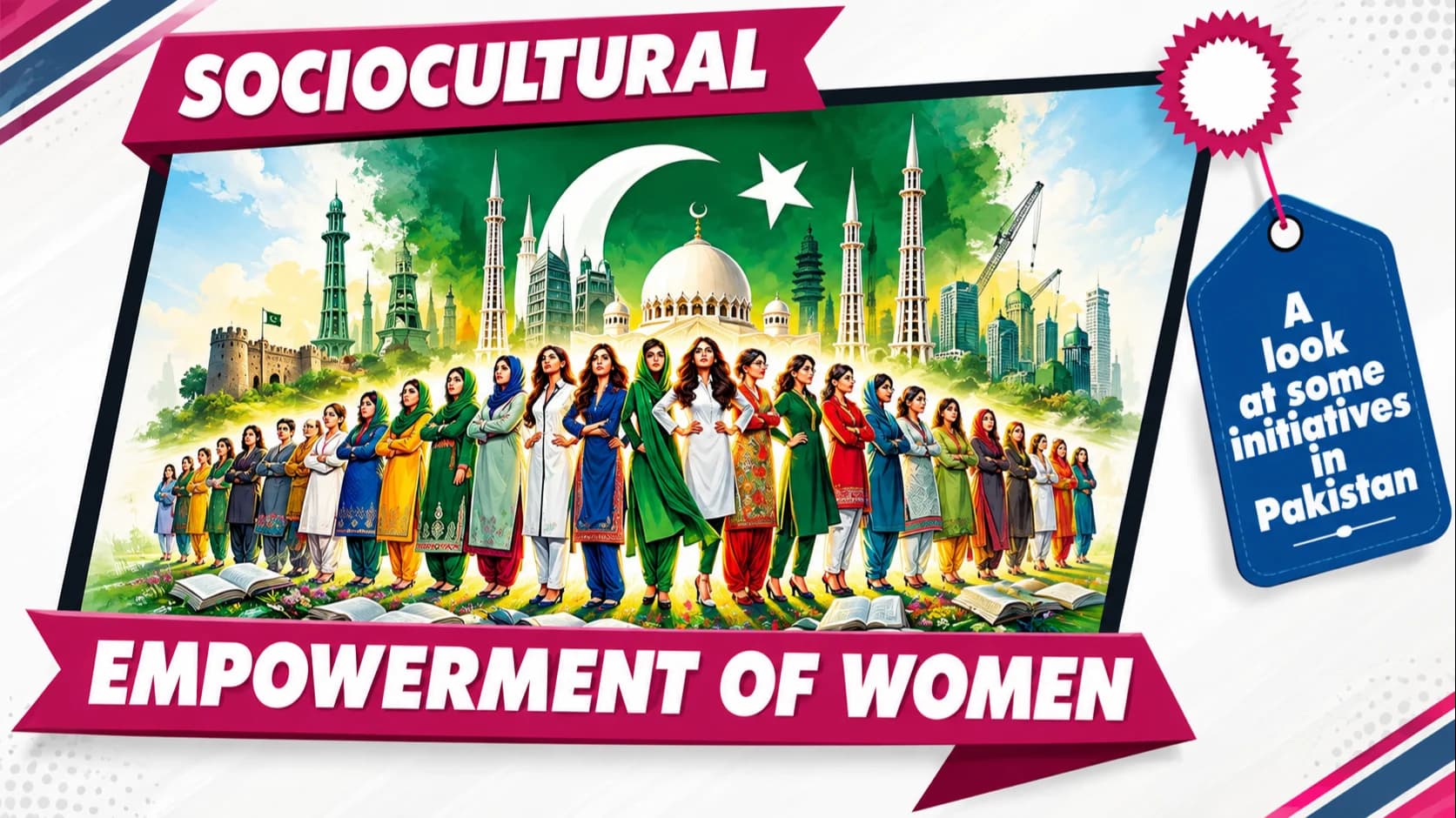
Summary. A look at some initiatives in Pakistan
Initiatives for women's empowerment in Pakistan have grown significantly recently, with the goal of fostering an atmosphere that allows women to actively engage in social, economic, and political domains. Chief Minister Punjab, Maryam Nawaz Sharif, has started several initiatives for women's empowerment, such as the Chief Minister Digital Skills Program, which gives rural women access to IT devices and training; the Pink Scooty Scheme for transportation; and the Pink Van initiative, which offers mobile police units managed by female officers to help women with administrative and legal duties. In addition, there is the Dhee Rani Program, which offers daughters social and financial protection, and the CM Livestock Assets Program, which gives rural women free cows and buffaloes to help them make a steady income. The government and different organizations have developed important programs such as the Benazir Income Support Programme (BISP), Punjab Women Empowerment Initiatives and the creation of women-friendly facilities such as day-care centers, crisis centers and working women's dormitories. These initiatives seek to protect women's rights nationwide, guarantee ownership rights, enhance education and career training and encourage political and economic engagement. A 2025 assessment on women's empowerment finds that progress has been gradual, with the global gender gap closing by 68.8%, but large discrepancies in economic and political involvement continuing. According to reports, difficulties such as violence against women, a lack of access to education and healthcare and impediments to economic independence exist both internationally and in individual regions, such as Pakistan, which ranked last in the Global Gender Gap Index 2025. Pakistan's Vision 2030 incorporates several aspects of women's empowerment, highlighting women's self-esteem, access to resources, decision-making authority and ability to influence social change. Despite cultural and socioeconomic constraints, these efforts aim to elevate women from the fringes to mainstream roles by improving female leadership, entrepreneurship and participation in national development. Continuous policy reforms, grassroots mobilization and measures to combat gender-based violence are critical to achieving long-term empowerment and gender equality in Pakistan.
Women's empowerment in Pakistan is an important area of concern because of the considerable social, economic and cultural barriers that have historically prevented women from fully participating in the country's growth. Women make up around 51% of the population and 22.7% of the labour force, although their potential is frequently underutilized. Pakistan's constitutional structure, particularly Article 25 (2), prohibits gender discrimination and seeks to ensure equal opportunity for women. Several federal and provincial efforts have attempted to empower women by expanding access to education, healthcare, employment and political representation. Provincial efforts, particularly in Punjab, have included talent development, internet literacy and financial support programs for female entrepreneurs. Women's safety measures, such as police stations and crisis centers, have been stressed, as have initiatives encouraging gender equality and expanding women's participation in local government. The Punjab government's Skilled Punjab initiative involves digital skills training and monthly stipends to enable rural women to access online learning and entrepreneurship opportunities. Women's education, political participation with reserved seats in assemblies and workforce involvement have all improved, but issues like gender-based violence and social conservatism persist. Specific projects include property ownership rights for women, the construction of day-care centers for working moms, women's crisis centers and working women's hostels. Legal safeguards, such as the Harassment Act, are being actively implemented, along with helplines and institutional structures, to protect women's rights. Gender mainstreaming policies guarantee that women's issues are addressed in broader economic and social development objectives. In terms of recent Punjab government initiatives, the province has taken positive efforts to improve women's empowerment on a broad scale. These include expanding vocational and technical training for skill development, encouraging women entrepreneurs through financial assistance programs, building women-friendly workplaces and providing access to healthcare services. Financial inclusion is becoming a priority, with programs such as the State Bank of Pakistan's Banking on Equality framework, expanding mobile banking and fintech services to reach unbanked women, particularly in rural regions. More than 37 million women now actively possess bank accounts, marking a milestone in Pakistan's efforts to financially empower women. NGOs play an important role in women's empowerment in Pakistan by providing education, leadership training, campaigning for legal reforms and economic inclusion initiatives. Prominent organizations, like the Aurat Foundation, the Aga Khan Foundation, the SHAD Foundation and others, provide grassroots mobilization, capacity building, and support for female leadership and economic independence. These NGOs are likewise concerned with decreasing gender-based violence, promoting political representation and expanding women's rights.
In general, Pakistan's programs for women's empowerment cover legal, social, political and economic aspects. They aim to address enduring issues like gender-based violence, cultural conservatism and unequal access to opportunities. Pakistan's framework for women's empowerment combines social services, legal protection, policy and economic initiatives backed by both the government and civil society. Punjab's comprehensive approach to skill development and safety programs reflects a targeted provincial commitment to empower women and effectively incorporate them into mainstream socioeconomic activity.
The writer is a lecturer at the Army Public School, Rahim Yar Khan.
Topics
The writer is a lecturer at the Army Public School, Rahim Yar Khan.