Print subscription includes a free wall-size coloured map.Special offer: Subscribe Now (Print) and Get Free Wall Size Coloured Map!Subscribe Now
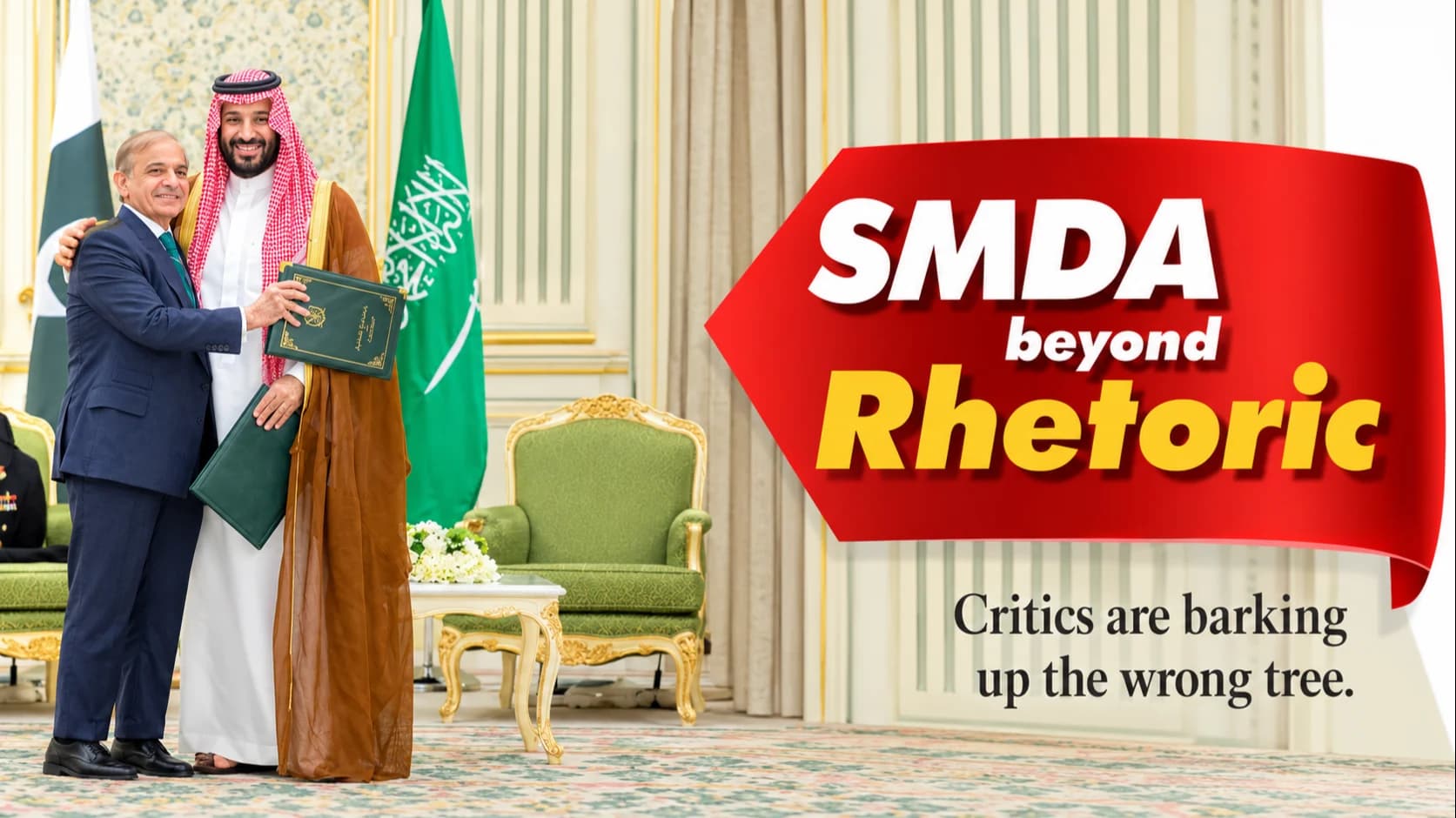
Summary. Critics are barking up the wrong tree
During the recent months, the Government of Pakistan has taken swift and significant foreign policy steps with an aim to enhance the country's strategic autonomy and diplomatic leverage in an increasingly complex international environment by positioning Pakistan as a key security actor and an emerging middle power on the global stage. One milestone achievement in this domain is the signing of the “Strategic Mutual Defense Agreement” with Saudi Arabia that is set to transform the decades of symbolic gestures of solidarity between the two countries into institutionalized bilateral security commitments. This agreement, which states that any aggression against either country shall be considered an aggression against both, reflects the shared commitment of both nations to enhance their security and achieve security and peace in the region and the world.
The Strategic Mutual Defense Agreement (SMDA) signed by Saudi Arabia and Pakistan, on September 17th, 2025, reverberates across the Middle East and Asia, marking a major shift in global alignments and a significant upgrade in their long-standing bilateral security relationship. Expectedly, the agreement, which states that any aggression against either country shall be considered an aggression against both, has upset many. Although many consider the agreement a mere formalization of historical Pak-Saudi strategic engagements, the public signing of the agreement has a significant impact, particularly as a tool of communication, which is a key component of effective deterrence in the global security milieu that prevails in today's uncertain world.
While the agreement is celebrated by most pro-government and even independent quarters in Pakistan, it is also criticized and questioned by sceptics who base their doubts on two premises.
· One, Saudi Arabia would not follow through on its promises to side with Pakistan in a war with India – Saudi Arabia's second-largest trading partner.
· Two, Saudi Arabia lacks military capabilities to deploy troops directly in case of a conflict.
However, in reality, those doubting Saudi Arabia's support for Pakistan in an India-Pakistan conflict in pursuance of the agreement tend to ignore the foundational premise on which the defense pact has been erected and the context within which the need for the pact has arisen.
Though the critics of the SMDA seem to be barking up the wrong tree, the pact is not without fault lines, which may soon become visible. The real risks of the pact may be the nuanced nature of the threats that Pakistan faces, its ability to muster resources to serve as a net security provider and off-the-field factors that will shape both countries' responses to each other's security needs.
The pact has been signed amidst the heat that Qatar has faced from the holes in the US security umbrella. It has been concluded within the context of a paradoxically 'specific yet vast' security vacuum left by the United States—its inexorable failure to protect its allies in the Gulf against Israeli aggression, significantly complicating the security paradigm in the region. One manifestation of which, as has become clear with the signing of the SMDA, is the lengths to which Gulf nations have become willing to go to protect their territorial integrity and sovereignty. This gap is narrow in that the US security guarantees protect US allies against all threats, except those from Israel. Whereas, at the same time, it is vast in that Israel can attack any Gulf state at any time with undefined force. In a pre-Qatar attack world, the doubts raised would have much credence; today, they cannot stand the facts on the ground laid bare by the attack.
This security gulf has always been there, hidden under the guise of US hopes that its illegitimate and defiant child would spare its allies in the Gulf. It is a manifestation of US policy contradictions in the Middle East. On the one hand, the US sells security guarantees and weapons worth billions of dollars to its Middle Eastern allies, including Qatar and Saudi Arabia, while on the other, it provides Israel with impunity to attack anyone in the region. “There's no part of the world where the contrast between objective reality and US foreign policy is greater than in the Middle East,” wrote Steven Cook in the Foreign Policy magazine.
In this context, Saudi Arabia will have no choice but to honour its agreement with Pakistan under any circumstances to establish credibility of its newly acquired deterrence through the pact. Failing to do so will embolden Saudi Arabia's potential foes, who will, then, not expect a response from Pakistan in case of a violation of the former's integrity and sovereignty. In other words, Saudi Arabia's inaction would defeat the deal's purpose and potentially green-signal aggression against it.
The trade argument is self-defeating. Take the case of China. Despite its strategic partnership with Pakistan, China emerged as India's second biggest trading partner in 2024/25 - after the United States - with two-way trade of $127.7 billion. Despite reports that Pakistani pilots used the Chinese-made J-10 aircraft and PL-15 missiles, as well as live intelligence input from Chinese sources in the recent Pakistan-India clash in May 2025, India has warmed up its relations with China. It was seen cosying up with China during its celebrated 2025 Tianjin Shanghai Cooperation Organization (SCO) Summit in August 2025, promising a progress in “our relations [with China] based on mutual respect, trust and sensitivities.” This clearly shows India is not willing to take up enmity with any regional power, or market for that matter, based on the latter's strategic partnerships with Pakistan. Moreover, India does not enjoy an upper hand in trade with Saudi Arabia. India would not be willing to disrupt its relations with Saudi Arabia because the latter hosts around 2.7 million Indian expats as of 2025, who remitted a whopping $138 billion in 2024, per the World Bank data.
India's policy towards China, despite the latter's support for Pakistan and the fact that it does not enjoy a trade environment conducive to bargaining with Saudi Arabia, makes it unwilling and unable to manoeuvre bilaterally to coerce the latter away from siding with Pakistan.
What, then, can be potential risks to the SMDA?
Well, there may be quite a bunch.
The first one being the history of cooperation itself, security or otherwise, based on the 'Muslim brotherhood'. Similar calls for cooperation, based on the religious connections, have been made historically without any strategic impact. For example, the Arabism during the three wars with Israel in 1948, 1967 and 1973 fell prey to miscoordination, fake announcements of victory by leaders and sheer complacency and arrogance. Similarly, the Organization of Islamic Cooperation (OIC) has failed to take any concrete action on the pressing issues facing the Muslim world. For the SMDA to be successful, it would need to be based on a resolve of strategic action instead of sentiments. Strong mechanisms for coordination and communication in times of crisis and transparency and free transfer of information and knowledge between the partners would be needed to make the pact successful.
The second challenge to the defense pact is the multi-front stress that Pakistan faces. In the face of the precarious economic conditions and the internal security environment, the country may not yet be ready to be a net security provider in the region. Terrorist attacks in Pakistan have surged after the Taliban's return to power in Afghanistan in 2021. Pakistan ranked second, only after Burkina Faso, in the Global Terrorism Index 2025, a report published by the Institute for Economics and Peace (IEP). While Tehreek-e-Taliban Pakistan (TTP) is believed to be responsible for 52% of the attacks, attacks come from more than one threat, the second important threat being the Baloch Liberation Army (BLA), active in Balochistan province. While TTP uses Afghan soil to orchestrate terror attacks on targets inside Pakistan — mainly security forces — the BLA gets support and funding from India.
Terrorist organizations have changed their strategy almost exclusively to target security forces. This has a significant impact not only on Pakistan's ability to mobilize troops for the potential new fronts that will open in case of aggression against a security partner like Saudi Arabia, but also on the security personnel's number and morale. While Pakistan possesses defense architecture, it will need strenuous efforts to train personnel, upgrade technology and foster agreements with other major security partners to deliver on the pact. Pakistan seems determined to achieve this goal.
Moreover, Pakistan's security crisis on the western front has taken a completely new dimension in the face of the conflict that erupted on the Afghan-Pakistan border in October 2025. Afghan security forces opened fire on Pakistani posts “in retaliation” for an alleged aerial attack on Kabul by Pakistan that was intended to kill the TTP leader Nur Wali Mehsood. According to Pakistan's Inter-Services Public Relations (ISPR), 23 Pakistanis were martyred in the attacks, while 45 Afghan attackers were eliminated. Given Afghan forces' limited capabilities and paucity of international or bilateral support, the losses inflicted are alarming. They expose potential holes in Pakistan's security apparatus and its preparedness.
The Pak-Afghan conflagration came almost concurrently with the visit of Afghanistan's foreign minister Amir Muttaqi to India, during which the latter vowed unwavering support for Afghanistan to protect its “independence and territorial integrity.” This is unsurprising. India has been a constant supporter of Afghanistan to counter Pakistan's attempts to extend its influence in Afghanistan to gain “strategic depth” against India. This precarious security milieu has implications on multiple layers for policymaking, including the defense agreements such as SMDA.
This points to yet another level of complexity in Pakistan's security environment. If India expects any kind of collective response from Pakistan and Saudi Arabia to direct aggression, it will focus more on what it does better: proxy wars. In the only war against Pakistan in which India emerged as winner in 1971, India fought a proxy war through “Mukti Bahini”. This strategy makes it more difficult for Pakistan's defense partners to join in the response since the threats convert from external to internal. Tackling this would require a significant shift in Pakistan's defense strategy from “defensive defense” to “offensive defense.” Post-Pahalgam attack and the May 2025 conflict between India and Pakistan, India follows the latter strategy by not making a distinction between “governments that support terrorism” and “terrorist groups,” as PM Modi vowed in a speech after May tensions. Modi went on to say, “India will 'retaliate on its own terms' if there is any future 'terror' attack on the country.” In saying so, Modi was hinting at a possible preemptive action against Pakistan, and declaring any terror attacks against India as the pretext for Indian aggression against Pakistan. Pakistan would need to adopt a similar posture to protect itself against the multitude of proxy threats from TTP, BLA and other actors in order to invoke the collective response clause of the SMDA.
To sum up, the biggest risk to the SMDA is not that Saudi Arabia would not follow through on its commitment, but a potential preference for optics and slogans over action, and Pakistan's multi-front security issues. Yet Pakistan seems determined to be strategically managing these issues by balancing its ties with major powers and restructuring and reforming the structure of defense institutions.
The writer is currently working at the Sindh Revenue Board as a Tax Officer
Topics