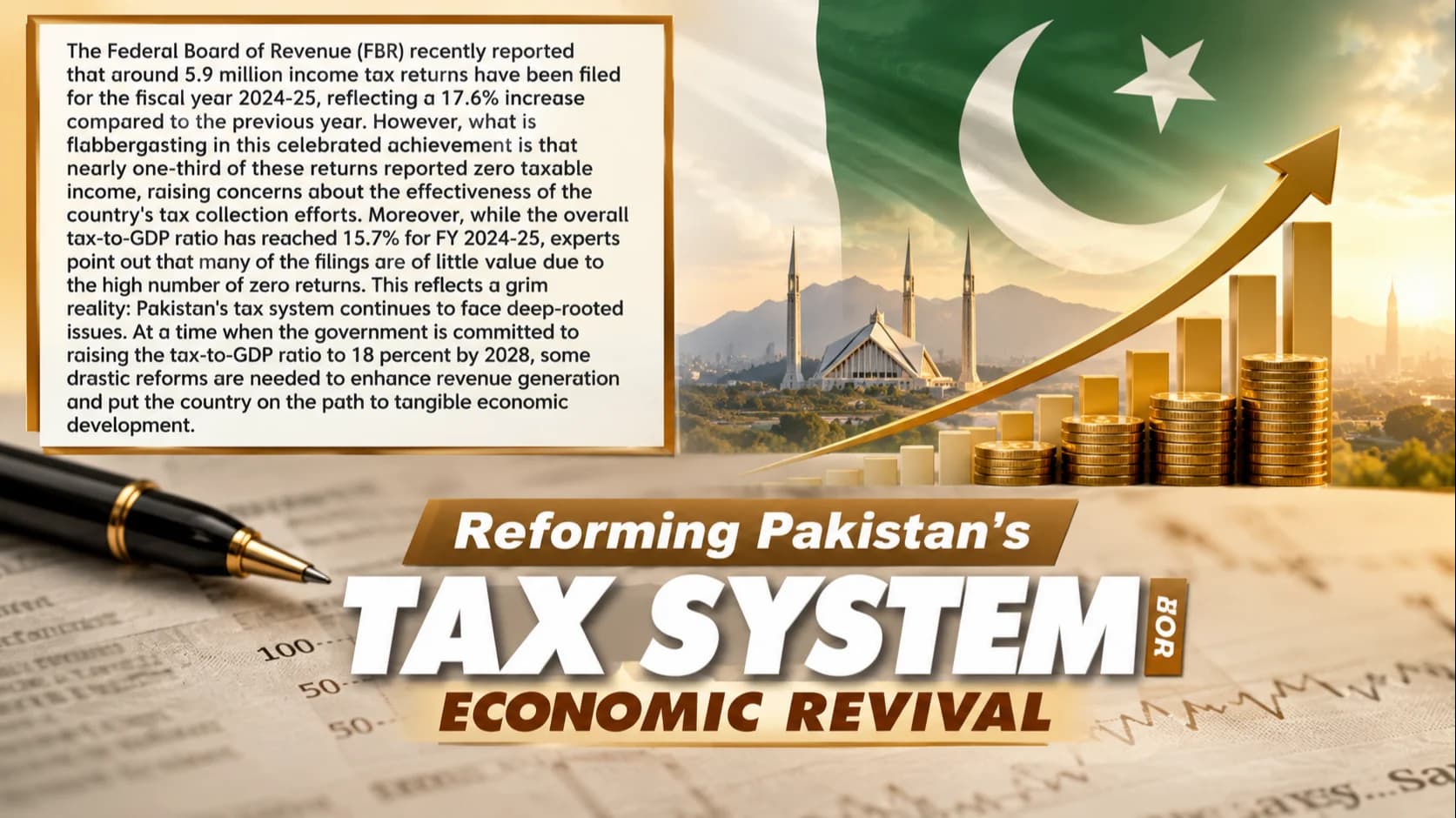
Although recent improvements in Pakistan's tax statistics — including a rise in the tax-to-GDP ratio to 15.7%, and a 17.6% increase in tax filers for FY2024–25 — seem encouraging, the reality is that these achievements are largely superficial, as a closer look reveals this apparent success hides deep-rooted issues of tax evasion, zero-return filings and an overburdened salaried class. According to the Federal Board of Revenue (FBR), the total number of income tax returns filed this year, as of October 31, 2025, stands at around 5.9 million, showing a 17.6% increase. Yet nearly one-third of these are zero returns, showing no taxable income. This is a sign of the FBR's misplaced focus on quantity over quality, as people file returns mainly to maintain access to banking services or avoid penalties rather than to contribute actual tax revenue. This shows that Pakistan's taxation system remains riddled with structural weaknesses and chronic under-performance.
Introduction
Tax collection is of paramount importance, as it is the primary source of revenue for modern governments, enabling them to fund essential public services, infrastructure and social programs. A robust tax system is essential for economic stability, national development and the overall well-being of a society. However, taxation can also be seen as a form of accountability. When citizens pay taxes, they are essentially giving their consent to the government to spend their money on these services. This gives citizens a say in how their government is run and helps to ensure that the government is held accountable for its spending.
In Pakistan, taxation has traditionally been seen as a burden rather than a benefit. This is partly due to the fact that the tax system is complex and difficult to understand. It is also due to the fact that the tax burden is often disproportionately borne by the poor and middle class.
Flaws in Pakistan's tax system
An efficient tax framework enables a state to mobilize domestic resources, invest in human capital and build fiscal independence. Pakistan's regressive system, however, imposes a disproportionate burden on low- and middle-income groups while allowing the elite and influential sectors to evade taxes. Some of the flaws of Pakistan's tax system are as under:
· More focus on quantity: In Pakistan, there is more focus on increasing the number of tax filers rather than actual revenue generation, as a significant portion of the tax base remains unproductive. A growing number of taxpayers are filing zero returns simply to maintain their status on the FBR's Active Taxpayer List (ATL) or to avoid penalties, without contributing meaningfully to the national revenue.
· Higher tax burden: Effective tax rates have reached a point where there is no economic incentive to invest in the economy, in the absence of which economic growth will remain a distant dream. High tax rates, both on the corporate sector and on individuals, are no longer sustainable for an economy already struggling with slow growth, declining investment and the flight of both capital and talent.
· Discriminate taxing: The salaried class continues to bear the brunt, contributing significantly to the total tax revenue. In FY 2025, this group paid Rs555 billion in income taxes, which is nearly double the combined amount collected from the retail and real estate sectors. The reliance on the salaried class for tax revenue points to the challenges of broadening the tax base, particularly with the continued presence of a large informal economy that remains largely untaxed.
o When businesses are compelled to surrender a majority of their earnings to the state and the salaried class finds a large portion of their income consumed by taxes, the natural outcome is discouragement, contraction and non-compliance. The country's recent revenue shortfall, despite record-high taxation, is proof that overburdening existing taxpayers cannot compensate for structural flaws in the system.
· Distorted slab structure: The distribution of our distorted slab structure is such that 10.8% of total income-tax payers were in the top slab. Effectively, the sovereign takes away an average of 28.6% of top slab taxpayers' taxable income, largely to fund a perpetual deficit. That capital can potentially be better utilized through channelizing it to private savings, and investments through directed policy interventions, rather than stimulating consumption.
· Less collection of direct taxes: Pakistan's direct tax collection has seen an improvement in recent months, with a 12% growth recorded in the first quarter of FY 2026. However, most of this increase has been driven by withholding and advance taxes, not through the formal documentation of business income.
· Policy inconsistencies: The country's tax system remains narrow due to policy inconsistencies, tax exemptions and the dominance of indirect taxes, which disproportionately affect lower-income groups while sparing wealthier individuals and businesses.
· A large informal economy: Efforts to bring the informal economy into the tax system, such as the integration of Point-of-Sale (PoS) systems for retailers, have not yet yielded substantial results. The pace of documentation remains slow, and enforcement mechanisms are still weak. Despite these efforts, the mismatch between declared incomes and visible wealth continues to be a significant issue, which has been acknowledged by authorities.
· Administrative weaknesses: The tax administration is plagued by bureaucratic inefficiency, corruption and outdated systems. The Tax Administration Reform Project (TARP)—meant to improve VAT collection—backfired, as revenue growth slowed, forcing rate hikes. Weak integration of technology, poor monitoring of electronic invoicing and failure to link retailers' POS systems to the FBR further impede performance.
· Exemptions and preferential treatment: Major sectors such as agriculture, retail and real estate enjoy vast exemptions despite contributing substantially to GDP. Agriculture contributes one-fifth of GDP but under 1% of tax revenue; retail accounts for 18% of GDP but less than 4% of taxes. These privileges to the elite drain state revenue and perpetuate inequality, pushing the government to rely on debt and external aid.
Global lessons in tax reform
1. Georgia
Following the 2003 Rose Revolution, Georgia overhauled its corrupt and inefficient tax regime through a radical simplification strategy designed by economist Niko Orvelashvili's team. Key measures included:
· Reducing the number of taxes and rates to simplify compliance and curb corruption.
· Eliminating privileges, double taxation and special levies.
· Ensuring transparency and taxpayer rights, shifting the burden of proof to tax authorities in disputes.
· Clear, accessible and predictable tax laws.
Reforms unfolded in stages: anti-corruption enforcement, institutional cleansing, simplification of laws and administrative strengthening. Results were dramatic: the tax-to-GDP ratio rose from 12% in 2003 to 21.7% by 2021, while Georgia ranked among the world's easiest places to do business. Corruption declined sharply, and investment surged.
2. South Korea
South Korea's experience shows how gradual, technology-based reforms can transform tax capacity. The country collects both national and local taxes, with VAT (10%) as a major revenue source since 1976. Over time, the government adjusted policies to encourage exports, foreign investment and SME growth while maintaining fairness.
From the 1990s onward, Korea integrated digital governance into taxation:
· Tax Integrated System (1997) unified databases.
· Home Tax Service (2001) enabled online filing.
· Cash Receipt System (2005) tracked transactions to combat evasion.
· E-Tax Invoice System (2010) ensured transparent documentation.
· Neo Tax Integrated System (2015) enhanced data protection and analytics.
By 2021, South Korea's tax-to-GDP ratio reached 16.8%. Digitalization increased compliance, reduced corruption and supported rapid economic industrialization.
3. Ukraine
Despite wars and crises, Ukraine steadily strengthened its tax system through proportional taxation, administrative modernization and anti-evasion reforms.
Major features included:
· Proportional Tax Structure: uniform 18% rate on all income, ensuring fairness.
· Comprehensive taxpayer register tracking all income sources, deductions and assets.
· Corporate Tax Reduction (to 18%) to encourage investment and export growth.
· Electronic VAT Administration (since 2015) eliminating paper invoices and reducing fraud.
· Ongoing digital reforms linking tax agents and fiscal authorities to curb the grey economy.
Through these measures, Ukraine's tax-to-GDP ratio improved from 11.7% in 2001 to 19.1% in 2021, even under adverse geopolitical conditions.
Recommendations for Pakistan
1. Progressive Tax Reform
To escape the current crisis, Pakistan must establish a progressive tax system modelled on successful global experiences. Key measures include:
· Broaden the tax base by bringing agricultural, retail and real estate sectors into the net.
· Reduce reliance on indirect taxes that burden the poor; emphasize direct income and corporate taxes.
· Introduce higher marginal rates for upper-income groups while granting middle-class deductions for education and healthcare.
· Lower corporate tax rates for compliant businesses to foster investment and export competitiveness.
Eliminating preferential treatment and enforcing equitable taxation would mobilize domestic resources, reduce fiscal deficits and restore public trust.
2. Bureaucratic and Institutional Reform
Administrative inefficiency and corruption are major barriers. Pakistan should:
· Implement capacity-building programs and performance-based incentives for tax officers.
· Strengthen coordination between federal and provincial authorities to harmonize tax policies.
· Introduce specialized enforcement units for high-risk sectors using data analytics.
· Establish merit-based hiring and promotion to replace patronage networks.
· Enact laws ensuring strict penalties for tax evasion and rewards for compliance.
· Engage with international institutions for technical assistance and training in digital tax administration.
Regular performance reviews, transparency measures and a professional culture within tax agencies are essential to dismantle entrenched corruption.
3. Digitalization and Integration
Digital transformation can modernize Pakistan's tax regime and curb the grey economy. Inspired by South Korea and Ukraine, Pakistan should:
· Develop a national digital tax infrastructure linking taxpayers, banks and the FBR.
· Mandate electronic invoicing and cash-receipt systems to track transactions.
· Use AI-based analytics to detect discrepancies between income and expenditure data.
· Partner with banks and fintech firms to facilitate electronic tax payments, especially in rural areas.
Digital integration would expand the number of tax filers, simplify compliance and reduce opportunities for bribery and concealment.
Government efforts
There is, fortunately, a growing realization within the government that the current tax structure is counter-productive. Prime Minister Shehbaz Sharif has instructed a comprehensive review of income and sales tax rates, acknowledging that excessively high rates are driving both companies and skilled individuals out of the country. His directive to the FBR seeks to explore ways to bring taxes down to levels comparable with regional economies, with the broader goal of keeping businesses anchored in Pakistan and halting brain drain. This recognition signals an important shift from a purely revenue-centric approach to a more growth-oriented fiscal philosophy. According to reports, the FBR is working on several models that propose rate cuts across multiple tax categories. The initial framework suggests reducing the corporate income tax rate from 29% to 25%, abolishing the 10% super tax, eliminating the 15% inter-corporate dividend tax and cutting the standard sales tax rate from 18% to 15%. Collectively, these adjustments could inject as much as Rs1.1 trillion into the economy, with the bulk of the stimulus coming from the reduction in sales tax. Such measures would significantly ease the burden on companies and households, potentially revitalizing economic activity and boosting investor confidence.
Conclusion
Pakistan's tax collection system is beset with deep-rooted structural, administrative and policy-level challenges that continue to undermine its fiscal potential and economic stability. Despite repeated reforms, the system remains regressive. This analysis reveals substantial untapped revenue potential, especially in the urban sector, the service sector agriculture through harmonized sales taxation. It also addresses policy loopholes, simplifying tax structure and moving toward a more equitable and broad-based system. Recent digital reforms by the FBR and recommendations for a unified national tax authority mark a positive shift, but implementation remains critical.
To achieve long-term success, Pakistan must adopt a modernized, transparent and efficient tax regime that prioritizes equity compliance and institutional coordination. Emphasizing local government, leveraging digital tools and integrating fiscal policy with social development goals can help build public trust, broaden the tax net and ensure that taxation becomes a pillar of economic governance rather than an obstacle to development.
The writer is a Lahore-based academic.
The Federal Board of Revenue (FBR) recently reported that around 5. 9 million income tax returns have been filed for the fiscal year 2024-25, reflecting a 17.6% increase compared to the previous year. However, what is flabbergasting in this celebrated achievement is that nearly one-third of these returns reported zero taxable income, raising concerns about the effectiveness of the country's tax collection efforts. Moreover, while the overall tax-to-GDP ratio has reached 15.7% for FY 2024-25, experts point out that many of the filings are of little value due to the high number of zero returns. This reflects a grim reality: Pakistan's tax system continues to face deep-rooted issues. At a time when the government is committed to raising the tax-to-GDP ratio to 18 percent by 2028, some drastic reforms are needed to enhance revenue generation and put the country on the path to tangible economic development.