Print subscription includes a free wall-size coloured map.Special offer: Subscribe Now (Print) and Get Free Wall Size Coloured Map!Subscribe Now
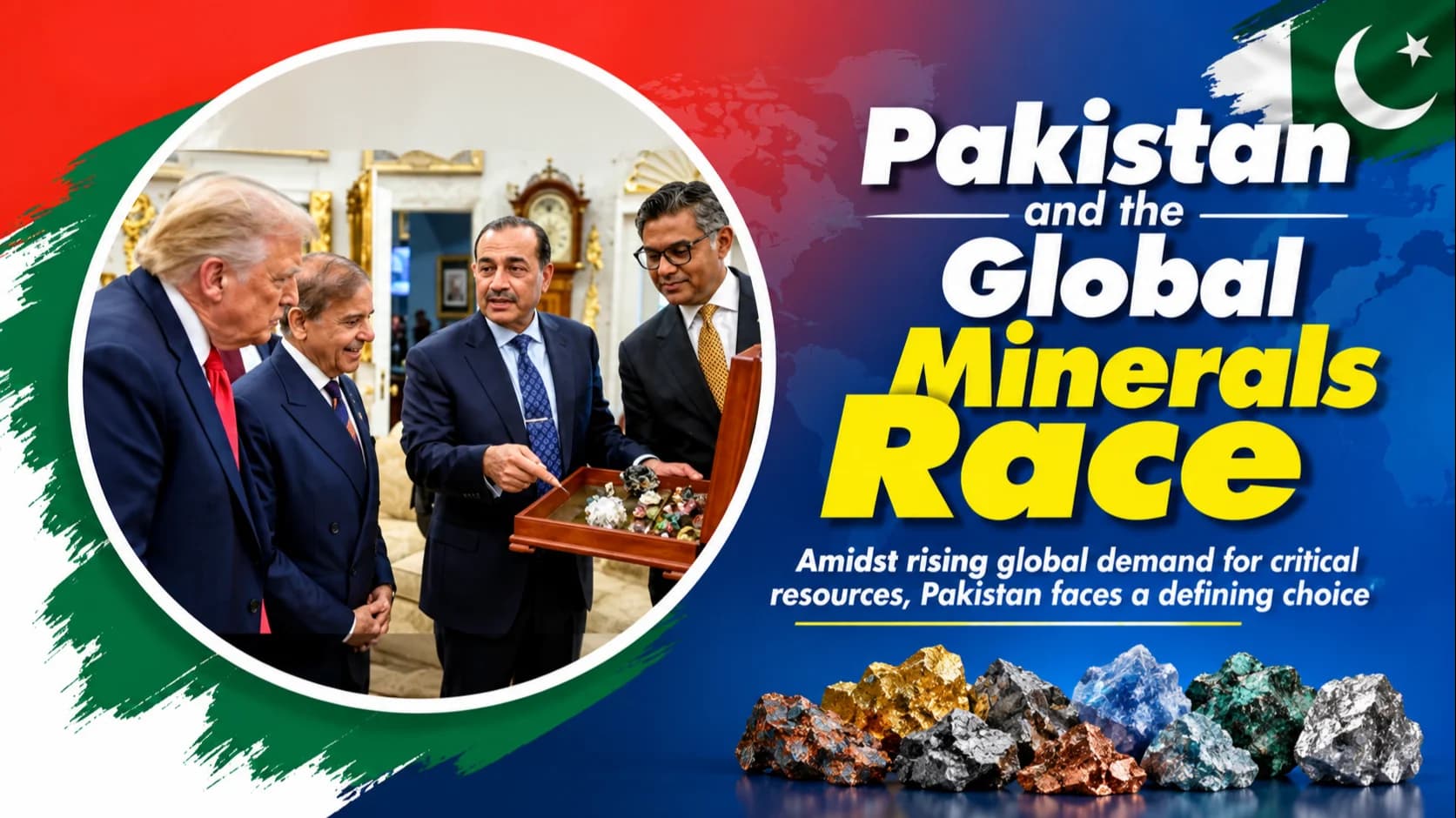
Summary. Amidst rising global demand for critical resources, Pakistan faces a defining choice
In recent years, the global race for critical minerals has become central to the clean energy transition and technological innovation. This aptly explains why global powers are scrambling for control over these minerals. As countries seek to secure lithium, copper and other rare earth minerals, new partnerships are emerging to diversify supply chains and reduce dependency on single markets. Pakistan, with its vast untapped mineral reserves, is an important player, making the country a potential beneficiary of the global race for critical minerals, with rising US interest in antimony opening a window for the country's mining sector. To make the most of this opportunity, the country needs robust policies to position itself to make hay while the sun is shining, and take advantage of this global shift in a way that supports inclusive and sustainable growth.
Minerals are the invisible engines of modern civilization. These are the raw materials behind the technologies that define our daily lives and shape global power structures. From copper and lithium to cobalt and rare earth elements, these critical minerals underpin the world's transition toward clean energy, digitalization, and advanced manufacturing. However, access to these resources is neither easy nor equitable. The global race for critical minerals is intensifying, with supply chains vulnerable to disruption and geopolitical competition.
In this landscape, Pakistan's untapped mineral wealth positions it as a potentially significant player in the minerals economy. Pakistan is positioning itself as a key player in the global minerals race, eyeing lucrative deals with major powers including the United States and China. With mineral reserves estimated at $8 trillion, Islamabad is seeking strategic partnerships to unlock its vast potential in copper, gold, rare earths and other resources.
The contest for critical minerals has increasingly become a source of geopolitical tension and a setting for direct great-power competition. China already occupies a position of dominance in the global minerals supply chain, controlling the refining of most critical minerals and the mining and refining of most rare earth metals. In recent years, Chinese companies have also sought a greater share of the upstream supply of minerals globally, such as investing in Afghanistan's critical mineral resources and copper and cobalt mining in Peru and the Democratic Republic of Congo.
Minerals have emerged as a pain point in the Sino-U.S. relationship: in response to the American ban on the export of advanced chips to China, Beijing paused the export of rare earth minerals used to make semiconductors. China has also leveraged its dominance in critical mineral production to curb the supply for defense uses.
To alleviate its dependency on China, the United States has accelerated efforts to secure critical minerals supply chains through strategic partnerships and significant investments. For example, the US Department of Defense recently inked a massive agreement with a domestic rare earth metals company. US President Donald Trump's executive order “Unleashing American Energy,” which prioritizes US mining and mineral processing, encourages the exploration of mining opportunities through the Quad, a grouping that also includes India, Japan and Australia.
In this context, critical minerals have become a staple priority early in the second Trump administration. Despite the importance placed on high tariffs to promote domestic manufacturing, the Trump administration agreed to lower the tariff rate on China in exchange for a deal on critical minerals. Trump also appeared to have a change of heart toward Ukraine following the signing of a minerals deal.
The global race to secure critical minerals is not limited only to the US and China. The European Union (EU) has also sought to deepen its engagement in the critical minerals sector, with the EU Commissioner for Industrial Strategy pitching a minerals deal to Ukraine in February last. Meanwhile, Gulf countries are expanding their hold in the minerals sector by pursuing a combination of international acquisitions, local development projects and strategic alliances.
This global demand can be an opportunity for Pakistan. With its vast untapped deposits of copper, lithium, cobalt and rare earth elements, Pakistan can position itself as a supplier and a future destination for diversified critical minerals investment from the West as well as regional partners.
Pakistan is home to a vast range of mineral resources spread across all its provinces, from the mountains of Balochistan to the plains of Punjab and the rugged terrain of Khyber Pakhtunkhwa and Gilgit-Baltistan. The estimated worth of Pakistan's mineral resources is over $8 trillion, according to various geological surveys and expert estimates. Pakistan's mineral landscape spans 600,000 sq km, with 92 known minerals, 52 of which are commercially mined. The sector produces about 68.5 million metric tons annually, sustaining over 5,000 mines and 50,000 SMEs, and employing 300,000 workers. Some of the key mineral deposits include:
Reko Diq Copper-Gold Reserves (Balochistan): One of the world's largest undeveloped copper and gold mines, with estimated reserves of 5.9 billion tons of ore containing 0.41% copper and 0.22 grams/ton of gold. Moreover, gold and copper reserves in Daht-e-Kuhn and Nokundi have been identified as high-potential points for large-scale mineral extraction and processing.
Salt (Punjab): The Khewra Salt Mine is one of the oldest and largest in the world.
Chromite (Khyber Pakhtunkhwa and Balochistan): Pakistan ranks among the top ten chromite-producing countries globally.
Gypsum, limestone, and marble across various regions.
Critically, REEs and strategic minerals such as lithium, cobalt and nickel have been detected in various geological zones, particularly in Balochistan and Gilgit-Baltistan, though detailed mapping and exploration are still required.
Furthermore, Pakistan's coal reserves are among the largest in the world, totalling approximately 186,186 billion metric tonnes as of FY24. Most of these reserves are in Sindh, with the Thar coalfields being particularly prominent. Despite their vast potential, these reserves remain underutilized, primarily consumed in brick kilns and small-scale energy generation.
The US administration has shown growing interest in Pakistan's minerals sector, aligning with Washington's recent push to secure rare earths worldwide. A minerals conference hosted in Islamabad last year drew interest from global investors, with both Beijing and Washington competing for stakes. Analysts believe the US, following its model in Ukraine, could demand a substantial share in Pakistan's mineral wealth in exchange for aid or investment.
China, meanwhile, continues to strengthen its foothold through the Saindak copper and gold project and a newly awarded mining block in the Reko Diq belt of Balochistan. While Washington's attention remains uncertain regarding Reko Diq, Saudi Arabia has already expressed keen interest in joining the multibillion-dollar project.
Pakistan has also received a $5 billion offer for Reko Diq, far exceeding the estimated $3 billion investment required. Financing commitments have also been pledged by the Asian Development Bank, Islamic Development Bank International Finance Corporation, US Exim Bank, and European agencies from Germany and Denmark.
Japan is the latest country to show interest in investing in this flagship mining project. Tokyo is keen to invest in the Reko Diq copper-gold mine.
Oil-rich Saudi Arabia has also expressed interest in investing in the project, including acquiring a possible 15% stake.
Pakistan's mineral wealth provides it with multiple strategic advantages:
Geopolitical Location: Pakistan sits at the confluence of South Asia, Central Asia and the Middle East, offering a natural corridor for mineral trade and processing.
CPEC and Infrastructure Development: Under the China-Pakistan Economic Corridor (CPEC), Pakistan is developing the infrastructure necessary to support mining, transport and export of minerals.
Young Workforce and Technical Talent: With targeted training and investment in geological sciences, Pakistan can develop a skilled workforce for its minerals sector.
Investment Attraction: The recent resolution of disputes such as Reko Diq has paved the way for renewed investor confidence.
Pakistan confronts several institutional and strategic obstacles when it comes to using REEs as tools of diplomatic and economic influence, despite its potential mineral abundance. The main barrier is the lack of a cohesive national mining policy that links geological exploration with economic and foreign policy objectives, as well as the fragmentation of institutions. Less than 10% of the nation's mineral potential has been properly investigated, according to the Pakistan Mineral Development Corporation (PMDC), meaning that enormous quantities remain unexplored and undervalued.
The absence of technological capability for extraction and processing is equally urgent. Pakistan currently lacks the advanced refining infrastructure needed for REEs. This reliance runs the risk of reducing the nation to a provider of raw materials, losing out on the high-value profits from manufacturing and processing. Furthermore, security concerns in mineral-rich areas, regulatory inconsistencies and overlapping federal-provincial jurisdictions discourage international investment and postpone sustainable development.
Islamabad has to manage a careful balancing act between major forces in the geopolitical arena. Western nations look for alternate supply chains that are not controlled by Beijing, even though China's Belt and Road Initiative (BRI) provides ready infrastructure and technological assistance. By leveraging alliances with China, the United States, the European Union and Gulf states at the same time, Pakistan should position itself as a neutral facilitator in the developing mineral diplomacy rather than becoming overly dependent on any one bloc.
Amid rising geopolitical tensions—particularly between the US and China—Pakistan must walk a tightrope. It must not become a pawn in the new “Great Game” over minerals. Instead, Pakistan should position itself as a peace-oriented, neutral and development-driven state that engages all powers equally.
Pakistan's foreign policy must continue to reflect its founding principles of peace, friendship and non-alignment. It should deepen its strategic cooperation with China under CPEC, while simultaneously enhancing trade and investment ties with the US, Europe and regional countries.
To leverage its mineral wealth effectively, analysts and policymakers propose:
Strengthening regulatory and institutional capacity to attract and manage foreign investment.
Promoting local beneficiation and processing to capture more value domestically. Integrating community engagement and environmental safeguards into large-scale mineral development plans.
Pursuing strategic partnerships beyond extraction — including research, technology transfer and capacity building — with diversified global players.
Pakistan stands at a critical juncture in the global minerals race. Its vast yet underdeveloped mineral resources could be a catalyst for economic transformation and geopolitical relevance. However, realizing this potential will require strategic policy action, institutional reform and a balanced approach to international partnerships. History offers examples from Africa to Afghanistan, where foreign interest in natural resources led to conflict, instability and weakened state control. For Pakistan, this is a lesson worth remembering.
Granting any single power too much control or exclusive access risks compromising national sovereignty and increasing foreign interference. Pakistan must craft a mineral policy that promotes strategic autonomy, not dependency. As global demand for minerals like rare earths, copper and gold continues to surge, Pakistan's untapped resources represent a major economic opportunity.
If managed wisely – through inclusive partnerships, strategic diplomacy and sustainable development – this sector could power a new phase of national growth.
The writer is a Karachi-based academic.
The Reko Diq project stands at the forefront of Pakistan's mineral development strategy, and is internationally recognized as one of the world's largest untapped reserves of copper and gold. Currently, the project is being led by Canada's Barrick Gold Corporation in partnership with the Government of Pakistan, which holds a 25% stake. In a significant recent development, Saudi Arabia's state-backed investment mining fund, Manara Minerals, is poised to acquire a 10–20% stake in the Reko Diq project. The transaction, valued between $500 million and $1 billion, would involve purchasing part of the Pakistani government's share.
A feasibility study completed in 2024 confirmed the existence of 15 million tons of copper and 26 million ounces of gold. Production is expected to commence in 2028 with initial annual outputs projected at 240,000 tons of copper and 300,000 ounces of gold. The project's second phase aims to expand production to 400,000 tons of copper and 500,000 ounces of gold annually.
The Reko Diq initiative is being supported by the International Finance Corporation (IFC) of the World Bank Group, with co-financing from US, German, Japanese and other international funding agencies. This multilateral backing underscores the strategic global importance of the project and its potential to redefine Pakistan's economic landscape.
Topics
The Writer is a Karachi-based academic.