Print subscription includes a free wall-size coloured map.Special offer: Subscribe Now (Print) and Get Free Wall Size Coloured Map!Subscribe Now
Summary. Features and expected outcomes
Pakistan's economy today sits at a critical crossroads. Pakistan's industrial base, the lifeblood of sustainable economic growth, appears to be losing its strength, with large-scale manufacturing continuing to show worrying signs of stagnation. Despite glimpses of macroeconomic stability and improving geopolitical relations, the core of Pakistan's economy remains fragile, weighed down by policy inconsistencies, rising energy costs, and declining productivity across key industrial sectors.
Pakistan's industrial wheel, particularly its large-scale manufacturing, has slowed to one of its weakest phases in recent years. The sector, which accounts for around 8% of GDP in FY25 and employs millions directly and indirectly, has been contracting intermittently for over two years. According to data from the Pakistan Bureau of Statistics (PBS), LSM output in the last fiscal year fell by 0.74% after a brief rebound earlier, continuing a downward trend that began in the aftermath of global supply shocks and domestic energy crises.
Economists argue that such industrial stagnation poses a long-term threat to the country's economic health. Given the current state of affairs, Pakistan's economic policy framework needed an urgent shift from short-term fixes to structural reforms. Recognizing this fact the federal government has unveiled the National Industrial Policy 2025-30 that aims to reset the country's economic direction. This policy seeks to remove regulatory distortions and revive Pakistan's distressed industrial sector. Instead of focusing on short-term stimulus, the policy prioritizes reforms that are structurally transformative. It aims to provide a roadmap for industrial competitiveness, job creation and export expansion. It targets $60 billion in exports by 2030, GDP growth of 6 percent and manufacturing growth of 8 percent annually by the end of the decade. This article will discuss the salient features of the NIP and the expected outcomes.
This policy proposes a comprehensive tariff reform for the industrial sector. Over the next five years, customs-duty slabs will be reduced to just four 0, 5, 10 and 15. Moreover, the additional and regulatory duties will be removed altogether. According to estimates, these changes will deliver Rs175 billion in cost savings to industry during the current year alone. This reform will significantly reduce the input costs for manufacturers, especially those who rely on imported raw materials. Additionally, lower tariffs are considered as a structural change from the model that protects domestic markets for decades. This will encourage firms to scale up their export-oriented production.
Another significant feature of the NIP is the simplification of Pakistan's regulatory landscape that has hitherto done more harm than good. For decades, these unnecessary regulations have discouraged foreign investors and created hurdles in the industrial development. Through the Regulatory Guillotine Initiative, 465 outdated, overlapping or unnecessary regulations have already been removed, generating an estimated Rs250 billion in annual savings. This effort represents a shift from a culture of “harassment” to one of facilitation. To ensure durability, these simplifications will be permanently embedded through the forthcoming Asaan Karobar Act. This will help improve Pakistan's ease of doing business, shorten project timelines and will reduce informal costs that have long discouraged investment.
The center point of this policy is a new Debt Resolution and Industrial Revival Framework, developed jointly by the State Bank of Pakistan, the Securities and Exchange Commission of Pakistan and the Pakistan Banking Association. The framework aims to revive non-performing but potentially viable industrial units trapped under excessive debt burdens and outdated technology. A new National Industrial Revival Commission will oversee the restructuring of distressed assets, facilitate mergers and acquisitions and coordinate the rehabilitation of underutilized plants. By bringing these units back into production, the policy aims to preserve jobs, recover stranded capital, and prevent further deterioration of industrial capacity.
High energy prices and constrained financing have been major bottlenecks for the industry. This policy introduces targeted interventions in both areas. Special electricity tariffs will be offered to high-tech greenfield industries such as electric vehicles, data centers, and battery manufacturing, sectors. On the financial side, the government is to encourage banks to lower capital adequacy risk weightings for medium enterprises. This adjustment is designed to expand credit access for small and medium-sized manufacturers, a sector that has typically struggled to secure affordable financing despite its importance to employment and value addition.
Additionally, the NIP's broader macroeconomic targets include raising exports to $60 billion by 2030, achieving 6 percent GDP growth with 8 percent annual industrial growth, and lifting total investment to 15 percent of GDP. It explicitly aligns with Pakistan's current IMF programme, emphasizing reforms that are fiscally neutral but structurally powerful.
The policy draws lessons from countries such as Vietnam and Malaysia, which transformed their economies through export-oriented industrialization and integration into global supply chains. In both cases, sustained growth was achieved not through heavy subsidies, but by reducing disturbances, encouraging competition, and maintaining policy consistency. Pakistan's NIP reflects the same philosophy and aims to revolutionize the industrial sector.
If implemented effectively, the policy could mark a turning point for Pakistan's industrial sector. Lower tariffs and energy costs will improve competitiveness, while regulatory simplification and debt resolution can unlock foreign investment and revive the capacity. Over time, these reforms are expected to shift the structure of the economy toward higher productivity, greater export orientation, and more resilient industrial growth.
The NIP presents a promising picture of Pakistan- a one that's of hope, economic prosperity and sustainability. Yet, such policy frameworks have been introduced in the past too; multiple regulatory bodies have been created to deal with the never-ending lists of problems the country faces. At its core, the policy addresses every single issue and puts out a fully planned model for economic revival. However, poor implementation, inconsistent policy frameworks and political instability have always hindered any such plan. Pakistan's goal right now is to not only revive factories but to create a lasting change that encourages the spirit of business and empowers the country's economy. Time will tell whether this policy will realize all its goals or it will be yet another framework sacrificed to inconsistency!
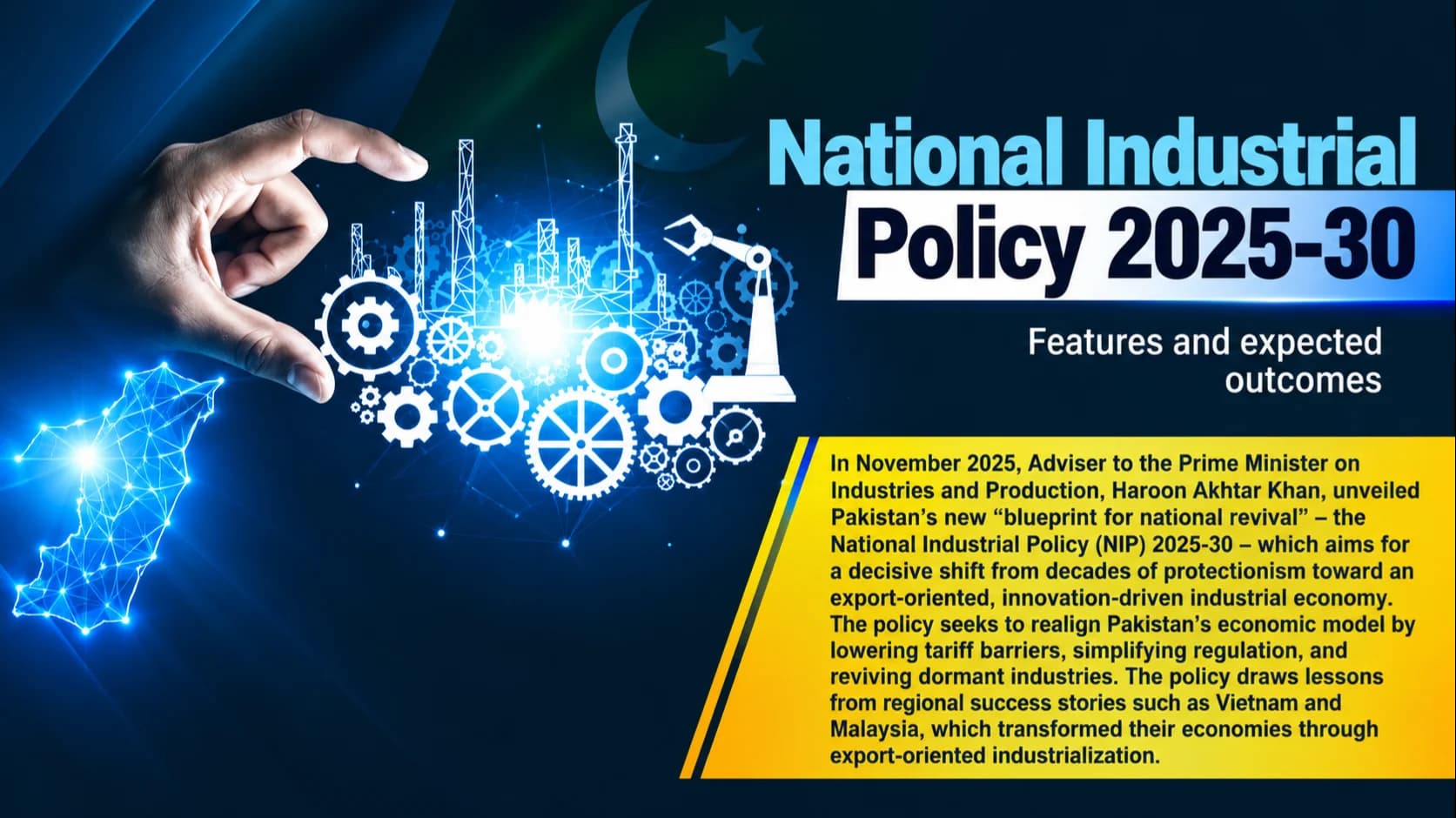
In November 2025, Adviser to the Prime Minister on Industries and Production, Haroon Akhtar Khan, unveiled Pakistan's new “blueprint for national revival” – the National Industrial Policy (NIP) 2025-30 – which aims for a decisive shift from decades of protectionism toward an export-oriented, innovation-driven industrial economy. The policy seeks to realign Pakistan's economic model by lowering tariff barriers, simplifying regulation, and reviving dormant industries. The policy draws lessons from regional success stories such as Vietnam and Malaysia, which transformed their economies through export-oriented industrialization.
Topics