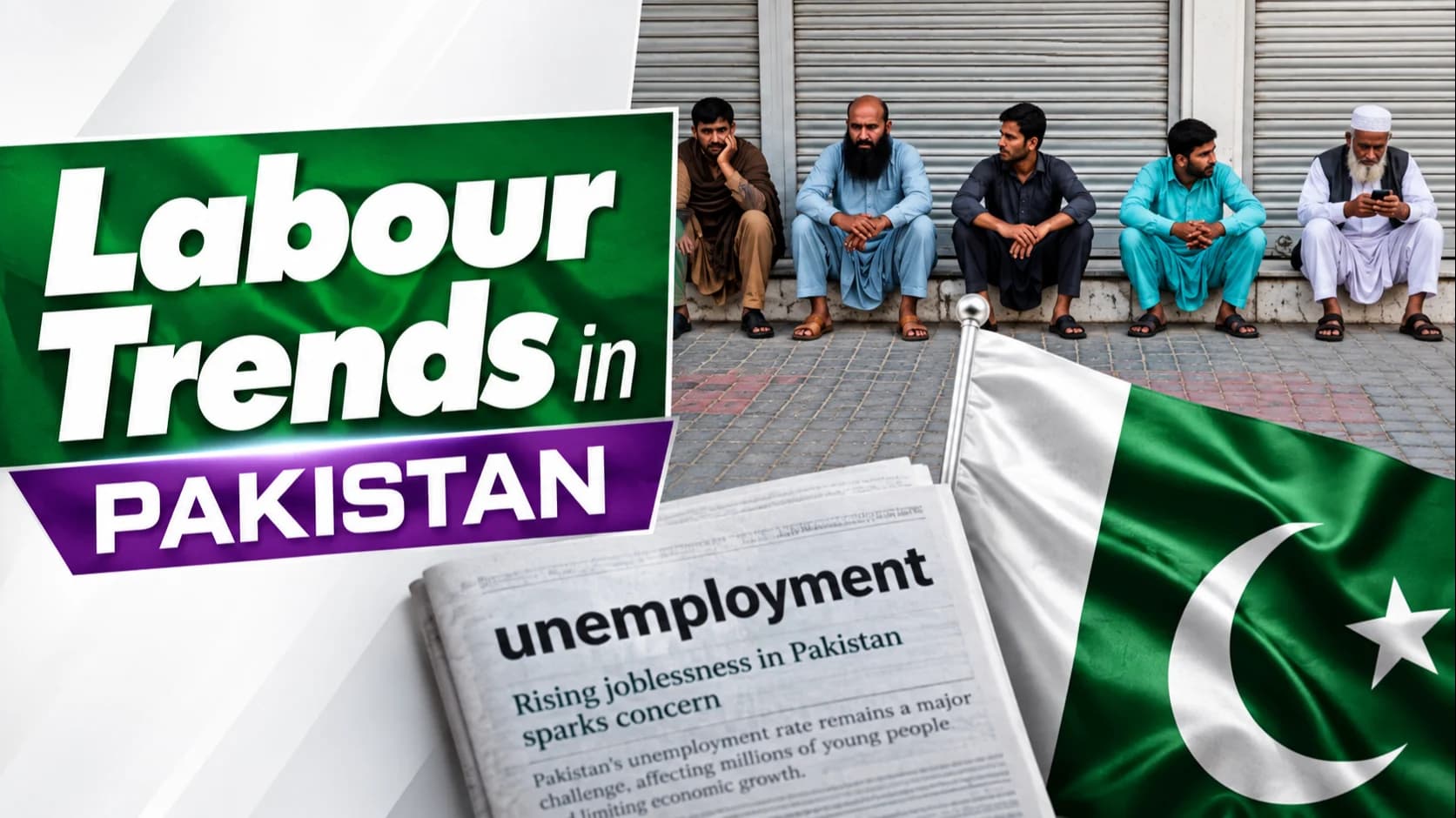
The Pakistan Bureau of Statistics (PBS) has released the Labour Force Survey (LFS) 2024-25 which offers an unsettling portrait of the country's economic trajectory. Far from easing, unemployment remains a critical pressure point that has continued to worsen over time, underscoring an economy increasingly unable to create durable and dignified work.
Key Highlights
· Pakistan's labour force increased from 71.8 million in 2020-21 to 85.6 million in 2024-25.
o This shows 3.5 million people per annum are added to the labour force.
o As per the 19th International Conference of Labour Statisticians (ICLS), the total labour force is 83.1 million, comprising 63.2 million male and 19.9 million female workers.
o Pakistan's average economic growth, which stuck below 3% for several years, has failed to create enough jobs for the 3.5 million people entering the labour market annually.
· The labour force participation rate has exhibited an upward trajectory from 44.9% to 47.7% during the comparative period (2020-21 & 2024-25).
· Participation rates have increased for both males (67.9% to 69.8%) and females (21.4% to 24.4%).
o Rural areas witnessed an increase from 48.6% to 52.3%, while urban areas experienced a modest increase from 38.8% to 40.8%.
o As per the 19th ICLS recommendations, the labour force participation rate is 46.3% overall, with 68.7% for males and 22.7% for females.
· The volume of employed persons increased by 12.4 million from 67.3 million in 2020-21 to 79.7 million in 2024-25.
o This shows 3.1 million people are added to the employed labour force per annum.
o As per the 19th ICLS recommendations, the total employment is 77.2 million, comprising 59.4 million male and 17.8 million female workers.
· Out of the working-age population of nearly 180 million, about 118 million people, two out of every three, are unpaid workers performing domestic, caregiving or livestock-related tasks.
o 23% were engaged in childcare, 18.7% in livestock, 7% in fetching water and 7.1% in poultry-raising at home.
· The volume of unemployed persons increased by 1.4 million from 4.5 million in 2020-21 to 5.9 million in 2024-25.
o As per the 19th ICLS recommendations, the total number of unemployed persons remains same 5.9 million, out of which 3.8 million are males and 2.1 million females.
o Of the 5.9 million unemployed people, 4.6 million, or 77.5%, are literate, while around one million hold formal educational degrees.
o Youth unemployment remains the most acute, with the highest numbers in the 15–29 and 15–24 age brackets.
· Unemployment rate has gone up from 6.3% in LFS 2020-21 to 6.9% in the LFS 2024-25.
o Increase is observed both in case of males 5.5%, 5.9% and females 8.9%, 9.7%.
· Unemployment rate has gone up both in urban (7.3%, 8.0%) and in rural areas (5.8%, 6.3%).
o As per the 19th ICLS recommendations, the overall unemployment rate is 7.1%, with 6.0% for males, 10.5% for females, 6.5% in rural areas and 8.2% in urban areas.
· Employment has decreased in agriculture, forestry and fishing (37.4%, 35.1%) and manufacturing (14.9%, 14.4%).
o It has increased in construction (9.5%, 9.6%), wholesale & retail trade (14.4%, 15.5%), transport storage & communication (6.2%, 6.4%), community/social & personal services (16.0%, 17.4%) and 'other' category (1.5%, 1.6%).
· The report also records a notable rise in average monthly wages, increasing from Rs24,028 in 2020-21 to Rs39,042 in 2024-25.
· Male wages increased from Rs24,643 to Rs39,302 and female wages from Rs20,117 to Rs37,347.
PBS data further highlighted the significant burden of unpaid domestic and care work on women, with 45.4 million involved in household tasks, 32.1 million in livestock activities and 20 million engaged in caregiving responsibilities.
The $3 trillion economy dream
The dream of becoming a USD 3 trillion economy—often echoed in speeches and policy documents—rests on one core foundation: our labour force. Yet the latest data confirms what many economists have feared for years: Pakistan's workforce is structurally unprepared for economic takeoff.
The key message from the LFS is simple: Pakistan does not have a productivity-driven labour market; it has a survival-driven one. Too many people are employed in low-return sectors; too few in dynamic, high-growth industries. Too many are outside the labour force; too few have skills aligned with the modern economy. Too many women are working unpaid; too few are transitioning into formal, high-productivity work.
The way forward
If Pakistan is serious about its economic future, the labour market must be restructured—deliberately, urgently and systemically.
· The first priority must be massive skill transformation. In the era of AI and automation, Pakistan needs a national programme of digital upskilling—not as a standalone initiative, but integrated with local governments, schools, and community centres. Every district should have a digital skills hub with AI-assisted learning tools accessible to all—especially women and rural youth.
· Second, the economy must break free from its overdependence on agriculture and informal retail. That does not mean abandoning agriculture; it means commercializing it. The government should incentivize high-value crops, agritech adoption and rural enterprise clusters linked with cold-chain logistics and processing. Rural Pakistan must become a site of value creation, not merely subsistence.
· Third, formalization must be redefined—not as taxation, but as access. Informal workers will not enter the formal system if it brings only taxes and inspections. They will enter when it brings credit, insurance, market linkages, digital identity and legal protections. Formalization without facilitation is harassment.
· Fourth, Pakistan must dramatically increase female labour force participation. This requires targeted childcare support, safe transport, home-based digital work platforms and legal enforcement of wage equality. Without women, no economy in history has achieved sustained high growth.
· Fifth, wage inequality must be addressed through productivity-linked wage systems, sectoral minimum wages and investments in enterprise modernization. Low wages are not a sign of competitiveness; they are a sign of structural weakness.
· Finally, labour market governance must be decentralized. The LFS reveals what economists have long argued: a highly centralized system cannot manage diverse regional labour markets. Provinces—and ideally districts—must develop their own labour market information systems, skill councils and employment strategies.
Conclusion
Pakistan, the world's fifth most populous country with over 255 million people, stands at a critical juncture in its socio-economic development. Among its most pressing challenges is unemployment, particularly youth unemployment, which has intensified in recent years and threatens to undermine the country's stability, growth, and future prospects. The findings of the Labour Force Survey 2024-25, in sum, point to an urgent need for authorities to move away from their economic stabilization refrain and address structural issues such as the poor business climate, shortage of skilled workforce, gender barriers and inadequate investment in agriculture and industry to kick-start the economy. That is what we need for employment generation and poverty alleviation.
The writer is a member of staff.
Gig Work in Pakistan
The Labor Force Survey 2025 shows that gig work has become a significant part of Pakistan's labour market. As per the Survey, 2.39 million Pakistanis are engaged in gig work — 2.2 million as main work and 0.19 million as subsidiary work. The LFS provides a breakdown of gig activities by occupation and gender.
The largest group of gig workers is involved in teaching and tuition, with an estimated around 425,000 people earning through tutoring or educational services.
Close behind are two major categories:
Selling goods, which engages about 402,000 gig workers, and
Taxi and transport services, which also account for approximately 402,000 workers.
These two categories reflect the strong presence of small-scale commerce and transport-based work in the informal labour market.
Freelancing is another significant area, with around 342,000 workers involved in digital or project-based online work — highlighting the continued expansion of Pakistan's digital economy.
Delivery services employ nearly 292,000 gig workers, driven by the growth of e-commerce and app-based logistics.
A smaller but important segment is medical and health-related gig work, involving about 100,000 people, including community health workers and private medical support staff.
Other key categories include:
On-location services, such as electricians, plumbers, beauticians and technicians, employing about 112,000 workers.
Digital content creation — YouTube, TikTok, vlogging — involving around 134,000 individuals who now form part of Pakistan's growing creator economy.
Renting services, which include equipment or vehicle rentals, with about 67,000 workers.
Finally, other miscellaneous services make up about 119,500 gig workers, covering a range of small-scale and informal activities not captured elsewhere.