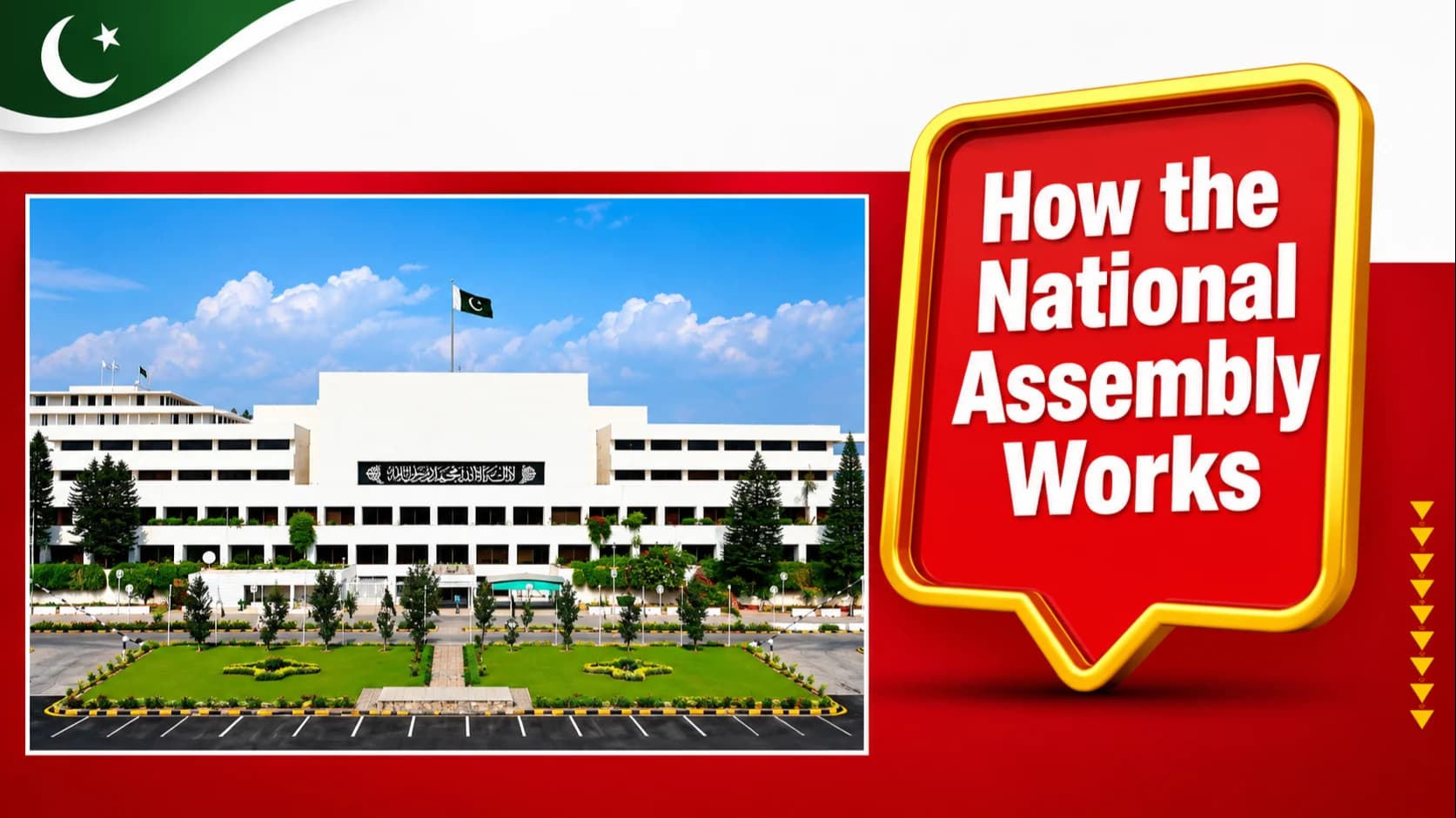
Pakistan operates under a federal parliamentary democratic system, where the Parliament serves as the supreme legislative body. Modelled on the British Westminster system, it embodies the principles of democracy, representation, and checks and balances. The Parliament of Pakistan consists of two houses, the National Assembly and the Senate, ensuring both proportional and regional representation in law-making. Additionally, the President of Pakistan acts as the head of state, while the Prime Minister, elected from the National Assembly, functions as the chief executive. This system ensures that laws reflect the will of the people while maintaining constitutional safeguards.
Structure of the National Assembly
The National Assembly consists of 336 members, including 266 directly elected representatives, 60 seats reserved for women, and 10 for religious minorities. Members are elected through a mixed electoral system that combines elements of regional and proportional representation.
Leadership
During the first NA meeting following a general election, members elect a Speaker and Deputy Speaker. The Speaker, and in his/her absence the Deputy Speaker, presides over the sessions of the Assembly. Both the Government and the Opposition also have leaders in the NA. The Leader of the Opposition is elected by the opposition parties and the Leader of the House is the Prime Minister.
Key Functions:
Legislation (Article 70): Debating, passing the Federal Laws, including the money bills, and sending them to the Senate for approval. It also acts as a reviewing chamber for bills passed by the Senate.
Government Formation: The Prime Minister is elected by the majority party or coalition from this House. Hence, he is also the Leader of the House.
Executive Oversight: It holds the government accountable through debates, questions, and no-confidence motions.
Budget Approval: The National Assembly scrutinizes and approves the Federal Budget. The Budget is presented by the Minister for Finance or the Minister-in-Charge, no other business is transacted, and there is no discussion on the day of the Budget except the introduction of the Finance Bill (Rules 184 & 185 of the Rules of Procedure and Conduct of Business in the National Assembly, 2007).
Business of the House
a. Summoning of the Assembly and Annual Calendar of Sessions
When the National Assembly is summoned, the Secretary issues a notification to be published in Gazette, stating the starting date, time and place. It is sent to each Member. The government provides a calendar for sessions of the Assembly to the Speaker after the commencement of each parliamentary year.
The Assembly is summoned on dates given in the calendar, with the President able to summon the Assembly on a date other than that of the calendar. The Speaker also has the powers to 2 summon a requisitioned session at any time.
b. Sessions of the Assembly
There shall be at least three sessions of the Assembly every year, and not more than 120 days shall intervene between the last sitting and in one session and date appointed for its first sitting in the next session. The Assembly shall meet for not less than 130 working days in each parliamentary year. Working days include any day on which there is a joint sitting, and any period, not exceeding two days for which the 3 National Assembly is adjourned.
c. Days and Hours of sitting
The National Assembly shall sit on such days and commence at such hour as the Speaker may direct.
d. Classes of Business
i. Government business: shall include bills, resolutions, amendments and other motions introduced or initiated by a Minister.
ii. Private Members' business: shall include bills, resolutions, amendments and other motions introduced or initiated by private Members.
e. Allotment of Time for Transaction of Business:
In the National Assembly, on Tuesdays, private Members' business has precedence, and on all other days, no business other than government business is transacted except with the consent of the Leader of the House.
f. Quorum
If at any time during a sitting, attention of the chairperson is drawn to the fact that less than 1/4th of the total Membership is present, he shall either suspend the business until the requisite number of Members is present, or cause the bells to be rung for five minutes.
g. Legislative Process
Legislation or law-making is the fundamental responsibility performed together by the two Houses of Majlis-e-Shoora (Parliament). A bill is a legislative statement, which becomes an Act of Parliament if passed by both Houses and duly assented to by the President.
Types of Bills:
i. Government Bills: Introduced by a minister and passed by simple majority.
ii. Private Member's Bill: Introduced by any Member of the House & passed by simple majority.
iii. Constitution Amendment Bill: A bill intending amendments in the Constitution requires two-thirds majority of both Houses to pass it and also that of other Houses (in some cases). It can originate in either House.
iv. Money Bill: A government bill dealing with matters of revenues and expenditures, and it originates in the National Assembly. It is sent to the Senate within seven days. It is the prerogative of the National Assembly to pass the bill with or without incorporating recommendations of the Senate.
Legislative Process: from a Bill to an Act
Step 1: Introducing a Bill: Three copies of the bill along with a Statement of Objectives and reasons shall accompany a 10-day written notice to the secretary to move a bill.
Step 2: Order of The Day: Motion to introduce private Member's bill shall be set down on the Orders of the day for private Member's day and copies of it would be circulated to all Members.
Step 3: Bills Repugnant to Islam: Such a bill is referred to Council of Islamic Ideology for advice.
Step 4: 1st Reading – Discussion on Principles of Bill: The bill is circulated among Members for eliciting their opinion in addition to discussing its principles.
Step 5: Motion of Consideration by Member in Charge.
Step 6: Reference to Committees: All bills other than the Money Bill are referred to the concerned Standing or Select Committee for recommendations.
Step 7: Committee's Recommendation: The Committee may allow the bill to be taken into consideration as a whole, with respect to particular clauses or amendments only or with instruction to make some particular or additional provision in the bill.
Step 8: 2nd Reading - Amendments: One day notice of amendments from the day a bill is to be considered has to be given by a Member. Thus, the whole bill, clause by clause, goes through the second reading and the Speaker decides if amendment proposed meets conditions of admissibility.
Step 9: 3rd Reading – Debate: Members argue on general character of a bill either in support or to reject the bill. It may be noted that only verbal amendments can be moved at this stage.
Step 10: Vote: After debate, the Speaker puts the motion for the decision of the House.
Step 11: Transmission of Bills to Senate: Once a bill (other than Money Bill) is passed by the House in which it originated, it is sent to the other House. The bill undergoes a similar process of debate and committee scrutiny, and when it is passed, it is sent to the President for assent.
Step 12: Authentication and Submission of Bills for Assent: When a bill is passed by the National Assembly, without amendment, an authenticated copy signed by Speaker is transmitted to the President.
Step 13: Promulgation: When the President assents a bill, the secretary shall immediately ensure its publication in the Gazette as an Act of 6 Majlis-e-Shoora.
NA Committees
Committees play an important role in giving in-depth consideration to the legislative bills presented in a House. Through their specialization and expertise, Members of committees assess bills drafted by a private Member or the government and advise the respective ministries and divisions on various issues, as well as serve as an effective vehicle to evaluate performance once a bill is passed into law. Committees empower Members to hold public hearings of experts outside government as well as constituents and/or relevant communities related to an issue and/or legislation under consideration.