Print subscription includes a free wall-size coloured map.Special offer: Subscribe Now (Print) and Get Free Wall Size Coloured Map!Subscribe Now
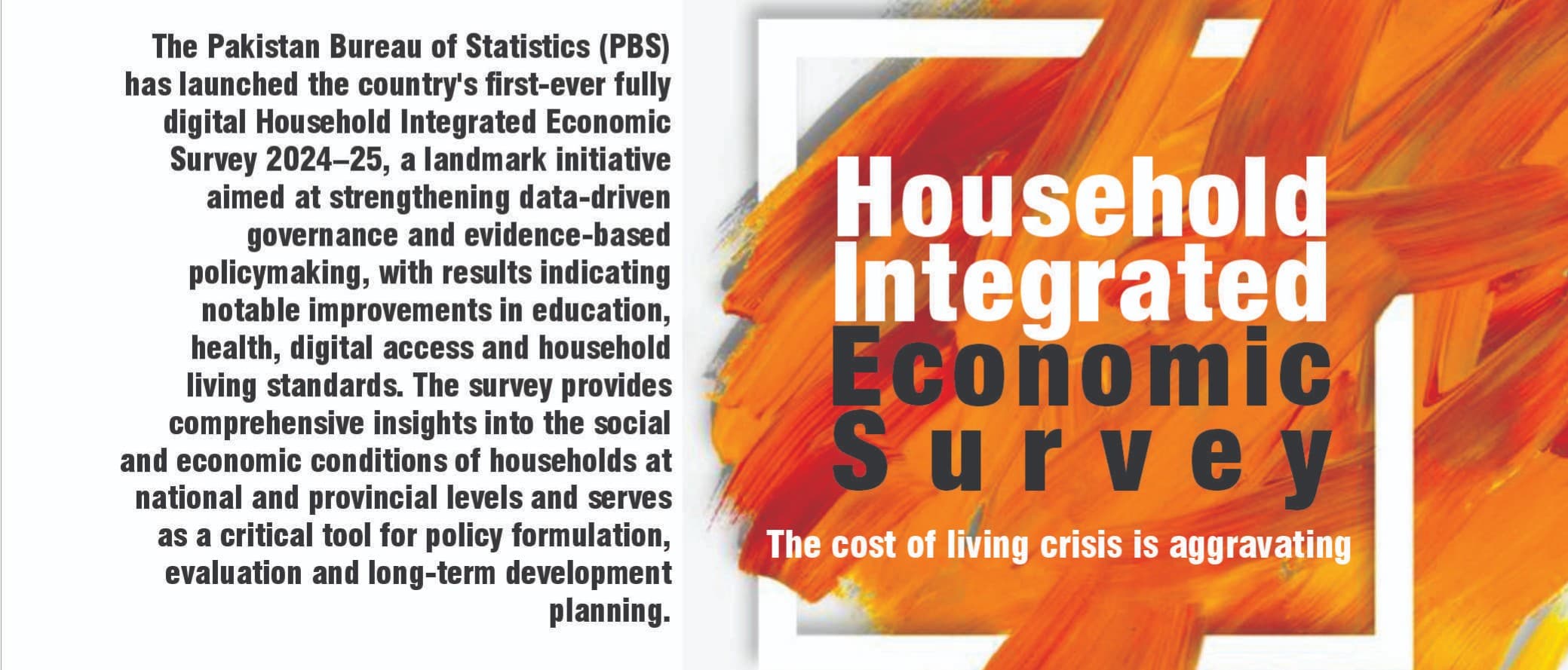
On January 01, the government unveiled the first-ever fully digital Household Integrated Economic Survey (HIES) 2024–25, a landmark data milestone that reveals sharp improvements in literacy, internet access and immunization. The survey, which was conducted from September 2024 to June 2025, after a gap of six years, is focused on social and economic conditions of the country to provide data for policymaking at the national and provincial levels. A statement from the Press Information Department (PID) said that “the survey provides comprehensive insights to review the social and economic conditions of the country and serves as a key tool for evidence-based planning and policymaking.”
Following are the key results and major highlights of the survey:
Literacy has risen from around 60% to 63%, yet far short of global benchmarks.
The number of out-of-school children dropped from 25.3 million to 20 million when compared with the school-going age population figure given in the 2023 census.
Gender parity at the primary level improved significantly from 92% to 96%.
Out-of-school children remain a concern at 28% nationally.
Out of 28%, as many as 20% of the children never went to schools, while the remaining 8% first joined and then dropped out.
Rural girls, particularly in Sindh and Balochistan, face the highest exclusion rates, while Punjab performed best and Balochistan the worst, despite recent improvement.
The details showed that one out of every four boys remains out of school, while this ratio is almost one out of three for girls.
Four out of every 10 boys could not continue studies because they had to take odd jobs to help the family or the education was 'too expensive'.
The girls often leave due to financial constraints, unwillingness or restrictions by the family.
The Punjab government could not depict any progress in bringing the out-of-school kids to the schools and its ratio remained unchanged at 21%.
In Sindh, the out-of-school children ratio decreased from 42% to 39%.
The KP government reduced its out-of-school rate from 31% to 28%.
In Balochistan, the out-of-school children ratio decreased from 59% to 45% – the maximum reduction in any province.
The Survey reveals how far Pakistan still lags in terms of education. While some people would proclaim success by noting that the national literacy rate has inched upward to 63% and enrolment is also up, the figures are still among the worst in the world. Meanwhile, some 20 million children — or 28% of student-age kids — are not even enrolled in schools. This is nothing short of a national emergency, failure to address which will make it impossible for the country to ever truly shine. Also notable is the fact that education spending is now less than 1% of GDP. The only way to address this problem quickly is to heavily invest in measures such as direct financial support to students that could encourage poor families to keep their children in school, a massive scaling-up of alternative learning pathways and a massive spike in the education budget for primary and secondary education, rather than higher education, which can be open to abuse as a virtual subsidy for students from wealthier backgrounds and the professors and owners of universities.
Household internet access increased from 34% to 70%.
There was an increase from 17% to 57% in the number of individuals using the internet in Pakistan.
Household mobile or smartphone facility was increased to 96%.
Household internet access increased from 34% to 70%.
The ownership of computing devices like laptops and desktops has halved to just 7%.
Mobile phone usage has also declined from 91% to 83%.
Digital financial inclusion has been measured for the first time, revealing that only 12% of individuals own a bank account and 9% use mobile money service while 76% have no financial account.
Widespread internet and social media access can be harnessed to promote national cohesion, shared social values and a sense of collective identity, while also improving the flow of information essential for social and economic development. For residents of remote areas, direct digital access to the rest of the country marks a significant shift, narrowing long-standing gaps in information and opportunity.
There are also clear economic implications. As the government seeks to position Pakistan as a participant in the global digital skills economy, widespread internet access is a necessary precondition. Higher connectivity opens new pathways for employment, entrepreneurship and the creation of diversified revenue streams, particularly for younger populations and those outside traditional job markets.
The neonatal mortality rate declined from 41 to 35 per thousand live births.
The infant mortality rate decreased from 60 to 47 per thousand live births.
Total fertility rate decreased from 3.7 to 3.6 children per woman.
Full immunization coverage increased from 68% to 73%.
Over the last six years (FY19 to Fy25), poverty has increased and income inequality has widened between the “haves” and the “have-nots.”
Average monthly household income increased over the past six years, with urban households earning more than rural households.
Urban income rose from Rs53,000 to Rs96,767, while overall average income increased from Rs41,545 to Rs82,179, reflecting an average annual growth rate of 16.3%.
In the last fiscal year, the poorest 20% of households earned Rs41,851 per month compared to Rs139,317 for the richest 20%.
Expenditures increased faster than incomes, rising from Rs37,159 to Rs79,150, which represented an average annual increase of 19%.
This suggests that while richer households may still afford some discretionary spending, lower-income households are cutting back sharply on health and education. There are increasing indications that even middle-class families are shifting children to lower-tier private schools and postponing medical treatments.
Many readers have personally felt the strain of the past six years and have witnessed even harsher stories among friends and family with lower incomes. Any claim of economic recovery or stability is hollow and incomplete when the quality of life for a population of over 250 million is deteriorating.
The HIES findings should serve as a wake-up call for policymakers to refocus on basic food security and education for the masses, rather than relying on headline numbers and optimistic narratives.
Across Pakistan, around one-fourth of households experience moderate or severe food insecurity, with marked disparities across provinces and income groups.
Vulnerability remains the highest in Balochistan and Sindh, while the lowest income quintile faces nearly five times greater risk than the highest.
Only 19.5% of households can always afford desired meals, while 30% sometimes go without three meals a day.
Food insecurity significantly increased in Punjab, where it jumped from 14.4% to 22.6%, and the severe food insecurity almost doubled within six years.
The food insecurity in KP also increased from 16.7% to 21.5% in six years.
The situation was more alarming in Balochistan, where the food insecurity doubled to over 30%, while in Sindh it increased by 10% to 29%.
The HIES 2024-25 makes one uncomfortable point abundantly clear: Pakistanis are eating less. Not just the poor, not just rural households, not just one province or one demographic category. Per capita food consumption has deteriorated across income quintiles and across regions compared with the last survey in 2018-19. In several staples, the decline is even starker when compared with two decades ago. This is not a temporary blip. It is a slow, grinding erosion of household welfare.
Food alone now absorbs more than a third of household spending. Another quarter goes into housing, electricity and gas. Together, these basic needs consume 63% of total expenditure. This is the direct result of prolonged inflation and policy choices that have steadily raised the cost of essentials.
The writer is a member of staff.
Topics
The writer is a member of staff.