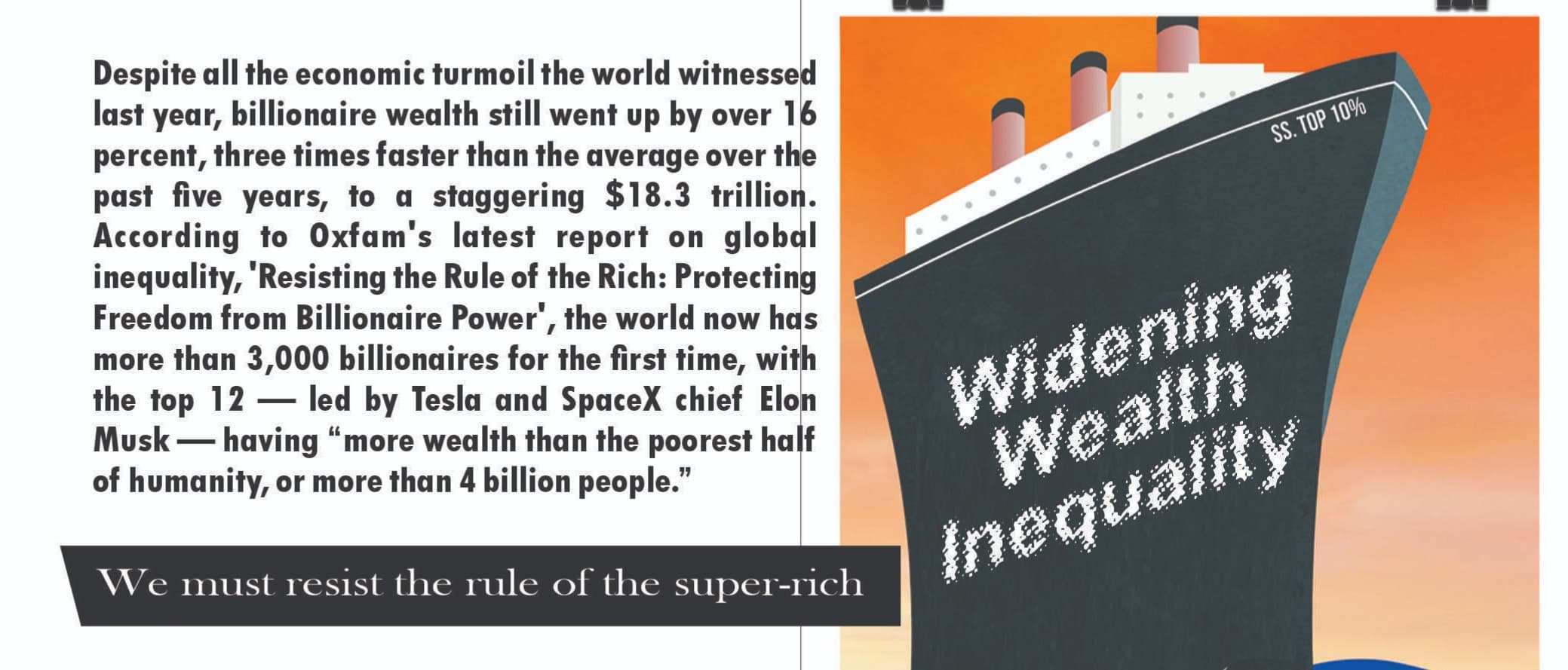
The collective wealth of the planet's billionaires soared to a record level in 2025, deepening economic and political divides that threaten democratic stability. In a report timed for the opening of the World Economic Forum in Davos, the anti-poverty group Oxfam said the fortunes of global billionaires jumped 16% in 2025 to $18.3 trillion, extending an 81% rise since 2020. The gains happened even as one in four people worldwide struggle to eat regularly and nearly half the global population live in poverty.
Oxfam's study, which draws on academic research and data sources ranging from the World Inequality Database to Forbes' rich list, argues that the wealth boom is being matched by a dramatic concentration of political clout, with billionaires 4,000 times more likely than ordinary citizens to hold political office.
Key Findings
a. Record surge in wealth of billionaires
The wealth of billionaires has grown three times faster than the average growth seen over the past five years.
Their wealth increased by $2.5 trillion last year alone.
This amount is equal to the combined wealth of around 4.1 billion people, nearly half of the world's population.
o In contrast, one in four people globally is unable to access sufficient food.
If this money were used to support the poor, global poverty could be eliminated 26 times.
b. Trump's policies favoured the wealthy
Policies introduced during President Trump's tenure helped increase the wealth of the rich, while widening inequality worldwide.
o These policies included major tax cuts for the super-rich, weaker rules on taxing large corporations and support for artificial intelligence-related companies.
While US billionaires have seen the sharpest growth in their fortunes, billionaires in the rest of the world have also seen double digit increases.
c. Extreme wealth accumulation in tech
Tech billionaires are expanding into AI, media organizations and social media.
Highlighted individuals include Nvidia CEO Jensen Huang and Tesla CEO Elon Musk.
o Musk is noted as the first individual to amass over half a trillion dollars in wealth.
d. Influence in politics and media
Billionaires are increasingly consolidating political power.
o The wealthiest individuals being 4,000 times more likely to hold political office than the average citizen.
The growing concentration of wealth among the elite is also exacerbating the concentration of media power.
o More than half of the world's major media companies are now owned by billionaires, including Jeff Bezos, Elon Musk and Patrick Soon-Shiong.
Ownership of news organizations and social media platforms enhances their ability to shape public opinion.
e. A good decade for billionaires
In 2025, billionaire wealth increased three times faster than the average annual rate over the previous five years.
One study found that more unequal countries are up to seven times more likely to experience democratic erosion than more equal countries.
Billionaires are over 4,000 times more likely to hold political office than ordinary people.
The amount of wealth gained by the world's billionaires over the last year is enough to give every person in the world US$250 and leave the billionaires more than US$500bn richer.
The world's 12 richest billionaires have more wealth than the poorest half of humanity, or more than four billion people.
Oxfam’s recommendations
1. All countries must commit to radically reducing economic inequality.
2. Governments can take concrete steps to curb the power of the super-rich, including increasing taxes on the wealthiest.
3. Build the political power of the many.
4. Defend our rights, fight for a more equal world and demand an end to inequality.
Analysis
Is it the business and innovative genius of these billionaires that is pushing their wealth to new heights while the rest of us struggle to maintain the standard of living our parents had?
Not exactly. According to Oxfam, billionaires' financial muscle is now quickly being converted into an even more potent currency: political power. The report finds that the super-rich are securing political power to shape the rules of our economies and societies for their own gain, at the expense of people's rights and freedoms around the world. Civil liberties and political rights are being rolled back and suppressed as countries across the globe curtail freedom of expression and meet protests with violence.
The 2025 surge in the wealth of the ultra-wealthy coincides with arguably the most pro-rich US presidential administration ever, led by a man who just so happens to be a billionaire himself. This is no mere coincidence. Oxfam estimates that billionaires are 4,000 times more likely to hold political office than ordinary citizens. The same money that can buy super yachts can also buy judges, politicians, newspapers or even votes and elections themselves. And this isn't just a US phenomenon. A World Values Survey of 66 countries found that almost half of respondents said the rich often buy elections in their countries. In Asia, the wealthiest 10 percent capture 77 percent of the region's income, while over half a billion people survive on less than $4.20 a day. And while there might be few billionaires in Pakistan, this phenomenon of financial inequality translating into political inequality is hardly foreign. The country's 'K-shaped' economic recovery is deepening wealth inequality.
The consequences of living in a system that increasingly operates in favour of its richest few are also getting starker. The rate of poverty reduction has stagnated at levels broadly where they were in 2019, and extreme poverty is rising again in Africa as rich countries race to slash aid budgets and dodge the climate bill that they have imposed on the Global South. As such, the ability of countries like ours to rely on the West to help with development is eroding.
The Way Forward
So how can this growing billionaire tyranny be defeated? The Oxfam report cites how philosopher Ingrid Robbins has set out a case for a legal limit on private wealth, similar to how nations set things like poverty lines and, at least ostensibly, work to ensure citizens do not fall under them. Restrictions on things like political donations might also be useful. But in a world where the ultra-rich now have the power to shape the opinions, perceptions and even emotions of the many, it remains unclear whether such a political movement is even viable.
The writer is a graduate of UMT, Lahore.