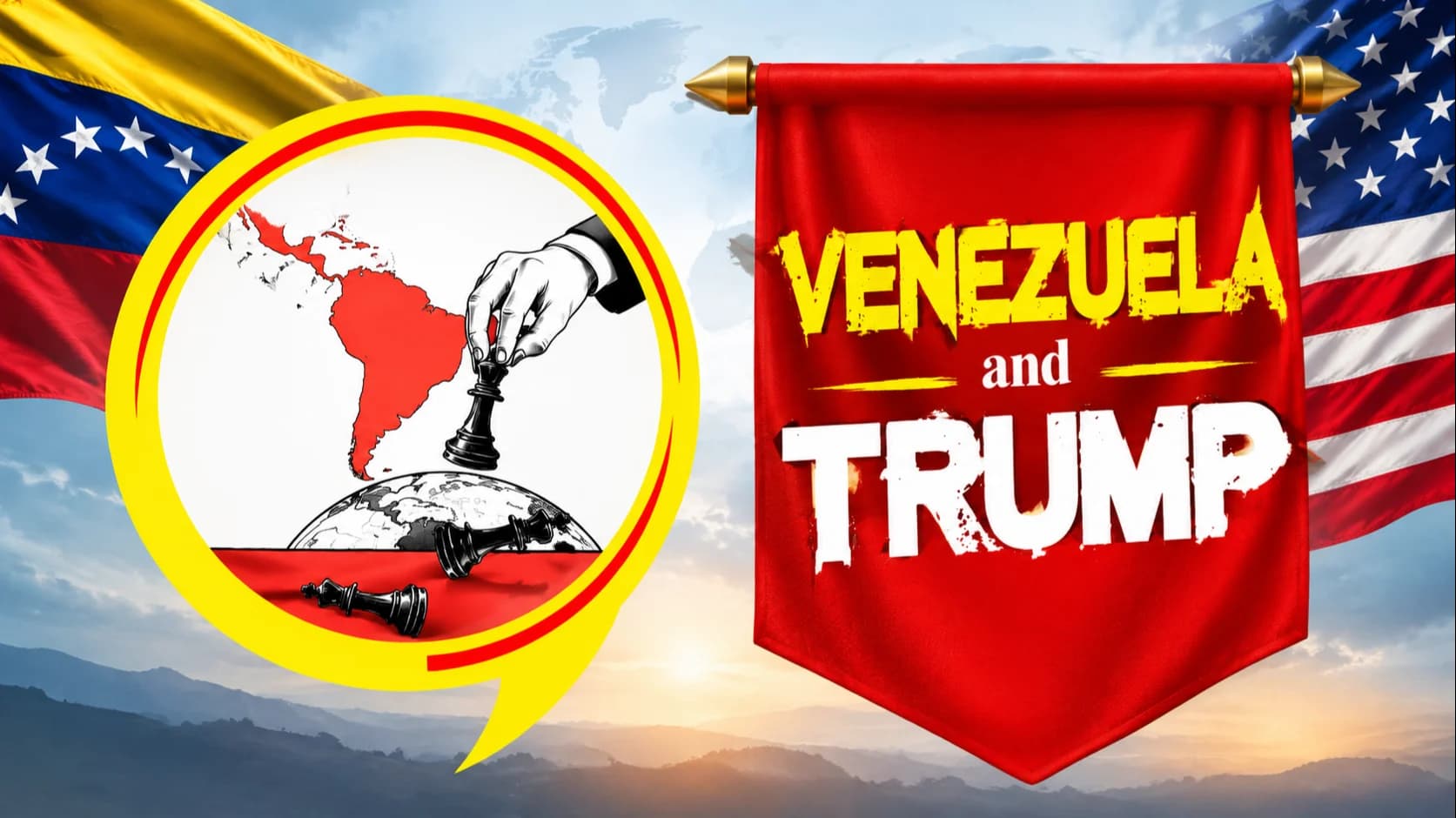
On New Year's Eve, when asked about his resolutions, a very passionate Trump said, “Peace on Earth.” Just three days later, he invaded Caracas, the capital of Venezuela, and abducted the president, Nicolás Maduro, and his wife in a large-scale operation in the middle of the night. In an age of fragile world order, the US's reckless foreign policy action has caused severe geopolitical harm in the region. This article will focus on the situation of Venezuela's governance, Trump's motives and possible outcomes of this escalating war.
Nicolás Maduro
Coming from a humble background, Maduro rose to power quickly. He was born into a working-class family on November 23, 1962, in the El Valle neighbourhood of Caracas. He was raised under the significant influence of his father's politics.
Maduro's political rise began in organized labour. He is believed to have joined the Socialist League of Venezuela, a Marxist-Leninist party, in the early 1980s. In 1986, Maduro was sent as a representative of the Socialist League to Cuba for a year of political training at the Escuela Nacional de Cuadros Julio Antonio Mella, run by the Union of Young Communists (UJC). Upon his return, he started working as a bus driver in Caracas city's metro system, and then founded and led the SITRAMECA, or Sindicato de Trabajadores y Trabajadoras del Metro de Caracas, in 1991.
Maduro was moved by the leadership of Hugo Chavez, a Venezuelan lieutenant colonel who led the armed Bolivarian movement rebelling against the so-called “Puntofijismo” system — Venezuela's two-party democracy system — and the sitting President Carlos Andres Perez, citing corruption. Inspired by Chavez's leadership, Maduro campaigned for his release when he was jailed for the 1992 coup. During this time, he met his future wife, Cilia Flores, who led the legal battle for Chavez's freedom. After being released, Chavez became the president in the 1998 elections. In December 2012, as Chavez fell ill, he appointed Maduro as his political predecessor.
In elections after Chavez's death, Maduro won by a slim margin in April 2013.
Maduro's presidency started with gaining firm control of the military, courts and media, and with a hostile attitude towards the United States. He suppressed domestic opposition, labelling them as fascists. During his term, he had to deal with a collapsing economy and rising opposition led by Maria Corina Machado – Maria has won the 2025 Nobel Peace Prize. Maduro's tactics to deal with opposition have always been violent and they resulted in hundreds of deaths, while some opposition leaders have been forced into exile. In 2018 and 2024, Maduro won the presidential elections twice, which were largely termed as non-transparent. The opposition led multiple protests against the Maduro regime. The general public opinion has been against Maduro, and since his arrest, there is a new wave of hope among citizens. The public emerged in streets after his arrest in celebration, while the uncertainties of what happens next continue to worry individuals.
Trump's Involvement
After Trump returned to the White House, he started rigorous opposition against the Venezuelan president. On multiple occasions, Trump has threatened Maduro with an unfortunate fate, providing support to the opposition. In January 2026, Trump bombed Venezuela, violating international law and arrested the leader of a sovereign country and his wife. This arrest was undertaken citing drug charges – Trump termed Maduro as “the kingpin of a vast criminal network responsible for trafficking colossal amounts of deadly and illicit drugs into the United States”. However, according to the UN World Drug Report 2025, only 5% of Colombian cocaine passes through Venezuela.
Under the mask of the terror-drug network, US intervention has different motives. For instance, Venezuela's oil reserves are even greater than those of Saudi Arabia, and over time, the US has expressed interest in occupying these reserves. Venezuela's oil reserves are concentrated primarily in the Orinoco Belt, in the eastern part of the country controlled by the state-owned oil company. Refining oil from this region requires advanced machinery, which the US possesses. Additionally, Venezuela is one of the largest foreign oil sources for the US. Due to corrupt practices and inefficiency, the country's production has fallen. President Trump plans to tap into the vast oil reserves of Venezuela and restore the collapsing industry. The United States completed its first sale of Venezuelan oil on 12th January 2026, valued at $500 million, and additional sales of oil are also expected.
Apart from oil, Trump has expressed, time and again, his interest in natural minerals. Venezuela has roughly three billion metric tons of coal reserves, 3.6 billion metric tons of iron ore, 407,885 metric tons of nickel and 1,020 million diamond carats. These reserves worth billions of dollars are definitely a main US interest. Trump has repeatedly asserted that he is in control of the oil reserves and the government of Venezuela in general.
Global Implications
The reckless invasion of Venezuela will have extensive implications on the already fragile world order.
Firstly, as the arrest is in direct violation of international law, it will destabilize the framework of international law, setting a precedent for future interventions.
Secondly, the intervention would reshape global energy politics. US control over Venezuelan oil production and export will have implications for energy prices, supply chains and geopolitical leverage.
Thirdly, this would accelerate the fragmentation of the international system into competing blocs. Many countries in Africa, Asia and Latin America already view global order as unevenly enforced, with powerful states operating under different rules. It will push more states toward China and Russia for better security.
While the Venezuelan drug networks have proved to be a headache for the US, it doesn't warrant an arrest of their top leader, who had immunity. Recent actions have suggested that the motives were entirely different from what was being presented to the general public. If the US interventions don't stop here, it will significantly become harder for the states to form alliances, damaging the already fragile international order.
China's Geopolitical Aims in Venezuela
Venezuelan oil recently constituted only 4% of Chinese oil imports, but that share has been increasing. The Reuters news agency quoted two market analysts who estimated that maximum daily import volumes will hit new highs.
China is set to import more than 600,000 barrels a day from Venezuela, the majority of its daily production. For China, Venezuela is an important oil source, primarily because it reinforces Beijing's energy independence amid the global tug-of-war over raw materials. Venezuela's Merey oil blend is particularly well-positioned to do this, as the West has sanctioned it. In turn, a lot of Chinese money flows into Venezuela, including in the form of credits. Caracas is variously estimated to be indebted to Beijing to the tune of between $60 billion and $70 billion.
Venezuela is also a market for Chinese technology. Many of its armaments are Chinese-made, and the telecommunications infrastructure is substantially based on Chinese components.
In September 2025, Maduro presented a new Huawei cellphone at a press conference in Caracas. He announced that the Chinese President Xi Jinping had personally gifted him the "best phone in the world" and that American intelligence services couldn't possibly hack it.
Venezuela's authoritarian-nationalist socialism is compatible with China's state ideology. By verbally condemning the US seizure of oil tankers, as it recently did, Xi's government can present itself as an ally. This presumably also serves to keep the United States busy in its own backyard.
For more than a decade now, US presidents have been more focused on the Indo-Pacific region, where China also wants to be the dominant power and is being increasingly aggressive in asserting its claim to Taiwan. It, therefore, plays into China's hands if the US is forced to devote more attention to the situation in Venezuela or Cuba.