Print subscription includes a free wall-size coloured map.Special offer: Subscribe Now (Print) and Get Free Wall Size Coloured Map!Subscribe Now
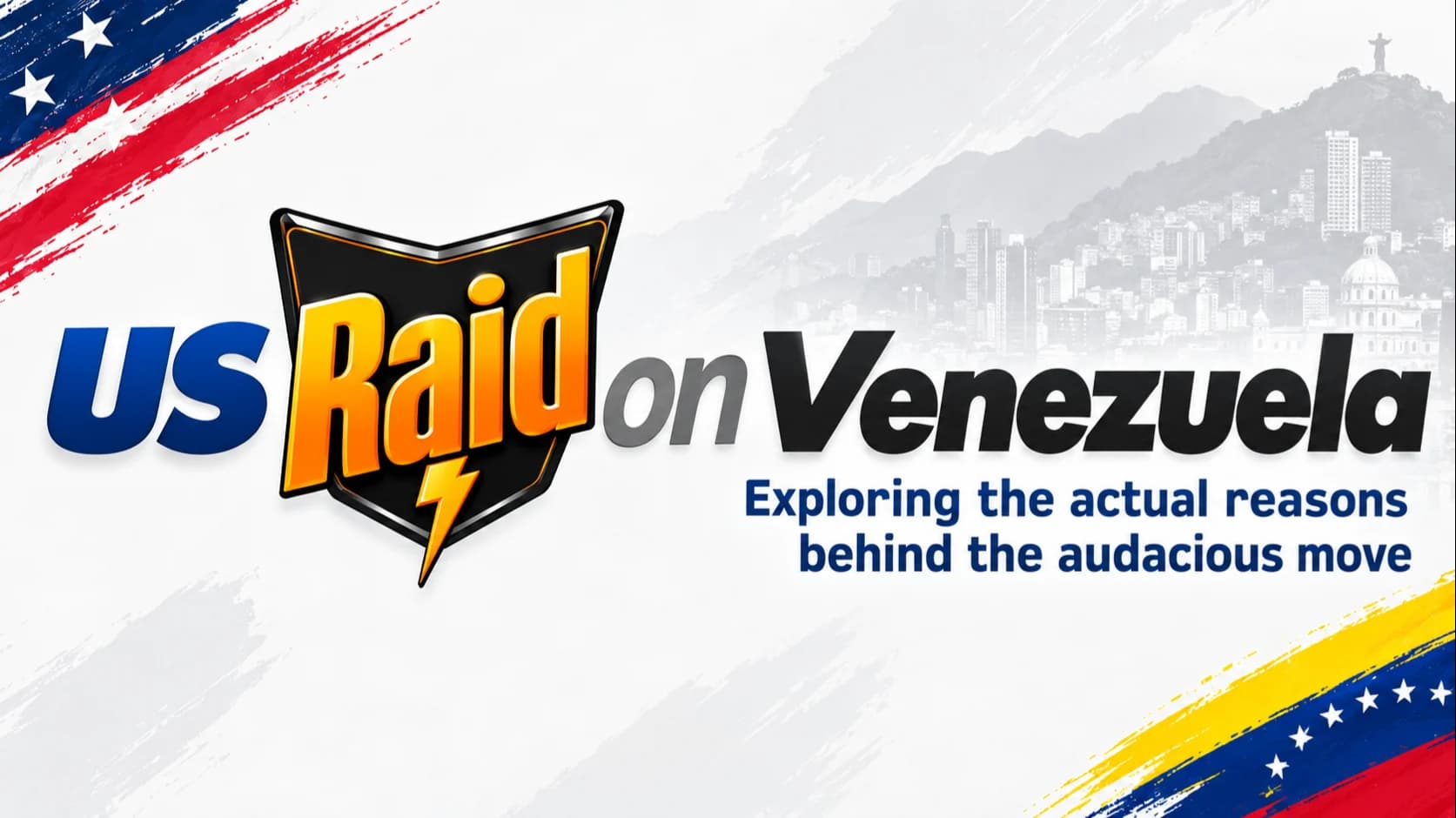
The U.S. military operation on January 3, which resulted in the capture of Venezuelan President Nicolas Maduro, immediately generated polarized interpretations. Some framed it as a moral struggle between democracy and authoritarianism; others denounced it as a violation of international law by the hegemon; still others reduced it to immediate economic interests tied to Venezuelan oil. Each of these readings captures only part of the underlying logic and fails to explain the operation's broader strategic rationale, as well as the persistent interest of successive US administrations in regime change in Venezuela. It should actually be seen through the lens of China-US competition. The United States sees Venezuela not only as a regional outlier, but as a node in China's expanding energy-security architecture in the Western Hemisphere.
In a move that stunned the world, the United States bombed Venezuela, on Jan. 3, and abducted its President Nicolas Maduro. President Trump praised the operation to seize Maduro and his wife, Cilia Flores, as one of the “most stunning, effective and powerful displays of American military might and competence in American history”. Although Trump has accused Maduro of "emptying his prisons and insane asylums" and "forcing" its inmates to migrate to the US, and also of shipping drugs to the US, analysts believe that the actual reasons are beyond such accusations.
The first instinct in moments like these is to zoom in—to count barrels, trace shipping routes or tally sanctions. That is a mistake. What is unfolding around Venezuela needs to be viewed from 30,000 feet, from the kind of altitude where individual data points fade and larger structures come into focus. From that height, the oil grab story, or for that matter that the US has gone into Venezuela for its gold, minerals and other reserves, seems myopic. We are still living in a long, violent extension of the Cold War – to borrow from Hal Brands' work, The Eurasian Century. In essence, the events we are seeing and the developments that will follow should be considered a continuation of an older, unfinished story: the long struggle between systems of capitalism and state-led control, maritime power and continental power, liberal order and revisionist ambition. In that sense, Venezuela is not an exception; it is just a node. And the lens that helps make sense of it is Cold War logic, updated for the 21st century.
Noted American strategist Hal Brands argues that we are living through the 'Second Eurasian Century'. The first, spanning the late 19th and early 20th centuries, was defined by great powers fighting for control over land, resources and influence across Eurasia, culminating in two World Wars and ideological confrontation. The second, Brands suggests, is marked by a renewed contest over the same terrain but under modern conditions: financial networks instead of empires, sanctions instead of blockades, energy flows instead of colonies.
Venezuela, geographically distant from Eurasia, nonetheless, sits squarely inside this struggle. It has become a pressure point where great-power competition spills into the Western Hemisphere.
This framing matters, because it immediately exposes the limits of the most popular explanation for recent US actions: oil. The idea that Washington moved decisively because it wants Venezuelan crude is not just simplistic; it is increasingly detached from market reality. Oil is a factor, yes, but it is not the factor. The “oil grab” narrative is overhyped, rooted more in habit than in hard numbers.
Venezuela does hold roughly 303 billion barrels of proven reserves, the largest in the world on paper. But paper barrels do not move markets. Flowing barrels do. After decades of mismanagement, underinvestment and sanctions, Venezuela's actual production hovers around 1.0–1.1 million barrels per day – barely 1% of global output. There was no physical disruption to production or refining infrastructure following US strikes; Venezuela's state-owned oil and gas company PDVSA (Petróleos de Venezuela, SA) itself reported no damage to core facilities. In the immediate term, supply risk is shaped not by geology but by logistics, enforcement and payments.
This context is critical. The United States is producing oil at record levels. Domestic supply chains remain robust and drilling activity - measured by frac spreads (unit of equipment used in the oil and gas industry for hydraulic fracturing of shale formations) and job counts – continues steadily into 2026. American refiners are practising capital discipline, not scrambling for heavy crude at any cost. If the goal was simply to secure oil, there were cheaper, quieter ways to do it. Venezuelan production cannot be “switched back on” with political goodwill alone. It is a capital-intensive, time-consuming repair job.
Here are some original calculations.
Maintaining current output already requires replacing roughly 110,000 barrels per day of declining capacity every year. At realistic sustaining costs for degraded heavy-oil systems, it implies $3–3.5 billion annually just to avoid further decline around $50 billion over 15 years. Restoring production to something like 3 million barrels per day would require nearly $175–185 billion by 2040. Therefore, this is a generational investment cycle. Now we will see a few hundred thousand barrels coming out of Venezuela but given the high sulphur content of their oil - imagine the viscosity of marmalade – it won't be globally acceptable.
The answer begins to emerge when Venezuela is viewed not as a producer, but as a strategic asset in someone else's portfolio, i.e. China's.
All through 2025, China aggressively but quietly built crude inventories, both strategic and commercial. Independent estimates suggest Chinese stockpiling removed roughly 0.9–1.1 million barrels per day from the global market through much of the year. Many thought of this as opportunistic buying, whereas, in reality, China was insulating itself from a future shock. Beijing was preparing for friction whether in the Middle East, Eurasia or elsewhere. Venezuela fits into this pattern less as a source of incremental supply and more as a tool of strategic positioning.
By late 2025, China had become the dominant destination for Venezuelan crude, absorbing perhaps 70–80 percent of its exports. Sanctions pushed PDVSA's heaviest barrels eastward, where opaque shipping, reflagging and barter arrangements flourished. In practice, Venezuelan oil increasingly functioned as quasi-captive supply for China, reinforcing Beijing's leverage in Caracas while hollowing out the credibility of US sanctions in its own hemisphere.
That erosion mattered. Sanctions had turned into a game of whack-a-mole. Dark fleets multiplied. Cargos were re-labelled, sometimes even rebranded as of Brazilian origin. Compliance became optional rather than mandatory. From Washington's perspective, this was no longer about punishing Caracas; it was about signalling: a sanctions regime that can be ignored ceases to be a regime at all.
Layer onto this the scale of Chinese and Russian financial engagement in Venezuela. Over the past decade, Beijing and Moscow extended tens of billions of dollars in loans, credit lines and oil-for-debt arrangements. Some estimates place total exposure north of $100 billion. These were not passive investments; they translated into operational influence, off-take agreements and geopolitical presence. For the United States, this represented a strategic black eye: two revisionist powers embedding themselves in a country long considered a part of Washington's natural sphere of influence.
Zooming back out, Venezuela starts to look less like a target and more like a message.
China's broader position in South America reinforces this interpretation. Since the mid-2000s, Chinese policy banks have provided roughly $120 billion in sovereign loans across Latin America and the Caribbean. That figure excludes equity investment, trade credit and project finance – meaning the real footprint is larger. Venezuela concentrated multiple forms of risk into a single relationship: sovereign lending, oil-backed repayment, infrastructure exposure and political volatility. When that node destabilizes, the signal radiates outward.
Trade deepens the stakes. China–Latin America trade now exceeds $500 billion annually, dominated by commodities essential to China's industrial system: oil, copper, lithium, iron ore, soybeans. Infrastructure—from ports to rail corridors—exists to service these flows. Political disruption threatens not just assets but the logic of entire supply chains.
Seen this way, the US move looks like a strategic reset rather than a resource grab. It is an assertion that influence in the Western Hemisphere is still contested; that alternative economic networks will not expand unopposed; and that sanctions are instruments of power and not mere suggestions.
At the highest level, this all feels eerily familiar. The 1930s were not defined by a single crisis but by overlapping economic stress, revisionist powers testing boundaries and great powers rediscovering coercion after periods of complacency. Today's tools are financial rather than military, sanctions instead of blockades, loans instead of occupations, but the logic rhymes.
Trump's 'Donroe Doctrine', which is a corollary to the Monroe Doctrine, is about reasserting US influence in the Western Hemisphere. This resurfacing of a 200-year-old foreign policy vision will carry serious consequences for the geopolitical landscape, not only in 2025 but for decades to come. Another lesson to be learned here is that geopolitics will continue to be guided by ideology (as mentioned in the beginning of the article) and the fragmentation – regarding which even the IMF has warned – will worsen and delineate further. We should be keeping a close eye on events in Taiwan and its surroundings. India-USA relations will also become strengthen, as they will need a stronger India to balance China. Expect more competition in trade, technology and weapons.
Venezuela, in that sense, is not about oil alone. It is about systems colliding, spheres of influence hardening and the slow unravelling of assumptions that globalization would override geopolitics. The Second Eurasian Century does not stay in Eurasia. It spills outward. And when it reaches the Caribbean, it reminds us that history does not repeat, but it does, unmistakably, return.
The writer is an international Energy and Economic
Analyst. His interests include macroeconomy,
commodities, complex systems and history.
The National Security Strategy, which was released by the Trump administration recently, lists the Western Hemisphere – including Greenland, Canada, Mexico, and Central and South America – as the top regional priority. According to the NSS, “after years of neglect,” the U.S. will reassert and enforce the “Trump Corollary” to the Monroe Doctrine, to “restore American preeminence in the Western Hemisphere.” Recent actions in Venezuela display this theme already being in action. The document, and the actions already carrying it out, lay the way for a decade of geopolitical upheaval and a new carving up of the world between the great powers across their spheres of influence. The document sets out four guidelines related to the Venezuelan crisis: protecting the U.S. from drug and human trafficking; preventing and discouraging mass migration; bolstering America's energy sector; and keeping the Western Hemisphere free of hostile foreign incursion or ownership of key assets – The document labels China, Russia and Iran, among others, as hostile.
As a Reuters story puts it, among the many goals of [the military operation in Venezuela] was to send China a message: stay away from the Americas. The story further says that for at least two decades, Beijing has sought to build influence in Latin America, not only to pursue economic opportunities but to gain a strategic foothold on the doorstep of its top geopolitical rival. China's progress - from satellite tracking stations in Argentina and a port in Peru to economic support for Venezuela - has been an irritant for successive US administrations, including that of Donald Trump.
Trump made the message explicit, expressing discomfort with China and Russia as a "next-door neighbor," in a meeting with oil executives. “I told China and I told Russia, 'We get along with you very well, we like you very much, we don't want you there, you're not gonna be there',” Trump said. Now, he said, he will tell China that “we are open for business” and that they can “buy all the oil they want from us there or in the United States.”
Topics

The writer is an international Energy and Economic Analyst. His interests include macroeconomy, commodities, complex systems and history.