Print subscription includes a free wall-size coloured map.Special offer: Subscribe Now (Print) and Get Free Wall Size Coloured Map!Subscribe Now
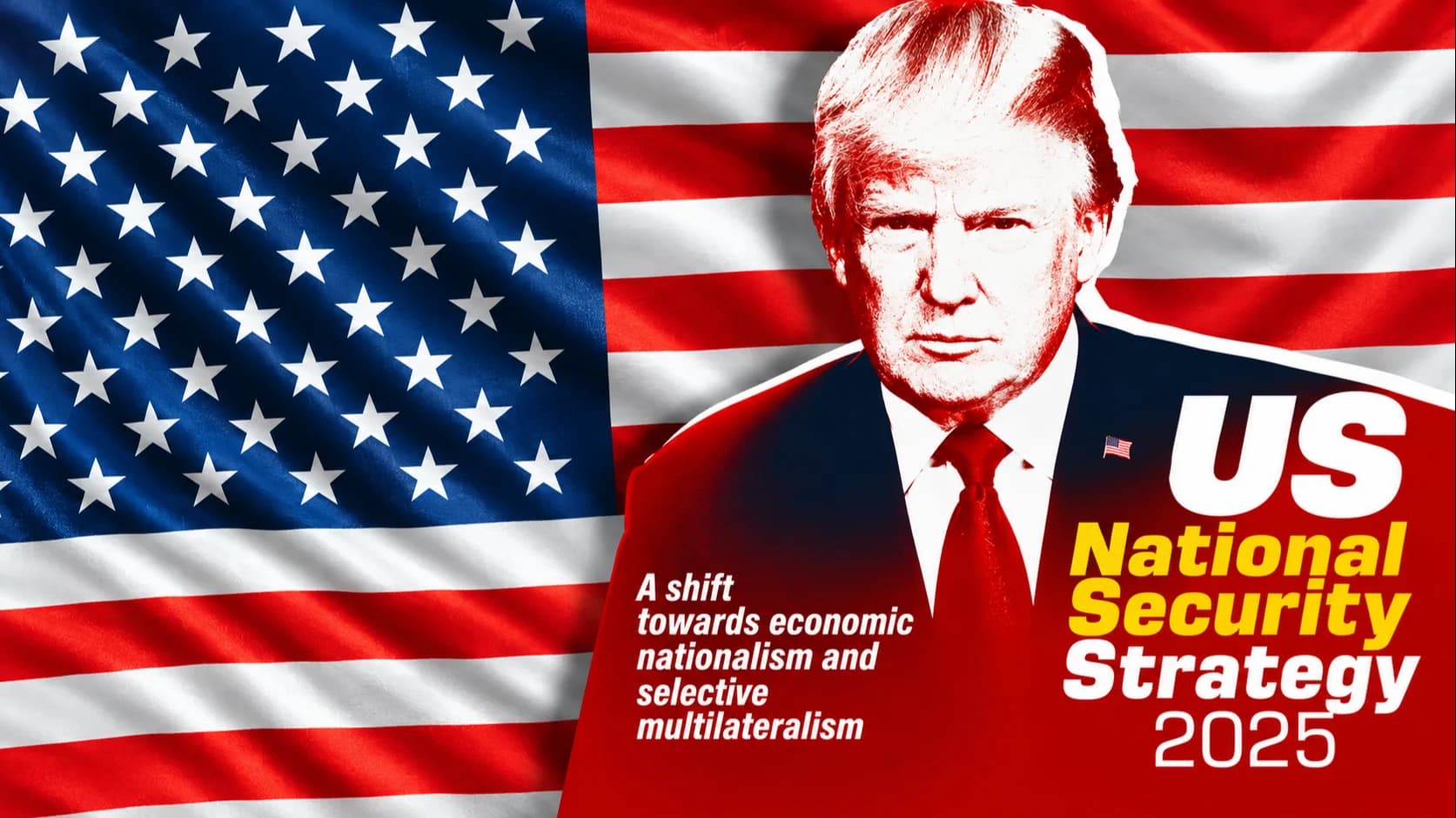
Summary. A shift towards economic nationalism and selective multilateralism
On December 4, 2025, the Trump administration published its 2025 National Security Strategy (NSS), a wide-ranging document that spells out President Trump's foreign policy aims and how the country should attain them. The policy, while criticizing US allies in Europe, emphasizes the need for US “preeminence” in the Western Hemisphere, reflecting President Trump's push for regional dominance. It also calls for balancing trade with China and deterring it from seizing Taiwan. It further focuses on building up a larger military presence in the Western Hemisphere, balancing global trade, tightening up border security and winning the culture war with Europe.
“After years of neglect, the United States will reassert and enforce the Monroe Doctrine to restore American preeminence in the Western Hemisphere and to protect our homeland and our access to key geographies throughout the region,” the document states. Below is a breakdown of what the strategy says — and what it means.
The 33-page document builds on Trump's “America First” ideology but also provides the first explicit reference to the president replicating the Monroe Doctrine – a 19th-century US policy in opposition to European colonization and interference in the Americas – calling for US dominance in the Western Hemisphere.
Other than deterring foreign influence in the hemisphere, it will push to combat the drug trade and irregular migration while encouraging “private economies”.
“We will reward and encourage the region's governments, political parties and movements broadly aligned with our principles and strategy,” the document reads.
Trump has already put this approach into action by publicly backing conservative politicians in Latin America and bailing out the Argentinian economy under right-wing President Javier Melei with $40bn.
The NSS also calls for shifting US military assets to the Western Hemisphere, “away from theatres whose relative import to American national security has declined in recent decades”. The document doesn't explicitly lay out a US retreat from the globe, but it does call for increasing burden sharing among allies.
The NSS narrows American purpose to “core national interests” and explicitly disavows the post-Cold War liberal order that the United States has built and led. It defines foreign policy as “the protection of core national interests” and says that is the “sole focus” of the document. It criticizes “American foreign policy elites” for chasing “permanent American domination of the entire world” and for tying the United States to “so-called 'free trade,” globalism and “transnationalism” that allegedly hollowed out the American middle class and eroded sovereignty. Where previous strategies wrapped US power in the language of democracy promotion and the rules-based order, this one redefines leadership and power through coercive leverage, bilateralism and transactional alignment.
Although Trump has cracked down on speech critical of Israel in the US and ordered the Department of Justice to target his political rivals, the NSS scorned Europe over what it called “censorship of free speech and suppression of political opposition”.
The strategy proclaimed that Europe is facing the “prospect of civilizational erasure” due to migration policies and “failed focus on regulatory suffocation”.
It also hit out at European officials' “unrealistic expectations” for the war between Russia and Ukraine, saying that the US has a “core interest” in ending the conflict.
The NSS blamed, without providing examples, the “subversion of democratic processes” for what it described as some European governments' unresponsiveness to their people's desire for peace.
The document also suggested that the US may withdraw the security umbrella it has long held over the old continent.
Instead, Washington would prioritize “enabling Europe to stand on its own feet and operate as a group of aligned sovereign nations, including by taking primary responsibility for its own defence.
The NSS stresses that the Middle East is no longer the top strategic priority for the US. It says that past considerations that made the region so important – namely, energy production and widespread conflict – “no longer hold”.
With the US ramping up its own energy production, “America's historic reason for focusing on the Middle East will recede,” the strategy says.
It goes on to argue that the conflict and violence in the region are also subsiding, citing the ceasefire in Gaza and the US attack on Iran in June, which it said “significantly degraded” Tehran's nuclear programme.
“Conflict remains the Middle East's most troublesome dynamic, but there is today less to this problem than headlines might lead one to believe,” it reads.
The US administration envisioned a rosy future for the region, saying that instead of dominating Washington's interests, the Middle East “will increasingly become a source and destination of international investment,” including in artificial intelligence.
It describes the region as an “emerging as a place of partnership, friendship, and investment”.
But in reality, the Middle East continues to be beset by crises and violence. Despite the truce in Gaza, near-daily Israeli attacks have continued as deadly raids by settlers and soldiers against Palestinians escalate in the occupied West Bank.
Israel has also been stepping up its air strikes in Lebanon, augmenting fears of another all-out assault against the country to disarm a weakened Hezbollah by force.
In Syria, a year into the fall of the government of former President Bashar al-Assad, Israel has pushed on with incursions and strikes in an effort to militarily dominate the south of the country beyond the occupied Golan Heights.
And with its uncompromising commitment to Israel's security, the US remains deeply entrenched in the region with continuing military presence in Syria, Iraq and the Gulf area.
The US will pursue its own interests in dealing with other countries, the document says, suggesting that Washington will not push for the spread of democracy and human rights.
“We seek good relations and peaceful commercial relations with the nations of the world without imposing on them democratic or other social change that differs widely from their traditions and histories,” it said.
“We recognize and affirm that there is nothing inconsistent or hypocritical in acting according to such a realistic assessment or in maintaining good relations with countries whose governing systems and societies differ from ours even as we push like-minded friends to uphold our shared norms, furthering our interests as we do so.”
However, the strategy suggests the US will still press some countries – namely Western partners – over what it sees as important values.
“We will oppose elite-driven, anti-democratic restrictions on core liberties in Europe, the Anglosphere, and the rest of the democratic world, especially among our allies,” it said.
The Trump administration's NSS is as much an economic statecraft strategy as it is a national security strategy, justifying US internationalism primarily based on economic interests, particularly in the Western Hemisphere and, perhaps surprisingly for those concerned about the merger of the United States Agency for International Development (USAID) into the Department of State, reinforcing the importance of soft power.
It frames foreign policy around traditional economic statecraft objectives such as preserving secure supply chains, access to raw materials, protecting US export markets and ensuring dominance of US technology and industrial capacity. International assistance is not dismissed, but it is also not presented as a tool of humanitarian obligation or for providing global public goods. Rather, assistance is considered meaningful when it helps protect or advance US interests.
This NSS's writing suggests a domestic audience, but its words are being parsed closely in the Indo-Pacific—where the time zone differences enabled publishing local first takes while Washington slept.
Language on China and Taiwan garnered the most attention. For example, some commentators are already opining that shifting from the last NSS’s wording of “oppose any unilateral changes” to the status quo in the Taiwan Strait to “does not support any unilateral change” is a softening, despite the new NSS calling this a “longstanding declaratory policy”.
Similarly, South Korean concerns that North Korea was mentioned seventeen times in the first Trump administration's NSS, but not once this time, are misplaced. Pyongyang has obviously not been a high priority for Washington since the inconclusive Hanoi summit of 2019, but the United States is doubling down on its alliance with South Korea and remains steadfast in deterring threats from the North. North Korea's Kim Jong Un might take solace that boilerplate language on denuclearization was absent, but Kim would be foolish to see this as a concession.
At least for the Indo-Pacific, friends and adversaries alike should read the clear signals in the NSS—the United States is committed to strengthening extended deterrence in the region, even as it reminds its Indo-Pacific friends that Washington expects them to increase their military contributions to such deterrence.
The 2025 NSS clearly outlines ambitions for US energy, industrial and technological dominance.
Resilient, modern infrastructure is the foundation of reliable energy and technological networks. Without robust power grids, supply chains and communications systems, ambitions for advanced nuclear reactors, AI-driven innovation and export leadership remain fragile. Supporting that infrastructure—and embedding redundant, disaster-resistant systems—gives real durability to the energy- and technology-dominance goals.
Likewise, broadening access to financial opportunities and capital—especially for infrastructure, clean energy, and emerging tech—would strengthen economic inclusion and mobilize domestic innovation at scale. A strategy anchored in resilience and financial empowerment would therefore bolster not just short-term gains, but enduring strength, capacity, and stability for decades.
While the NSS doesn't directly mention Pakistan, it briefly refers to the resolution of its military conflict with India in May this year. President Trump's second-term approach to Islamabad stands in stark contrast to the blistering tone of his first term, raising questions about how Pakistan should view its position in his latest strategic framework.
The new policy is positive for Pakistan on several counts:
Pakistan is now being treated on par with India, which is no longer being groomed by Washington as South Asia's regional policeman.
The US push for stabilizing relations with China reduces the likelihood of a new Cold War, easing pressure on Pakistan to choose sides.
A shift away from an Israel-centric Middle East in US priorities creates space for Pakistan to position itself as a net security provider for friendly Arab states.
Pakistan was ignored during the Biden administration. Now, that policy has seen a shift under Trump which is a source of satisfaction for Pakistan. Important thing is to note how much importance India will be given in Trump's second stint, particularly in view of recent strains in their relationship.
Focused national interest: Only issues directly affecting core US security and prosperity are treated as strategic; the document explicitly criticizes earlier “global domination” ambitions.
Regional Priorities: It puts the Western Hemisphere at the top, announcing a “Trump Corollary” to the Monroe Doctrine to re‑assert US pre‑eminence in the Americas, curb Chinese and other extra‑regional influence.
Primacy of nations and sovereignty: It asserts the nation‑state as the fundamental unit, defends US sovereignty against international institutions and “transnationalism” and encourages all states to put their own interests first.
Predisposition to non‑interventionism: It sets a high bar for interventions abroad, criticizing “forever wars” while still insisting the US maintain overwhelming military strength (“peace through strength”)
Economic nationalism: It elevates reindustrialization, reshoring, tariffs, balanced trade and “energy dominance” (including rejection of Net Zero/climate agendas) to central security objectives, aligning directly with MAGA economic themes.
End of mass migration: It declares that “the era of mass migration is over,” treats border security as the primary element of national security and links migration, drugs and crime as core threats—again mirroring MAGA domestic politics in the external strategy.
Stronger China Convergence: The 2025 NSS explicitly positions China as America's primary strategic challenge, representing a sharpened focus on containment and competition in the Indo-Pacific.
The Strategy signals the most sweeping ideological shift in decades. It makes “Making America Great Again” (MAGA) the explicit compass for US foreign policy, spelling out an unapologetically nationalist vision that rejects the globalist assumptions guiding American policy since the Cold War. It calls for shutting the door on mass migration, rebuilding US industrial power, demanding far greater burden-sharing from allies and reasserting US dominance in the Western Hemisphere — while avoiding the costly entanglements that have shaped American strategy since the 1990s.
The writer is a professor of International Relations.
Topics
The writer is a professor of International Relations.