Print subscription includes a free wall-size coloured map.Special offer: Subscribe Now (Print) and Get Free Wall Size Coloured Map!Subscribe Now
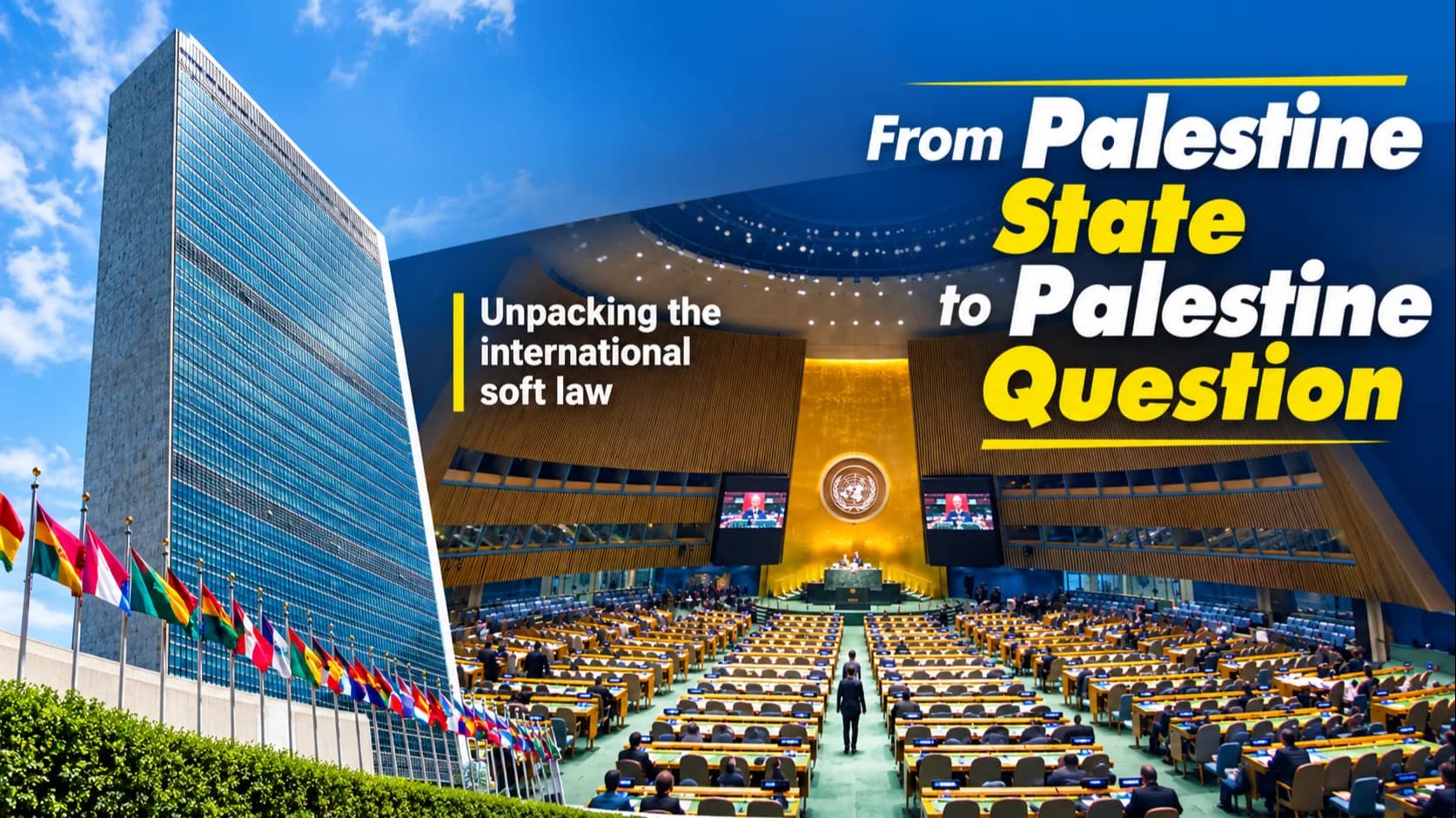
Summary. From Palestine State to Palestine Question
With geopolitics in flux, declining multilateralism and a doubtful West-led international legal order, the United Nations Security Council (UNSC) passed a Resolution (2803(2025)) on 17th November 2025 that raised more questions than it answered. Some of the more legalistic questions were:
What is the place of UNSC resolutions in international law?
What is the fate of the earlier UNSC resolutions vis-à-vis the latest one?
Is the nature of the latest UNSC Resolution binding or is it non-binding?
What is the future of the health of multilateralism?
What about the applicability of international human rights and international humanitarian law to the atrocities carried out in Gaza by Israel?
In addressing these issues indirectly, the instant write-up will try to elucidate and unpack some of the salient features of the UNSC Resolution 2803 by framing these in the following points:
1. Statehood to an Abstract Question
Rudyard Kipling referred to the intoxicating effect of words when he said that 'words are, of course, the most powerful drug used by mankind'. The UNSC Resolution 2803 used the drug of words in a slanting manner; in its second recital, it stated:
“Determining that the situation in the Gaza Strip threatens the regional peace and the security of neighboring states and noting prior relevant Security Council resolutions relating to the situation in the Middle East, including the Palestinian question.”
It linked the situation in Gaza (where unarmed women and children were killed by Israel) as a matter of 'regional peace' (and not to international security and peace), hence watering down the ferociousness of atrocities and aggression by Israel in Gaza that evoked a strong global response. In the same spirit, it used the term 'Palestinian question' instead of the term 'two-state solution' that has its origins in the earlier UNSC resolutions; this has turned a concrete factual matter into an abstract philosophical question!
2. Disengaging with the UN Charter
The UNSC resolutions derive their legality from Article 24 of the UN Charter; Article 24(1) reads:
“In order to ensure prompt and effective action by the United Nations, its Members confer on the Security Council primary responsibility for the maintenance of international peace and security, and agree that in carrying out its duties under this responsibility the Security Council acts on their behalf.”
As stated in the aforementioned article, the 'primary responsibility' of the UNSC is to the extent of 'international peace and security'. Precisely for this reason, predominantly, every UNSC resolution refers to the UN Charter in its recitals. This linkage connects the UNSC resolutions to the Purposes and Principles of the UN as provided in Chapter I of the UN Charter that uphold the principle of sovereign equality and exhort states not to use force or the threat of use of force against a state's territorial integrity and political independence. In diplomatic mannerism and nuances, the omission to refer to the UN Charter in the latest UNSC Resolution is not without consequences.
3. UNSC Resolution as International Soft Law
International law, as a legal order, has had its share of ontological queries from legal scholars in the mid-twentieth century. However, later, owing to the proliferation of international treaties and multilateralism at the international level, the international law firmed up its position. With the unilateralism of Trump 2.0, the old discourse is recurring. The international law, nonetheless, has traditionally been looked upon as a legal order having sources that are outlined in Article 38 of the Statute of the International Court of Justice (ICJ), which is an annex to the UN Charter. The sources of international law link it primarily to treaties and customary international law with 'subsidiary means of determination of rules of international law'. These 'subsidiary means' have many variants, and one of those is the 'soft law' component of international law. Derived from this is the term 'international soft law'. Often the 'voeux' (the comments/views of the states on different subjects addressed to the UN system) and resolutions of the General Assembly and the Security Council are labelled as the international soft law. In this context, the UNSC Resolution 2803 must be interpreted by applying the framework of the international soft law that implies categorizing it as subservient to the treaty law as contained in the international human rights and the international humanitarian law.
Alongside, an important step is to categorize the UNSC Resolution under one of the four chapters (VI, VII, VIII and IX) of the UN as per the textual interpretation of Article 24(2) of the UN Charter. These chapters determine the scope of application and enforcement of a UNSC resolution. As the latest UNSC Resolution does not expressly link it to any of the foregoing Chapters of the UN Charter, it is left open for interpretation to look at its enforcement modalities. Different scholars have, therefore, interpreted it differently. For example, according to the view of Mr. Ahmer Bilal Soofi, President of the Research Society of International Law (RSIL) of Pakistan, presented in his article 'UNSC Resolution on Gaza' published in Dawn on 21st November, 2025, if the latest UNSC Resolution is linked to Chapter VIII of the UN Charter (as it refers to 'regional arrangements'), then it needs a separate authorization from the UNSC for use of force under Article 52 of the UN Charter. Anyhow, these matters are not clarified in the text of the latest UN Resolution; reading it to be covered under Chapter VII (authorizing collective use of force) of the UN Charter, would be reading too much into it. As of now, however, due to the support of the US, it is apparently being treated as a Chapter VII UNSC Resolution.
4. Board of Peace and the Palestine Authority
The Resolution envisages a Board of Peace (BoP) that is to be 'a transitional administration' that will oversee the working of the Palestinian Authority (PA). It may be noted that the genesis of the BoP was in the 20-Point Plan on Gaza (the Plan), which has been agreed to between the US and Israel, and was guaranteed by the Middle East intermediaries. Hamas initially agreed to it, but with the way it evolved in the UNSC (where Russia and China abstained from voting), it distanced itself from it. The BoP has no representation from the parties to the conflict (i.e. Israel and Palestine) and lacks the level of trust that can keep all together; it did not even bother to invite any UN representation in it.
5. Collective Use of Force and the International Stabilization Force
The Resolution is ambiguous, as it provides for a 'temporary' International Stabilization Force (ISF). The composition of the ISF is not clear. The ISF, according to the Resolution, will work with Egypt and Israel. As per the Resolution, the ISF has the following mandate:
a. Secure borders;
b. Demilitarize Gaza;
c. Ensure destruction and prevention of rebuilding of the military, terror and offensive infrastructure;
d. Stabilize the security environment; and
e. Train, and provide support to, the vetted Palestinian Police Force.
The ISF is expected to use force, and its authorization is assumed to be based on Chapter VII of the UN Charter. Interestingly, the ISF will not be part of the peacekeeping contingent, which has UN signature on it.
6. Establishment of Palestinian Police Force (PPF)
The Resolution also provides for the establishment of the Palestinian Police Force, which shall ostensibly be responsible for policing within Gaza and shall work closely with the ISF. The composition of PPF is as sketchy as that of the ISF.
7. War Crimes, Illegal Occupation and Earlier UNSC Resolutions
The Resolution is silent about Israel's war crimes, its illegal occupation, earlier UNSC resolutions against Israel and the judgements and opinions rendered by the ICJ that require Israel to follow the international humanitarian law. The silence amounts to unilaterally reneging on the international legal obligations of the international community and will only result in dismantling the multilateral system sooner rather than later.
The latest UNSC Resolution has shown the vulnerabilities of the UN system and its capture by the West. It has further weakened the multilateral system and its legal order and shown how the vested interests upend the normative values that have been set over in space of seven decades by the international community. With the imposed 28-Point Peace Plan for Ukraine-Russia by the US, as rolled out on 22nd November 2025, in which all is being conceded to Russia, and which has polarized the West, the emerging worldview is not very optimistic and more bellicose than diplomacy is expected.
The author is an independent researcher and has done
his BCL from the University of Oxford.
Email: kamranadilpsp@gmail.com
I. Introduction
· Geopolitical instability and declining multilateralism shape the context of UNSC Resolution 2803 (2025).
· Central issues: its legal status, relation to prior resolutions and implications for Gaza, human rights and international law.
II. Language and Framing
· Resolution shifts from concrete “two-state solution” to the vague “Palestinian question.”
· Describes Gaza as a “regional peace” issue, diluting the scale of Israeli atrocities.
III. Disconnection from the UN Charter
· Omission of Charter references undermines legal grounding and weakens the normative framework of the UNSC.
IV. Soft Law and Legal Ambiguity
· Resolution resembles international soft law with unclear linkage to Charter Chapters (VI–IX).
· Enforcement and use-of-force implications remain disputed.
V. Governance and Security Mechanisms
· Establishment of the Board of Peace, ISF, and Palestinian Police Force, all poorly defined and lacking legitimacy.
VI. Silence on Accountability
· No mention of Israel's war crimes, ICJ rulings or past UNSC obligations.
VII. Conclusion
· Resolution exposes vulnerabilities of multilateralism and growing dominance of power politics.
Topics
The author is an independent researcher and has done his BCL from the University of Oxford.