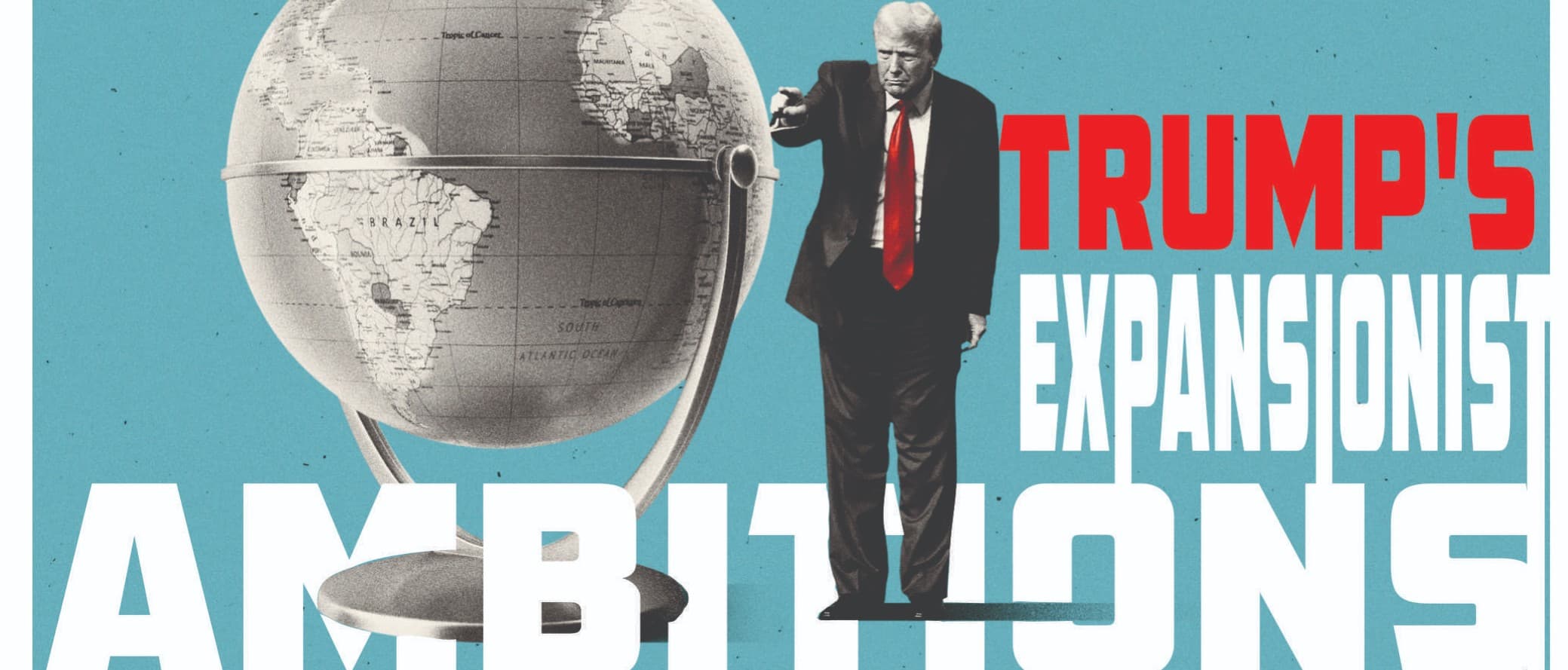
Trump's Expansionist Ambitions

Trump's Expansionist Ambitions

Summary. Neocolonialism is back with a vengeance

With US military special forces' audacious action to invade Venezuela and capture its president Nicolas Maduro, President Trump has unveiled his appalling neocolonialist project, signalling that he is a global 'sheriff' who does not respect any nation's sovereignty and even fundamental human rights. Besides, his intention of annexing Canada as the 51st US state, being at the helm of Board of Peace for Gaza and threatening to take Greenland by whatever means unmask his imperial and neocolonial ambitions of reshaping the world.


Donald Trump, who campaigned on what was seen as an isolationist "America First" platform, defends his policies as advancing US economic and security interests.

But his moves echo the actions of 19th-century colonial powers. His rhetoric seems to hover between fuzzily belligerent and crudely provocative. His actions have jeopardized the peace of the world and brought the world to a point where every powerful country has been given the license to forcibly take over the resources of its weak neighbors. What is more worrying is that Trump has openly expressed his disregard for the international law. In an interview with the New York Times, Trump was asked whether his administration needs to abide by international law on the global stage, he said, “Yeah, I do. You know, I do, but it depends what your definition of international law is. But the answer is, I do. But we have to keep the United States safe. We have to keep parts of the world safe that we feel responsible for.” He even said, “I don't need international law. I'm not looking to hurt people. I'm not looking to kill people.”

From Monroe Doctrine to Donroe Doctrine

Trump has taken such a belligerent position through his Donroe Doctrine.

Trump has set out to justify the attack launched on Venezuela and Washington imposing its will in Latin America by citing a policy from a 19th-century president. In a triumphant news conference following the capture of Venezuelan President, he called the raid an update to the Monroe Doctrine, the 1823 declaration by the fifth US president, James Monroe, adding that the US will “run the country” until “a safe, proper and judicious transition” could be carried out.

a. Monroe Doctrine

The Monroe Doctrine, articulated by US President James Monroe (the fifth president of the United States and the last of the Founding Fathers) in 1823, is a significant US foreign policy statement aimed at preventing European intervention in the Americas.

Primarily the work of Secretary of State John Quincy Adams, the Monroe Doctrine forbade European interference in the American hemisphere but also asserted US neutrality in regard to future European conflicts.

“The American continents, by the free and independent condition which they have assumed and maintain, are henceforth not to be considered as subjects for future colonization by any European powers,” Monroe said.

The origins of the Monroe Doctrine stem from attempts by several European powers to reassert their influence in the Americas in the early 1820s.

In North America, Russia had attempted to expand its influence in the Alaska territory, and in Central and South America, the US government feared a Spanish colonial resurgence.

Britain too was actively seeking a major role in the political and economic future of the Americas, and Adams feared a subservient role for the United States in an Anglo-American alliance.

The United States invoked the Monroe Doctrine to defend its increasingly imperialistic role in the Americas in the mid-19th century.

However, it was not until the Spanish-American War in 1898 that the United States declared against a European power over its interference in the American hemisphere.

The doctrine has had lasting impacts on US relations with its southern neighbors, reflecting America's desire to assert its influence while advocating for independence and self-determination in the region.

The isolationist position of the Monroe Doctrine was also a cornerstone of US foreign policy in the 19th century.

It took the two world wars of the 20th century to draw a hesitant America into its new role as a major global power.

b. Donroe Doctrine

The Donroe Doctrine, a Trump corollary to Monroe Doctrine, represents a shift from indirect influence to explicit guardianship by the US over the Western Hemisphere. It has three key elements:

a. Reassertion of a Sphere of Influence:

The Western Hemisphere is treated as a privileged security space where external actors are viewed as intruders.

Latin America is considered “our neighborhood,” and external engagement is seen as a trespass.

b. Securitization

Issues like migration, narcotics, organized crime and energy volatility are reframed as national security threats.

This allows for the use of coercive tools and blurs the lines between domestic governance in another state and US internal security.

Diplomacy and development are replaced by homeland protection.

c. Shift in Normative Language

Democracy promotion is no longer central.

Stability, predictability and control take precedence.

This operationalizes the US National Security Strategy, focusing on competition with major powers, control of strategic resources and management of instability close to home.

The neocolonial “Donroe Doctrine,” is a clumsy reference to the Monroe Doctrine which was originally intended to keep European nations from intervening in the Western Hemisphere. Trump's updated version aims to flush out any foreign presence in the Americas, as outlined in his administration's National Security Strategy 2025.

Trump’s Moves

President Trump's foreign policy moves in his second term under the Donroe Doctrine too speak of his neocolonialist ambitions. He has made a series of controversial moves that have shaken up today's world order, including a military raid that toppled Venezuela's leader and renewed threats to annex Greenland. Here are some of the Trump administration's most significant and controversial international actions:

1. Gaza Governance Proposal

In February 2025, Trump said the US will take over Gaza before gradually dropping that position - which was condemned by the UN as a proposal for "ethnic cleansing" - over the course of the year.

In another proposal, which started a fragile ceasefire in Gaza in October, he said Gaza's ⁠temporary governance will be overseen by a so-called "Board of Peace" of which Trump himself will be the chair. Israel and Hamas signed off on that Trump plan and a UN Security Council resolution authorized that board to establish a temporary international force in Gaza. In essence, the BoP resembles a colonial structure whereby Trump will oversee a foreign territory's governance. UN special adviser on sustainability Jeffrey Sachs called it "imperialism masquerading as a peace process" while multiple UN experts cast it as "regrettably reminiscent of colonial practices."

Analysis

Trump's peace plan for Gaza continues the pattern of foreign control under the guise of peace and development. Though the plan aims to bring stability and rebuilding, it mainly serves the interests of powerful elites and restricts Palestinian independence. Trump characterizes Gaza as a 'tabula rasa' that he would turn into what he calls the 'Riviera of the Middle East'. According to his plan, Gaza will be rebuilt through foreign investment and privatized work while two million Palestinians will be moved to Egypt and Jordan for a “better living condition”.

The Gaza plan transfers control of governance, aid and reconstruction to foreign actors represented by the “Board of Peace”. Much like the trusteeships of the colonies, where powerful states ruled on behalf of the local population, until the latter was ready for self-rule, the plan disguises the management of occupation as peace-building and domination as stability – which is a false agenda.

2. Venezuela Raid and Oil Interest

On his recent raid against Venezuela, Trump said Washington will “run” the country. Now Maduro's former vice president, Delcy Rodriguez, is governing the country as interim president under US oversight. Trump said major US oil companies would move into Venezuela, which has the world's largest oil reserves.

Critics argue Trump's focus on exploiting Venezuelan oil raises questions about his administration's efforts to frame the capture of Maduro as a law-enforcement action aimed at reducing drug trafficking. The UN human rights office says US actions in Venezuela were a violation of international law ... and made the world less safe.

Analysis

What unfolded in Venezuela is naked imperialism. Having ordered the abduction of a sitting head of state and imposed a naval blockade on a sovereign nation, Trump has set another example of might is right. President Trump's press conference, in which he proudly announced that an elected president would be brought handcuffed to New York, is the final nail being driven into the coffin of the UN Charter—a coffin that has been steadily hammered shut in the name of global order. He has made it clear that the Monroe Doctrine is no longer merely a historical term but a practical pillar of American foreign policy. His statement that American dominance over the Western Hemisphere will no longer be questioned effectively demolishes the very concept of sovereignty in international politics.

When a superpower declares that it will govern another country until what it considers a fair transition takes place, the moral authority of international law collapses. From oil to minerals, Venezuela's so-called crime lies in its geography and its vast energy reserves. In light of Trump's actions, it can be argued that after Samuel Huntington's theory of the “Clash of Civilizations,” we are now living in an era defined by a “Clash over Resources.”

President Trump has not even attempted to conceal his interest in Venezuela's mineral wealth. His claim that American companies were plundered and that he will now extract this wealth to compensate the United States represents one of the starkest examples of classic imperialism in its most unapologetic form.

3. Greenland Threat

Trump has repeatedly said Washington must own Greenland, an autonomous part of ⁠the kingdom of Denmark that houses a US airbase, to prevent Russia or China from occupying the strategically located and minerals-rich Arctic territory. He says US ​military's presence there is not enough.

Greenland and Denmark have said that Greenland is not for sale, but ⁠Trump has not ruled out taking it by force.

Analysis

Trump's referring to Greenland as a piece of ice echoes a colonial pattern whereby powerful states dismiss sparsely populated land, ignoring Indigenous ties. It reminisces about one of the long‑standing patterns of colonial powers to apply their own ideas of land ownership to places that were already inhabited, often overlooking established local systems. It's a pattern that reveals a deeper divide — two very different ways of understanding the significance and use of land. Trump believes that it is better to capture the existing apparatus in Greenland and redirect its functions — a form of neocolonialism that maintains the forms of statehood while exercising actual control.

If Trump takes over Greenland, middle powers will be encouraged to apply the theory of dominance in their own backyards. The dangers of allowing disputes about territory or any other issue to be settled through the use of force were already made evident long before the invasion of Ukraine.

Conclusion

President Trump's revival of an expansionist foreign policy—framed around a modern reinterpretation of the Monroe Doctrine—signals an assertive US strategy that could bring more sovereign states under American influence. His “Donroe Doctrine” reflects a willingness to use military power and political pressure throughout the Western Hemisphere and beyond. From Gaza to Venezuela to Greenland, the pattern is consistent: sovereignty becomes conditional, international law becomes elastic and strategic resources become the ultimate arbiter of legitimacy. The danger lies not only in the immediate crises these moves provoke, but in the long-term signal they send—that might confers right, and that global rules apply only when convenient. In such an environment, middle and rising powers will feel emboldened to assert dominance in their own regions, multiplying conflicts and accelerating geopolitical fragmentation.

The writer holds a master's degree in

international relations.

Read more on Exam Pack or related topics

About the Author