Print subscription includes a free wall-size coloured map.Special offer: Subscribe Now (Print) and Get Free Wall Size Coloured Map!Subscribe Now
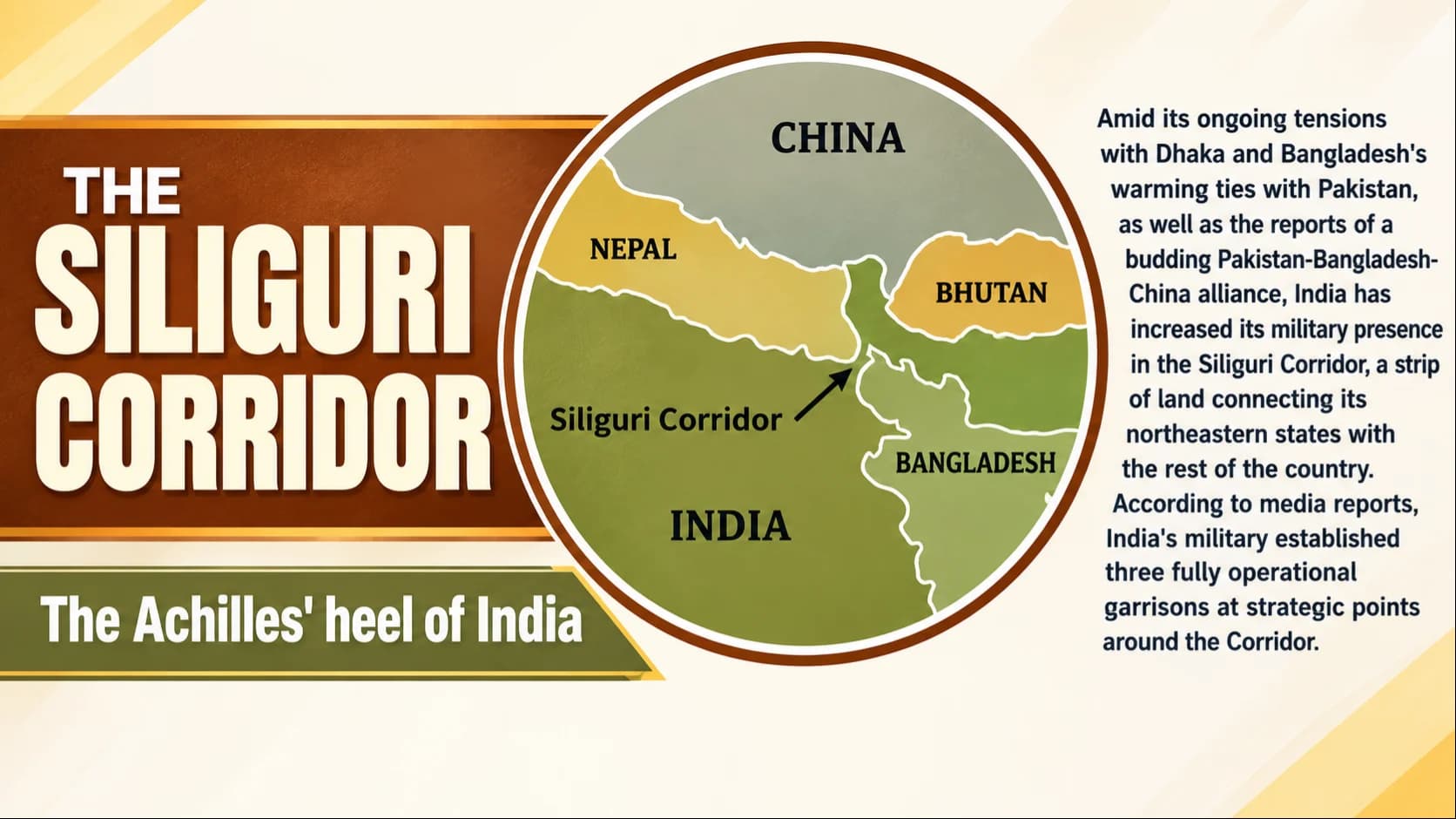
Amid its ongoing tensions with Dhaka and Bangladesh's warming ties with Pakistan, as well as the reports of a budding Pakistan-Bangladesh-China alliance, India has increased its military presence in the Siliguri Corridor, a strip of land connecting its northeastern states with the rest of the country. According to media reports, India's military established three fully operational garrisons at strategic points around the Corridor.
After losing the four-day war with Pakistan in May 2025, and amidst its deteriorating relations with Bangladesh since the ouster of Sheikh Hasina Wajed, as well as China's growing presence near its borders, India seems alarmed and in panic mode too. Out of strategic concerns and national insecurity, India is building up military presence in the Siliguri Corridor in North Bengal, also called the 'Chicken's Neck'—India's 22-km-wide and 60-km-long land bridge linking the mainland to its Northeastern states.
At first glance, the Siliguri Corridor appears unremarkable: a slender strip of land, barely wide enough to register on a map of India. Yet within this fragile passage lies a paradox. Too narrow to inspire confidence and too essential to ignore, this “Chicken's Neck” is both India's lifeline to its northeast and its most perilous vulnerability.
Before delving into the deep-seated importance of the corridor, it is necessary to become familiarized with its geography.
First of all, what's rather interesting is that the Corridor itself is merely a tiny stretch of land. It extends at around 60 kilometres in length and almost 22 kilometres in width, all the while even reducing to 17 kilometres in certain places of the corridor. It is called the 'Chicken's Neck' due to its narrow resemblance to a chicken's neck.
Hemmed in by the frontiers of Nepal, Bhutan and Bangladesh, and overshadowed by China's Chumbi Valley, the corridor embodies the uneasy coexistence of indispensability and fragility.
It is a very important strategic area of eastern India, located between Mahananda and Teesta rivers.
The Siliguri Corridor is strategically important and highly sensitive territory for India, as it remains the only bridge between northeastern states and the rest of the country. It connects India's mainland to its northeastern states, known as the Seven Sisters.
The region is important for trade, commerce and tourism for West Bengal, Sikkim, Assam, Nepal, Bhutan and Bangladesh. All land trade between the northeastern states and the rest of the country happens through this corridor. The corridor is the hub of a rail and road network connecting West Bengal and the rest of India to the northeast, including Assam, Nagaland and Sikkim.
It is also the hub of the railway network that connects to the strategic military formations along the Line of Actual Control (LAC). From the New Jalpaiguri (NJP) railway station, different rail links emerge to connect the three important military formations located right opposite China. From the NJP station, a rail link moves towards Guwahati in Assam. It is from here that a road network moves towards the strategically important Tawang town in Arunachal Pradesh.
The geography of the Siliguri Corridor is often dismissed as a mere cartographic anomaly. Yet, these lines are not abstract for India; they pulsate with tension, history and the relentless churn of geopolitics.
The vulnerability for India stems from the fact that if this corridor is cut off by Bangladesh or other countries inimical to India, it would cut off India's northeast from the mainland.
If, under any circumstance, China ever blocks off the corridor, it will have a catastrophic impact on India. This will disconnect the region from the entirety of India and cut off the supply lines and reinforcements reaching the area, impairing India in times of any form of confrontation.
o This will also cut-off India's supervision in the region and lay the ground for further insurgent and separatist movements.
This geography presents two realities at once:
First, the corridor is indispensable: it is the only land link that ties the northeast to the rest of India. More than 40 million people depend on it for their daily goods, services and connection to the wider country.
Second, it is fragile: because the passage is so narrow and hemmed in by foreign borders, any disruption, whether by military conflict, political blockade or natural disaster, could cut the northeast off entirely.
Unlike other regions that may have multiple routes of access, the northeast's reliance on this single chokepoint makes the Siliguri Corridor uniquely critical and uniquely exposed. This combination (indispensability and fragility) is what makes the corridor one of India's greatest structural vulnerabilities. It is not simply a matter of topography; it is the foundation on which both India's territorial integrity and its ability to govern the northeast rest.
This narrow passage is not just a transportation artery but a strategic lifeline, a vulnerability and now, the very fulcrum upon which great-power ambitions pivot.
China is tightening its grip across the Himalayas and the Bay of Bengal, employing a strategy of meticulous, expansive influence—a grandmaster playing patiently and methodically. The Doklam crisis revealed Beijing's objective: positional advantage. This pursuit manifests in the strategic use of infrastructure, where roads, airstrips and “civilian projects” serve a military shadow function.
India is concerned over China's involvement in redeveloping the Lalmonirhat airfield in Bangladesh. Barely a breath away from India's border, Lalmonirhat secures a vantage point offering potential intelligence visibility and surveillance reach into India's Eastern Air Command, which houses some of the Indian Air Force's most advanced assets, including frontline fighters, missile systems and integrated air-defence grids. A dual-use facility so close to such critical infrastructure is a clear strategic signal. Beijing understands the strategic leverage of the northeast, and it is positioning itself around it.
The United States views the Bay of Bengal through the lens of its broader Indo-Pacific contest, creating a complex dynamic with India. Washington's recent diplomatic signalling, including pressuring Bangladesh while simultaneously warming up to Pakistan, suggests a worrying future for India. Furthermore, the US's long-standing aspiration for access to St John's Island, a critical node for monitoring the eastern Indian Ocean, reveals a core divergence in strategic imperatives. While Washington seeks an enduring forward presence to project power and contain rivals, this ambition undermines India's aspiration for being a hegemon in the region.
Although Pakistan is not physically in the corridor, its growing influence in Bangladesh raises fears of coordinated efforts against Indian interests. The recent pivot of Bangladesh towards China and Pakistan in both rhetoric and practice to court investment and defence collaboration has thrown India off-kilter.
The writer is a student at KEMU, Lahore.
Topics
The writer is a student at KEMU, Lahore.