

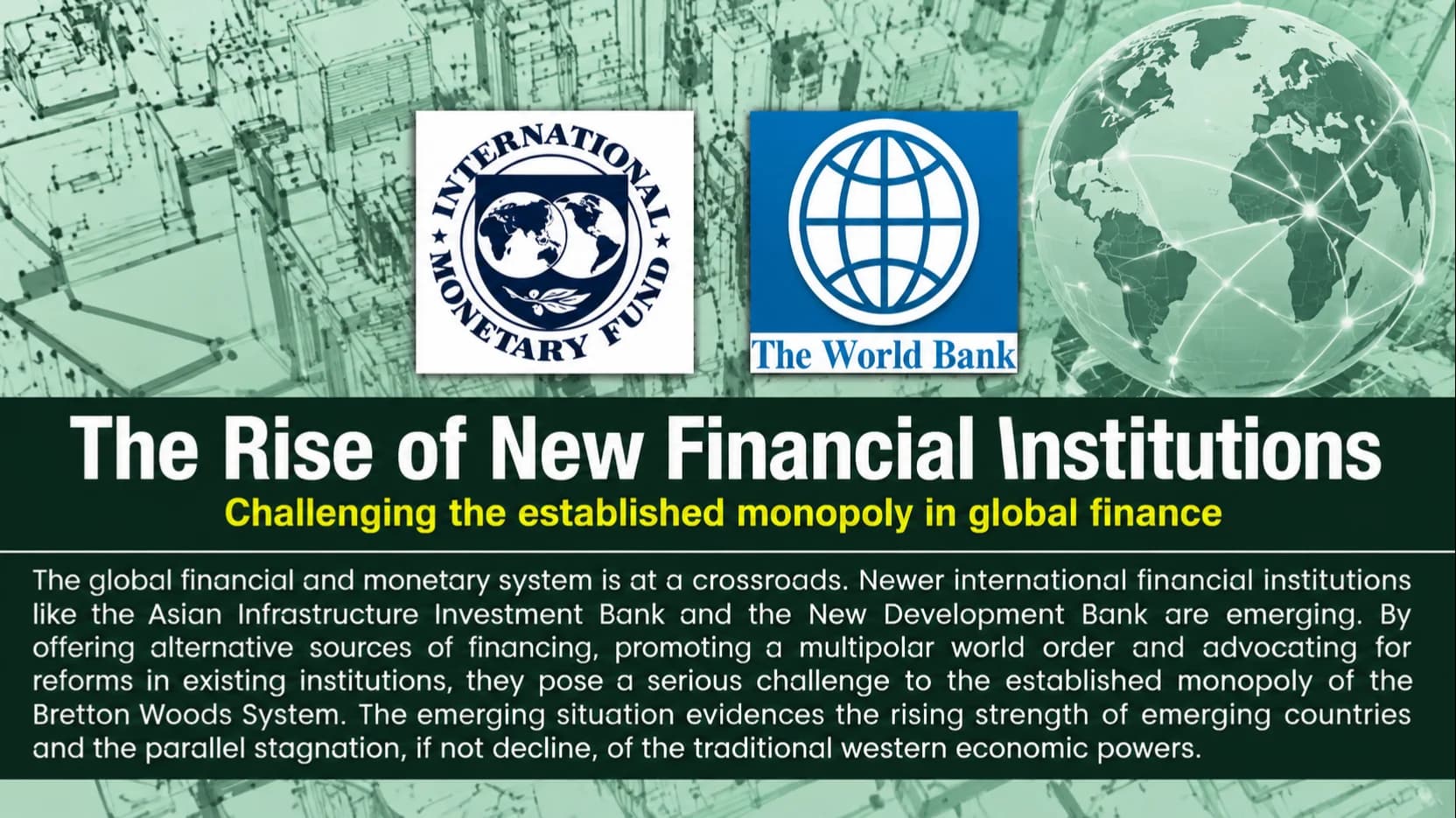
On December 27, the International Monetary Fund (IMF) and the International Bank for Reconstruction and Development (IBRD), a part of the World Bank, mark their 80th anniversary. These institutions emerged as central components of the Bretton Woods System (BWS), orchestrated by the United States post-World War II to stabilize global financial interactions, spur economic growth in nations recovering from war and reinforce American financial supremacy in the new world order.
The BWS saw its collapse when the US departed from a fixed gold standard for currency; however, the IMF and IBRD not only endured this upheaval but also rose to greater significance by the late 20th century. They contributed to the "Washington Consensus," advocating for principles of market fundamentalism — such as trade and financial liberalization, aggressive privatization and stringent measures to combat inflation and budget deficits — that served as catalysts for globalization at the turn of the millennium. Despite their credibility and influence, these institutions exhibited inherent weaknesses, facing criticism for maintaining politically charged frameworks that allegedly favored US foreign policy goals under the guise of political neutrality.
Amidst evolving global power dynamics, there have been increasing calls for a more inclusive and democratic international financial system. Since 2000, the IMF has undergone two significant quota reforms transferring voting shares from developed nations to emerging economies, although the US retains substantial leverage, holding approximately 17% of IMF shares — nearly three times that of China. Similarly, issues of influence and control persist within the IBRD.
Concurrently, emerging economic powers have begun exploring alternative multilateral mechanisms, leading to the establishment of entities like the New Development Bank and the BRICS Contingent Reserve Arrangement. Moreover, the Shanghai Cooperation Organisation has initiated plans for a new development bank aimed at providing financing outside the US dollar framework, potentially utilizing the renminbi to mitigate risks associated with sanctions and US dollar fluctuations.
These newer institutions, though currently modest and unstable, are already contesting the historical dominance of traditional financial entities by offering viable alternatives for state borrowing and project financing. The established financial institutions are unlikely to disappear in the immediate future; however, their former unparalleled status is unlikely to be restored. They may continue to play a role within the global financial architecture but will no longer monopolize the regulatory landscape. This shift is anticipated to yield benefits across the global spectrum.
The writer is a CSS aspirant.