Print subscription includes a free wall-size coloured map.Special offer: Subscribe Now (Print) and Get Free Wall Size Coloured Map!Subscribe Now
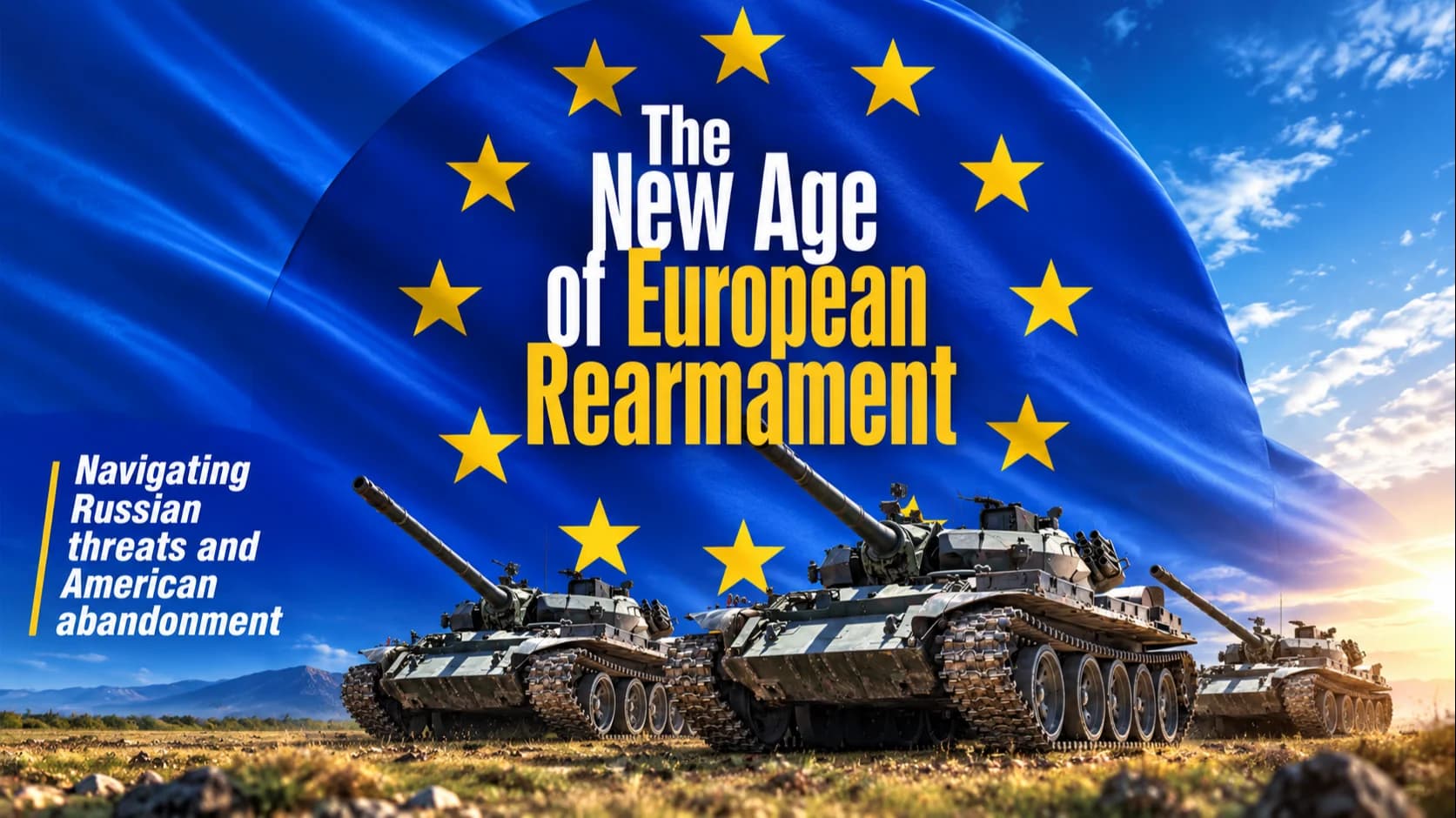
Summary. Navigating Russian threats and American abandonment
The clouds of uncertainty are hovering over Europe, as the continent faces a grave challenge in defending itself. The preparations for spending more on defence have dramatically increased, and the arrival of the Trump 2.0 administration has further complicated matters for Europe. His unpredictable policies have left European nations uncertain about their future security. So, the constant Russian threat and the fear of abandonment by the United States have compelled European countries to draw up policies to defend themselves on their own in the current turbulent world order, where force remains the first priority of nations. In this context, the instant piece of writing will discuss the rearming of Europe, the consequences for social welfare and other potential implications for the continent and beyond.
The thought of rearming Europe first came in 2014 when Russia annexed the Ukrainian territory of Crimea. But the unity of Europe, led by the US-led military alliance, the North Atlantic Treaty Organization (NATO), proved efficient in winning the trust of its allies. That trust witnessed a low blow by the arrival of Donald J. Trump in January 2025. His nationalistic, America-First policies caused widespread uncertainty among European nations over their future security. His constant threats of abandonment to NATO members have sent shockwaves throughout Europe. This gave thought to the European countries, particularly the E3 – France, Germany and the United Kingdom (UK) – to militarize the continent.
Previously, the European countries, under President Joe Biden, witnessed friendly ties with the United States. The Biden administration bolstered its defence, economic and social ties with Europe. He also poured billions of dollars into NATO to defend its European allies. The Biden administration also went a step ahead in helping non-NATO member Ukraine, allocating several billion dollars to the country to defend itself against the Russian incursion. As of now, Washington appears to take sides with Moscow in the current talks of a possible ceasefire between Russia and Ukraine. The ceasefire compels Kyiv to cede territories captured by Moscow and pledge not to join NATO in the foreseeable future. Such proposals have further intensified the talks of rearmament in most European capitals.
In this context, the US no longer seems to be a reliable ally in the present-day world order. There is acute uncertainty in the current US administration. Anytime, a disastrous step can be taken by Trump that could cause irreparable damage to European security. To cope with it, the European leaders launched a program in March 2025 to rearm Europe by 2030. The leaders voted to spend €800 billion on defence-related components, and also pledged to spend 3.5% of their respective GDPs on military-related investments. Moreover, to further curtail reliance on the US, the European defence-related companies are eager to completely replace the American companies – Their shares increased dramatically, fostering hope in the ability of European companies.
If we take a look at the history of Europe when it was heavily armed, we find several traumatic events where destruction, death and famine ruled the continent. From the fatal Thirty Years' War – a series of wars between various Protestant and Catholic states in the fragmented Holy Roman Empire between 1618 and 1648 – to the Napoleonic conquests, and from the horrific World War I to the deadliest World War II, the Europeans had lost millions of lives. These distressing events occurred only due to the heavy militarization of Europe and the nationalistic policies of certain European nations like Germany, France and Italy, as well as the Ottoman Empire. After such destruction, the continent began stabilizing with the Marshall Plan initiated by the US. Realizing the past agony of wars, the European nations excessively reduced their military expenditures to 4% of their GDP in the 1960s, further curtailing them to below 2% at the beginning of the 21st century.
At present, almost all the countries in Europe, except Russia, are pure democratic ones. They are greatly integrated via one of the most successful regional organizations, the European Union (EU). Currently, the EU is the best case study for regional cooperation and beyond. Almost every member state has the same privileges of social welfare. Every country, regardless of its population and culture, receives the same amount of benefits in the crucial fields of science, health, education and transportation. The ordinary Europeans are ignorant of the military adventurism, but are aware of the current turbulent geopolitical shifts. They are leading Europe towards militarization. This shift could massively affect the social welfare of the region. The heavy military expenditures that the leaders have vowed will significantly reduce social spending and other welfare-related approaches.
It is evident from the above discussion that Europe is currently facing the burden of defending itself on its own in case a war-like situation arises. The growing power of Russia under Vladimir Putin – the most powerful president in Russia's near history – and the mounting uncertainty from the incumbent US administration have left no option for the continent but of rearmament. Europe is deadlocked now, as both options can severely affect it. Either it completely relies on the US or rearms itself, there will be far-reaching repercussions.
The writer is a Larkana-based law student having a keen interest in International Relations.
He can be reached at shehzadbroheee@gmail.com
NATO, the transatlantic alliance uniting 32 countries, was founded in 1949 to deter Soviet aggression. Seventy-six years on, its role remains central but increasingly contested. With the war in Ukraine reshaping Europe's security landscape and growing calls to admit Ukraine into the alliance, NATO faces one of its toughest tests yet.
US President Donald Trump's criticism of uneven defence spending and his warmer stance toward Russia have raised concerns about American commitment. As geopolitical tensions rise, NATO stands at a pivotal moment: preserve unity or risk fracturing under pressure.
As NATO navigates war, politics and internal tensions, the question remains: can the world's most powerful military alliance stay united, or if it unravels, what might the global balance look like next?
The United States is NATO's dominant force, outspending all allies on defence and commanding the largest military presence. With this influence, Washington largely shapes the alliance's priorities and direction. Trump's friendly approach to Putin and sidelining of Zelenskyy have fuelled European doubts about America's dedication to NATO, raising questions about the alliance's future without strong US leadership.
At a recent meeting with nearly 50 of Ukraine's Western supporters, Peter Hegseth, the US Secretary of Defense since 2025, stated plainly that “stark strategic realities” mean the US can no longer prioritize Europe's security above all else, raising doubts about America's full commitment to NATO's collective defence pledge, though he reassured that the US has no plans to leave the alliance. “Now is the time to invest,” Hegseth urged, warning that Europe shouldn't assume America's military presence will be permanent and must prepare to take more responsibility for its own security.
Admiral James Stavridis, NATO's former Europe commander, recently warned that NATO may be nearing its end, framing the alliance's future as a clear choice between standing with a democracy under attack or siding with Moscow's dictatorship. He suggested we might be seeing the “last days” of the alliance and the rise of a new “European Treaty Organization” to take its place.
Topics