Print subscription includes a free wall-size coloured map.Special offer: Subscribe Now (Print) and Get Free Wall Size Coloured Map!Subscribe Now
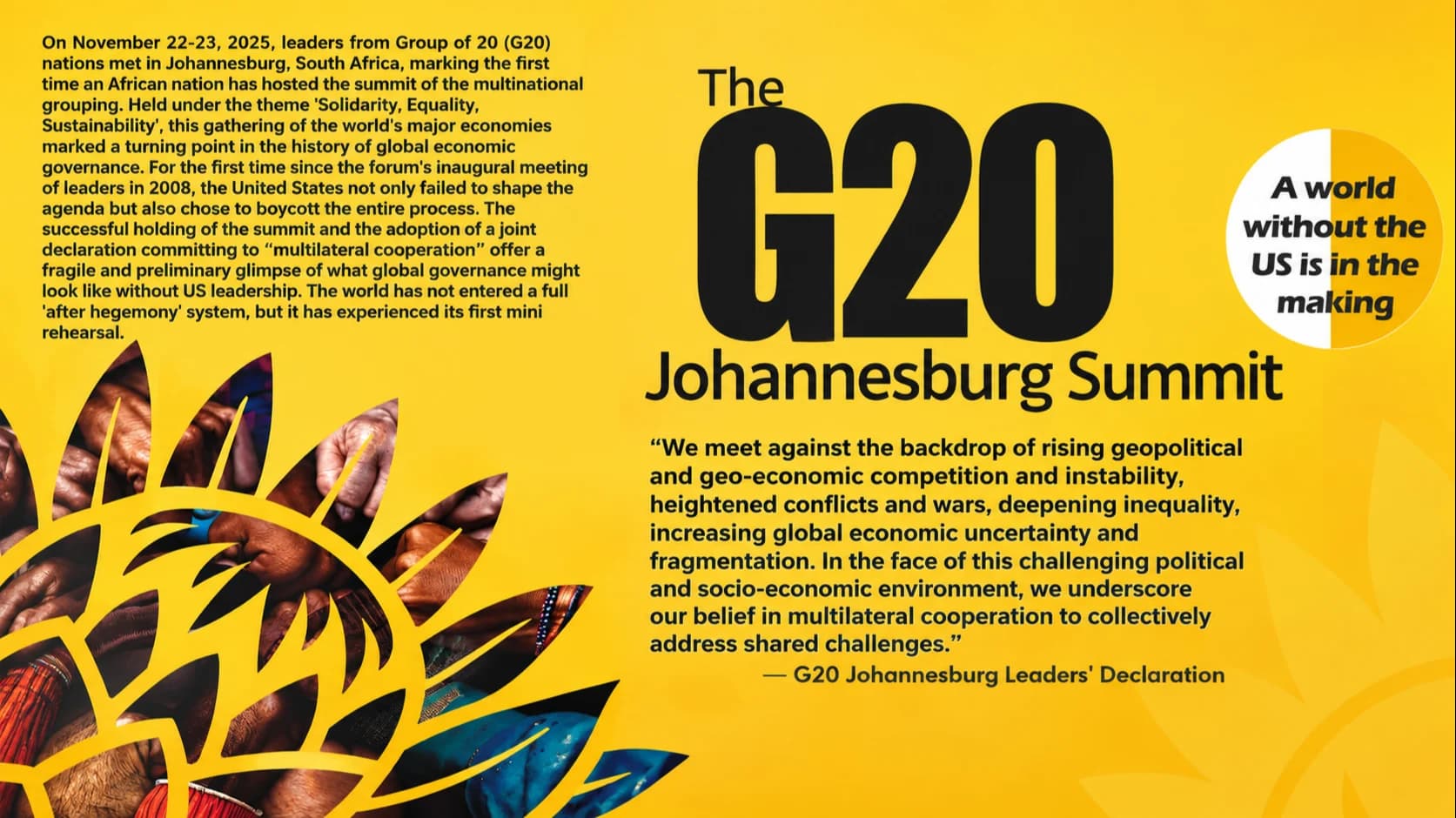
Summary. “We meet against the backdrop of rising geopolitical and geo-economic competition and instability, heightened conflicts and wars, deepening inequality, increasing global economic uncertainty and fragmentation. In the face of this challenging political and socio-economic environment, we underscore our belief in multilateral cooperation to collectively address shared challenges.” — G20 Johannesburg Leaders' Declaration
On November 22-23, 2025, leaders from Group of 20 (G20) nations met in Johannesburg, South Africa, marking the first time an African nation has hosted the summit of the multinational grouping. Held under the theme 'Solidarity, Equality, Sustainability', this gathering of the world's major economies marked a turning point in the history of global economic governance. For the first time since the forum's inaugural meeting of leaders in 2008, the United States not only failed to shape the agenda but also chose to boycott the entire process. The successful holding of the summit and the adoption of a joint declaration committing to "multilateral cooperation" offer a fragile and preliminary glimpse of what global governance might look like without US leadership. The world has not entered a full 'after hegemony' system, but it has experienced its first mini rehearsal.
South Africa became the venue of this year's Group of Twenty (G20) Summit, where 19 countries and 2 regional organizations gathered with a focus on helping developing economies adapt to the climate crisis, transition to clean energy and cut excessive debt and to discuss the issues of global governance.
This year's meeting garnered much world attention not just for taking historic decisions but also for the conspicuous absence of the United States from the forum. President Donald Trump refused to attend, justifying his absence with the fabricated claim that 'Afrikaners are being killed' in South Africa, and attempted to downgrade the summit by insisting that the host country hold a handover ceremony with a junior US diplomat. The vacuum created by the United States was taken in limelight by the global media and geopolitical analysts, but one thing makes it clear: the world has become so integrated in this multipolar order that the absence of any single power doesn't make a difference at all. That is why the South African president, Cyril Ramaphosa, encouraged by the other members of the G20, declined to bow to US pressure. Rather than yielding, he even 'dared' to issue a G20 Leaders' Declaration without the consent of the White House. This moment showed that multilateralism can survive without the US.
Gone are the days when global decisions were taken behind closed doors; multipolarity and multilateralism have now become the guiding light for the global community. The absence of the United States from this G20 summit makes it clear how the country has been isolated under Trump 2.0. The same event was once done in the name of the US, as it dominated the entire event, but this year not a single US delegate participated in the summit – and the world didn't stop. Moreover, the reason given by Trump for not participating was that South Africa had been maltreating, harassing and killing its white population of American, British, French and European origin. This illogical reason made a mockery of global diplomacy.
Although Washington was absent, the summit made some great decisions – all without the United States. The prominent development of the summit was that Africa achieved its long-awaited elevation as a permanent member of the bloc. Moreover, the summit also adopted the Global Debt Relief Framework 2.0 for the restructuring of debt for the developing nations. The group also did tremendous work by agreeing on the code of conduct for artificial intelligence, AI development, data transparency, cyber security protocols and cross-border data flow. Above all, the most visionary outcome of this summit was the creation of the $120 billion Green Energy Transition Fund, which aims at helping developing and least-developed countries to transition from fossil fuels to clean energy.
Although the US’s absence made global analysts ponder about the successful conduct of the summit, it really went successfully, and for the first time, the G20 showed that global governance can be done even if the United States chooses not to lead. The absence of the US did nothing to the multipolar world order; it rather diminished its role as a key player in taking decisions of global governance. Under Trump 2.0, America is already out of the Paris Agreement and many other UN-aligned organizations. Moreover, global geopolitical analysts and economists have also voiced concerns about the receding role of the US dollar in the global economy. Also, the United States is currently grappling with rising authoritarianism under Trump, its economy is being crushed under heavy debt burden, the US government has witnessed its worst-ever shutdown, inflation and unemployment have also skyrocketed, and the problem of immigrants is also unfolding. Amid these conditions, Trump's erratic foreign policy decisions are making America more isolated in the new world order. Thus, the G20 Summit broke the myth of the United States' geopolitical invincibility. The world has changed drastically; new powers have taken the global seat and the room for a monopoly of a single state has been closed.
Declaration Adoption
The 122-point G20 Leaders' Declaration was adopted on the summit's opening day, reflecting an effective early-consensus strategy by South African negotiators. This ensured timely agreement on priorities such as sustainable development, global equity and multilateral reform.
Mission 300: Transformative Energy Access
One of the outcomes was advancement of Mission 300, a joint World Bank and African Development Bank initiative aiming to connect 300 million people in Sub Saharan Africa to electricity by 2030. The project requires an estimated 30 billion dollars in public funding to catalyze an additional 90 billion in private investment. The summit served as a pledging conference, with commitments from European nations.
Climate Finance and Development
The declaration recognized the need to mobilize at least 1.3 trillion dollars by 2035 for developing countries to meet Paris Agreement goals. This "billions to trillions" shift represents acknowledgment that current climate finance flows are inadequate. The summit emphasized adaptation finance and operationalization of the Loss and Damage Fund to assist vulnerable nations.
Debt Crisis and Financial Architecture Reform
African nations face a sovereign debt crisis with public debt reaching 1.8 trillion dollars and annual servicing costs of 163 billion. 57 percent of Africans live in countries spending more on debt interest than healthcare or education. The summit launched a Cost of Capital Commission to reform credit rating methodologies and address the "African risk premium."
Topics