Print subscription includes a free wall-size coloured map.Special offer: Subscribe Now (Print) and Get Free Wall Size Coloured Map!Subscribe Now
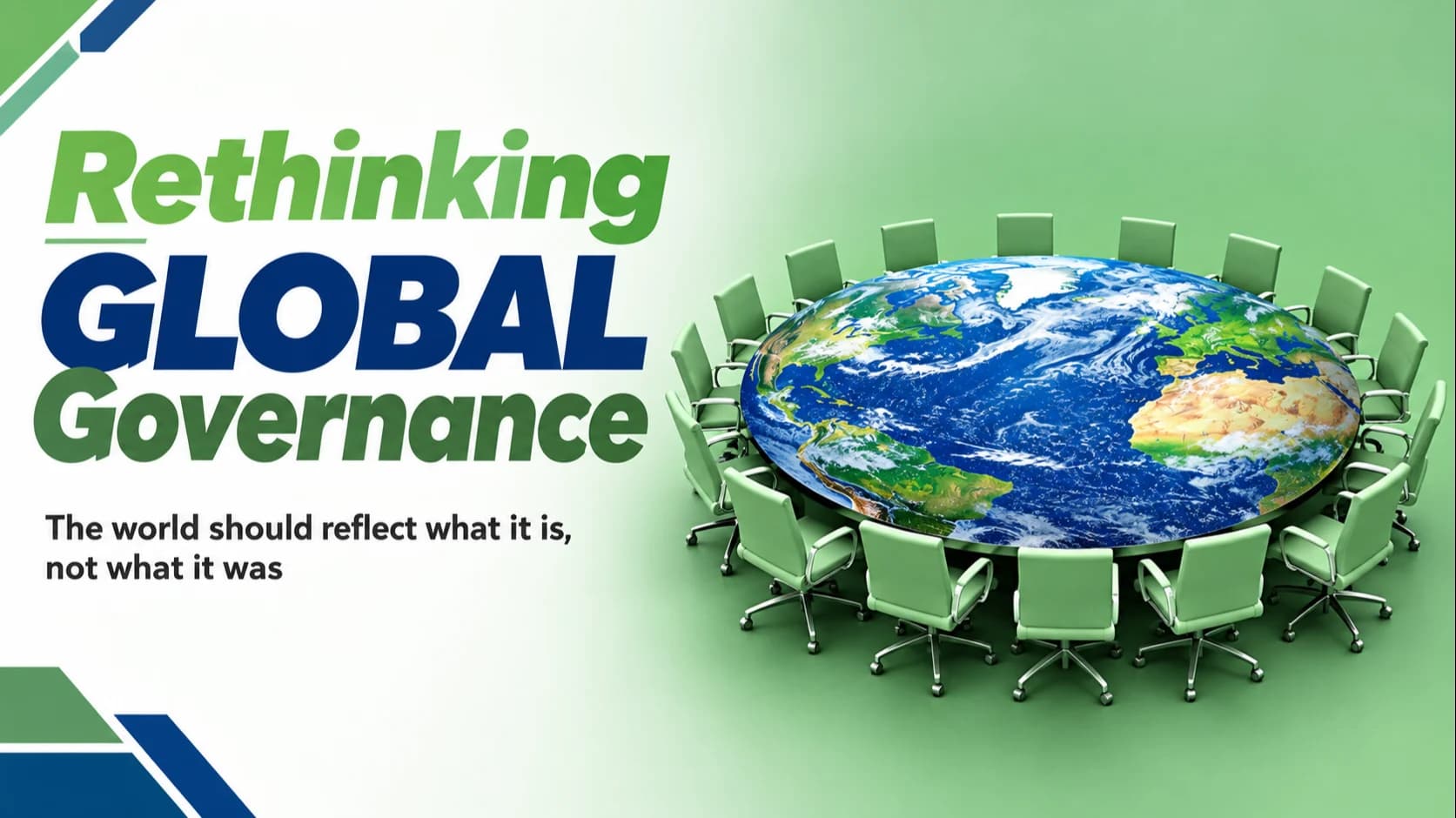
Summary. The world should reflect what it is, not what it was
The world has entered the year 2026 at a time when the global order is more fractured than ever and humanity stands at an inflection point. We are mired in several crises in political, economic, technological, ecological and civilizational realms. The existing global security architecture is in crisis, with mechanisms such as the UN Security Council and arms control frameworks losing effectiveness. Moreover, the tectonic plates of global power are shifting and the US-led postwar order is eroding without a clear successor. The world is experiencing a period of geopolitical flux. The old global rules no longer function effectively, while new norms have yet to take shape. There is a real sense that we are in a moment of transition.
The global governance architecture, rooted in post-World War structures, is fragmented and untidy, and also increasingly out of sync with contemporary political, economic and demographic realities. The very institutions created to preserve peace, facilitate cooperation and promote development are now viewed as outdated, unrepresentative and often ineffective. Support for traditional international institutions such as the UN and the WTO is weakening in the Global North as well as the Global South.
In addition, a combination of deglobalization dynamics, rising multipolarity, environmental urgency and digital transformation is reshaping the architecture of international economic relations. The return of strategic trade competition, evident in the US-China decoupling and the emergence of industrial policy tools in the Global North, poses significant challenges to the Global South. At the same time, emerging markets are increasingly expected to comply with new standards related to environmental sustainability, labor rights and digital governance in order to access key export markets.
While Samuel Huntington's “clash of civilizations” continues to echo, today's global divisions are far more layered. Instead of a simple East vs. West binary, the world today faces a complex multipolar environment, divided by divergent political systems, economic interests, technological development and environmental vulnerabilities.
The winners of World War II laid the foundations of current global governance. Institutions like the United Nations (UN), the World Bank and the International Monetary Fund (IMF) were created to shape a stable and rules-based international order, reflecting the realities of the post-World War II era. While these organizations managed to keep the world relatively peaceful for 80-odd years, it is increasingly failing to do so. One particular reason behind its failure is its outdated structure, where a handful of powerful states decide for the entire planet.
Indeed, the UN Security Council, the central body for maintaining international peace and security, still reflects the power dynamics of 1945. The veto-wielding permanent members (P5) — the US, UK, France, Russia and China — frequently paralyze the Council when their interests clash. In wars in Palestine, Syria, Ukraine, Myanmar, Sudan and elsewhere, the UN has failed to prevent conflicts. Instead of serving as a guardian of peace, the UN is often seen as a stage for geopolitical posturing.
The problem isn’t only about inaction; it’s also about representation. Paradoxically, while over half of the Security Council's agenda concerns African conflicts, no African nation holds a permanent seat. The same imbalance persists at the IMF and World Bank, where voting power remains skewed in favour of wealthy nations.
As the Western-led governance system experiences an incessant erosion of credibility over its own predatory and protectionist policies, leading to more international turbulence and slower global growth, the emergence of BRICS+ and various other minilateral organizations can be attributed to the perceived shortcomings of the UN-led multilateral system. This development calls into question the effectiveness, relevance and representativeness of existing international frameworks. However, this shift toward a multipolar world brings both promise and peril. On the one hand, new formations like BRICS+ offer alternative platforms for countries of the Global South seeking more autonomy in global affairs. On the other hand, these platforms often operate in silos and lack the institutional strength of traditional multilateral systems.
Meanwhile, akin to the bipolar world of the Cold War era, the world is again witnessing two competing models of governance: the US-led market-driven framework versus China's state-led development model. Europe, caught between caution and dependency, leans toward the former while hedging risks. In between lies the Global South, a diverse set of nations navigating between these powers while scrambling to establish their own governance paths. The collective rise of the Global South is the hallmark of a world undergoing a profound transformation. Organizations such as BRICS and the Shanghai Cooperation Organization (SCO) now represent a growing share of the global GDP and population.
Yet, the world's governance architecture grows increasingly out of touch with today's reality. The voice of the Global South remains marginalized in institutions shaped by the post-war West.
At the World Bank, developing countries hold 47% of its voting rights despite accounting for approximately 60% of global GDP in PPP terms and 80% of world's economic growth. At the IMF, the US retains a 16.49% voting share — enough to veto any major decision — while more than 40 sub-Saharan African countries hold less than 5% of the voting share combined.
This disparity is not only statistical. Global attention and funding are channelled to major-power geopolitical competition, while long-term, existential challenges such as climate change, poverty and public health are marginalized. Development financing is diverted to security agendas, sidelining the South's urgent needs for industrialization, infrastructure and job creation.
Rules are written in the North, but the costs are shouldered disproportionately by the South. The unilateral Carbon Border Adjustment Mechanism, for instance, forces developing nations to comply with a complex carbon pricing system, unfairly penalizing their exports and development needs. Another example is the global minimum corporate tax, which undermines the fiscal sovereignty of Global South countries by stripping them of legitimate tools like tax incentives — once used by rich nations themselves.
The failures of current institutions go beyond exclusion. Many multilateral frameworks were created under the assumption of Western primacy and homogeneity. They do not reflect the plural, multilingual, culturally diverse realities of the 21st century.
As the world is experiencing turbulence and great transformation – from widening security gaps to faltering development and governance failures – we are faced with unprecedented risks and challenges. Reform is no longer optional, it is essential.
How could greater balance and equity in the world be fostered? Well, it starts with giving all nations a fair say. All sovereign countries, regardless of size or wealth, are equal members of the international community and are entitled to have a say in decisions that affect everyone. The answer is all too clear: developing countries must have a place at the table.
This means firmly rejecting double standards, cherry-picking, unilateralism and exclusive clubs. It means upholding the international rule of law and the purposes and principles of the UN Charter, as well as empowering the UN to tackle the world's most pressing challenges in development, security, and trust.
What we need is a system that works for everyone, one that bridges the North-South gap and spreads the benefits of global cooperation to all. There must be action-oriented and results-driven solutions to deliver this vision.
The world stands at a governance crossroads. Traditional institutions are losing relevance, while emerging powers are asserting themselves. In these changing realities, the future of global governance will not be decided by reform alone. It will be shaped by those who build new systems from the ground up — systems that are fairer, more inclusive and better suited to the entire world, not just the interests of a few.
The writer is a member of staff.
Topics