Post-Khamenei Order

Post-Khamenei Order

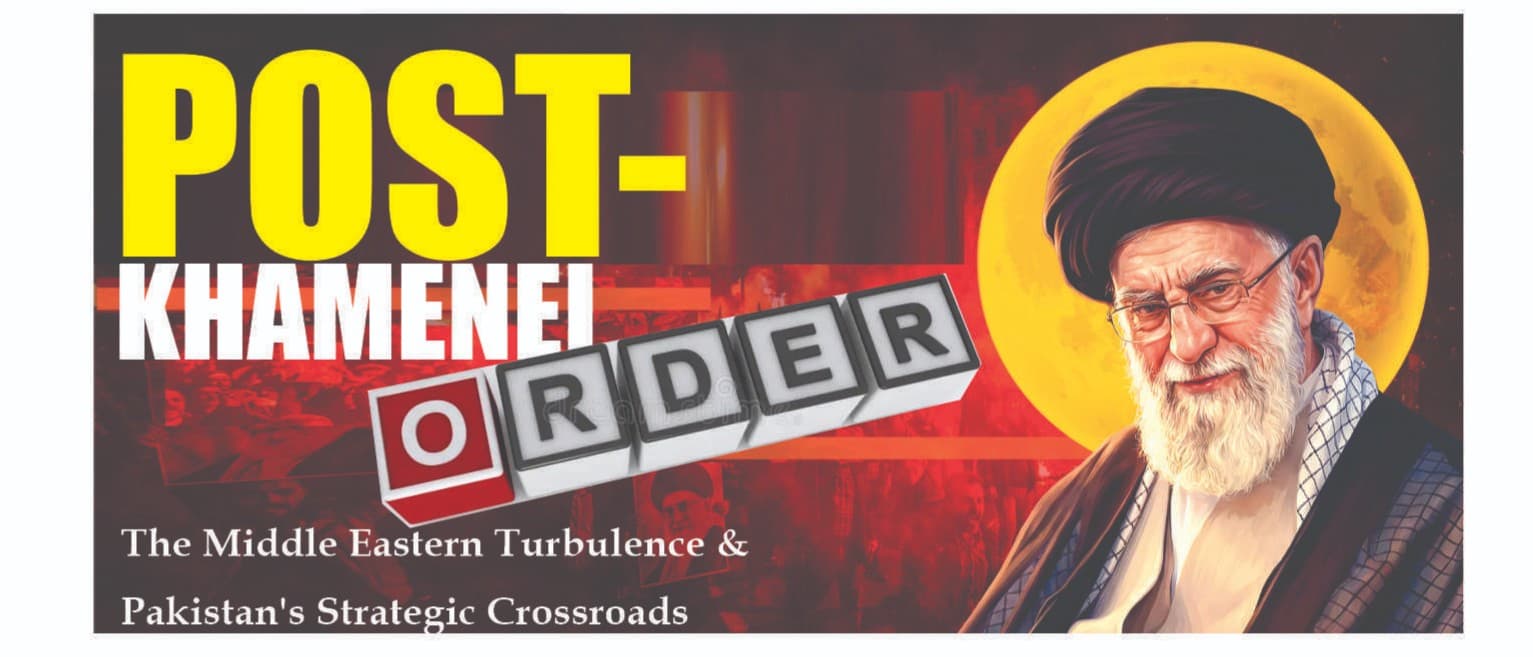
The long-standing confrontation between Iran and Israel has now shifted from a shadow war to an open confrontation. Tensions that escalated after the assassination of General Qasim Soleimani in 2020 and the Hamas–Israel conflict in 2023 intensified further in 2025 when Iran launched Operation True Promise in response to Israel's Operation Rising Lion, triggering a brief but intense twelve-day conflict. The rivalry reflects deeper ideological differences and a broader struggle for influence in the Middle East. The situation took a dramatic turn when the Mossad-CIA alliance reported the killing of Iran's Supreme Leader Ayatollah Ali Khamenei in an airstrike in Tehran on 1 March 2026, raising questions about political stability in Iran and the possibility of regime change. This evolving crisis is likely to reshape regional power dynamics, as it carries significant strategic and geo-economic implications for Pakistan.

The recent open war between Iran and Israel is much more than mere conventional military combat. It rather represents a struggle for substantial dominance in the Middle East. For decades, both actors have been engaged in indirect combat through cyber operations, proxy wars and covert intelligence activities, representing deep ideological and geopolitical rivalry. Iran's widespread Axis of Resistance has sought to expand its regional influence over the past few decades, which has widely been interpreted as an existential threat by Israel. Tehran's growing strategic outreach and nuclear ambitions were no less than a nightmare for Israel's regional dominance. Hence, the war waged, mainly as a pre-emptive strike by Israel, witnessed the considerable escalation of hostilities, followed by the death of Ali Khamenei, has further intensified this contest for power. Resultantly, the conflict risks widening beyond bilateral confrontation and may reshape the broader regional balance, drawing in other Middle Eastern actors competing to fill the emerging strategic vacuum.

Despite the gravity of the conflict between Iran and Israel, the response of the Muslim world has largely reflected political fragmentation rather than collective solidarity. Diverging strategic interests, sectarian divisions and competing regional ambitions have prevented a unified stance among Muslim-majority states, weakening the prospects of coordinated diplomatic or political action. In addition, this disunity, once again, highlights the limitations of existing platforms such as the OIC and UN in addressing major geopolitical crises, particularly in safeguarding the interests of Muslim countries.

Premium Content

Continue reading with unlimited access to exclusive insights, analysis, and expert perspectives.

Subscribe to unlock this article and more features