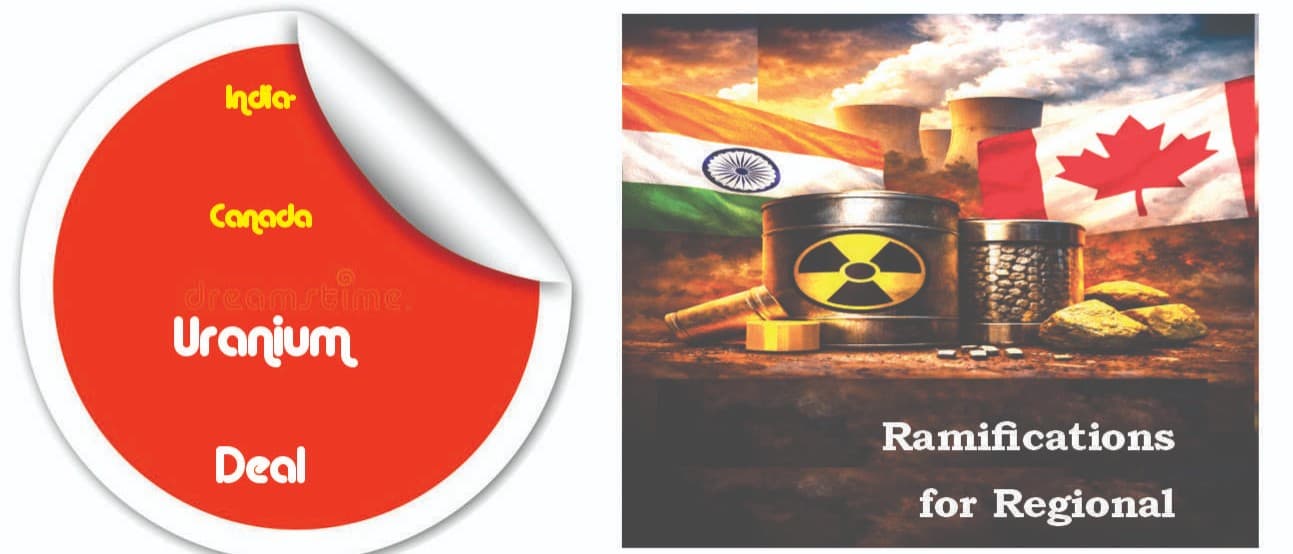
We are living in an era that is a textbook example of Thomas Hobbes' state of nature, wherein a war of all against all is being waged with dire consequences for international peace and security. With the joint US-Israel strikes on Iran – without any justification – and spreading tentacles of this so-called Third Gulf War in both time and geography, it seems that the death knell has been rung for the post-war world order. Seizing upon the opportunity created by anarchy and lawlessness on an international level, states are resorting to measures that were once strictly forbidden. One such development is the India-Canada Uranium Deal, signed in early March 2026 during Canadian Prime Minister Mark Carney's visit to New Delhi. The deal has raised serious normative and policy questions regarding the future of non-proliferation. Furthermore, given the fact that India is rapidly expanding its nuclear capabilities, the instant deal will have broader, long-term implications for global arms control regimes, fissile material production and strategic deterrence in South Asia. Before we move ahead to underline its ramifications, it would be pertinent here to discuss the salient highlights of this so-called “landmark deal”.
As per available details, Canada's Cameco Corporation, the world's largest publicly traded uranium supply company, has entered into a long-term agreement – worth USD 1.9 billion – with India's Department of Atomic Energy to supply 22 million pounds (approx. 10,000 tonnes) of uranium between 2027 and 2035. The deal also involves potential cooperation between the two countries on small modular reactors and advanced reactor technologies. It is to be noted here that this agreement is built on an earlier pact of 2015, whereby Cameco was to supply uranium to India, though at a smaller scale.
Canada is the second-largest producer of uranium, accounting for 13% to 15% of global output, according to the International Energy Agency. Apparently, the agreement is restricted to civil nuclear energy, as India is seeking to increase its nuclear power footprint ten-fold to 100 gigawatts by 2047. However, given the country's track record and the lack of proper oversight of the International Atomic Energy Agency (IAEA) over India's nuclear facilities, Pakistan has shown concern over the deal, warning that this arrangement could expand India's nuclear arsenal and undermine global non-proliferation regimes. The strategic consequences of this agreement, wherein India has been provided an assured external uranium supply, are multi-faceted and deserve our attention.
Premium Content
Continue reading with unlimited access to exclusive insights, analysis, and expert perspectives.
Subscribe to unlock this article and more features