Print subscription includes a free wall-size coloured map.Special offer: Subscribe Now (Print) and Get Free Wall Size Coloured Map!Subscribe Now
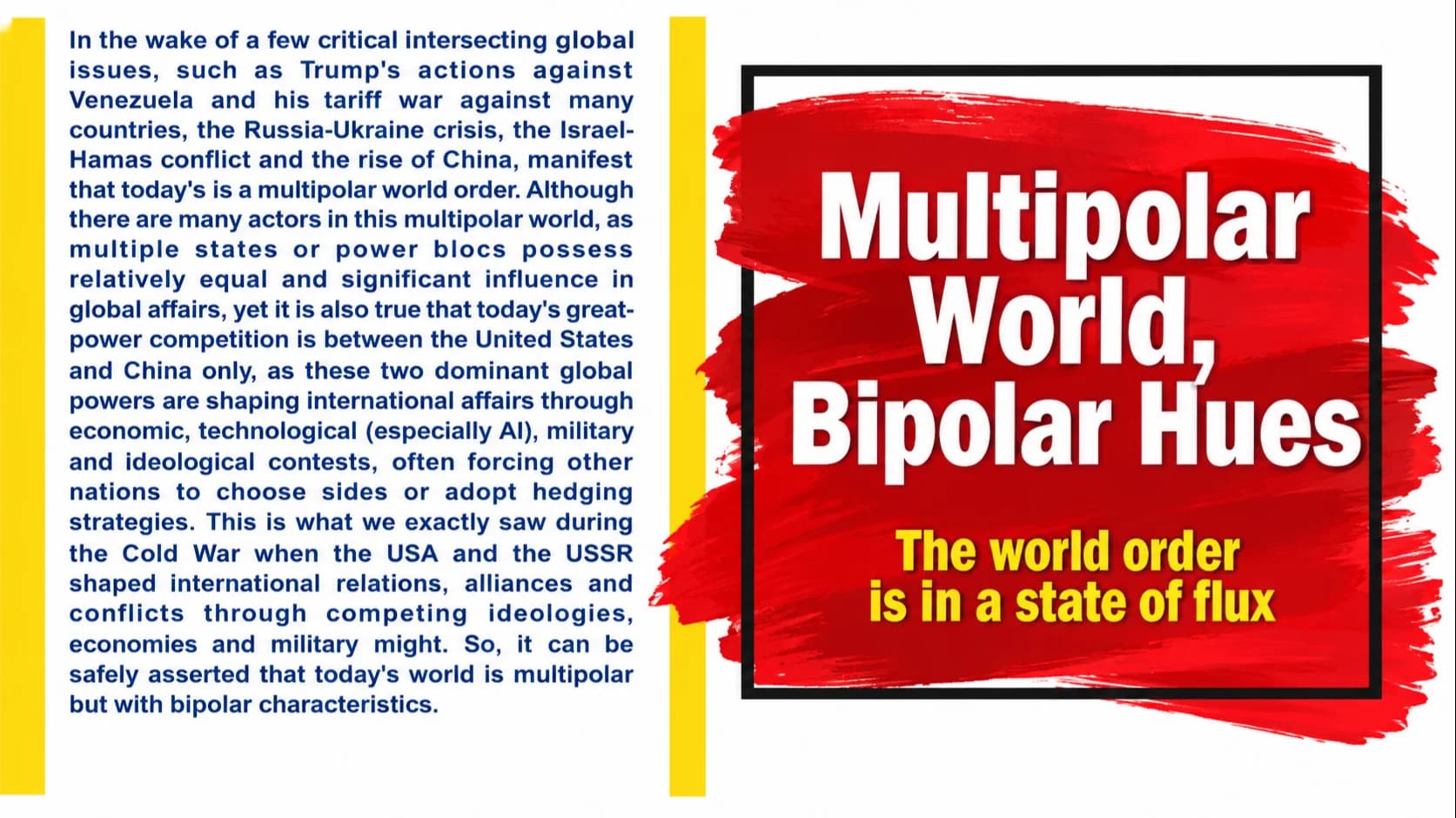
Summary. The World Order is in a state of flux
In the wake of a few critical intersecting global issues, such as Trump's actions against Venezuela and his tariff war against many countries, the Russia-Ukraine crisis, the Israel-Hamas conflict and the rise of China, manifest that today's is a multipolar world order. Although there are many actors in this multipolar world, as multiple states or power blocs possess relatively equal and significant influence in global affairs, yet it is also true that today's great-power competition is between the United States and China only, as these two dominant global powers are shaping international affairs through economic, technological (especially AI), military and ideological contests, often forcing other nations to choose sides or adopt hedging strategies. This is what we exactly saw during the Cold War when the USA and the USSR shaped international relations, alliances and conflicts through competing ideologies, economies and military might. So, it can be safely asserted that today's world is multipolar but with bipolar characteristics.
We live in a multipolar world where the churn of great-power politics shapes the world and touches, for good or ill, the lives of people everywhere. US-China relations are at the core of this contemporary global politics, influencing debates on whether the world is shifting towards a bipolar or multipolar order. The US has long been the dominant global power, but China's economic rise, military expansion and technological advancements have challenged American hegemony. Trade tensions, ideological differences and security concerns have further strained relations, leading to strategic competition rather than open conflict. This two-sided competition is reminiscent of the Cold War-era bipolar competition whereby the United States and the USSR were the principal competitors.
Unipolarity: It refers to a world system in which a single state acting unilaterally with little or no cooperation from other states can effectively resolve major international issues, and no other state or combination of states has the power to prevent it from doing so.
Bipolarity: It refers to a system where power is concentrated in two dominant states (superpowers), creating two opposing blocs with spheres of influence, famously seen during the US-Soviet Cold War, characterized by ideological competition, alliance systems and a balance of power where other states align with one of the poles, potentially leading to stability through deterrence but also proxy conflicts.
Multipolarity: It refers to an international system in which multiple states or power blocs possess relatively equal and significant influence in global affairs. Unlike a unipolar system, dominated by a single superpower, or a bipolar system, defined by two competing powers, a multipolar structure features several centres of power—political, economic, military and cultural—that interact in a complex balance. The idea became increasingly relevant in the early 21st century, as global power dynamics shifted away from the post-Cold War dominance of the United States towards a more diversified and interdependent order.
The concept of polarity in international relations stems from the study of power distribution among states. Throughout history, the world has witnessed various configurations of global power:
Pre-modern era: The international system was fragmented and regionally based, with civilizations such as China, the Ottoman Empire and Europe operating as separate poles of influence.
19th century (Concert of Europe): After the Napoleonic Wars, European powers such as Britain, France, Austria, Prussia and Russia maintained a balance through diplomacy and alliance networks—an early example of multipolarity.
Cold War period (1947–1991): The global system became bipolar, dominated by the ideological and military rivalry between the United States and the Soviet Union.
Post-Cold War (1991–2008): The dissolution of the Soviet Union led to a unipolar moment, with the United States emerging as the sole superpower, exercising unmatched global influence.
Contemporary era: The rise of new powers, including China, Russia, India, the European Union, and regional middle powers, has given rise to discussions of a renewed multipolar world order.
A multipolar world is distinguished by a diffusion of power across several actors, preventing any single state from dominating international affairs. Key features include:
Multiple power centres: Economic, military and diplomatic power is distributed among various nations or regional blocs.
Complex alliances: States form flexible, overlapping partnerships rather than rigid blocs.
Regionalism: Regional powers exert greater influence within their spheres—examples include Brazil in South America, India in South Asia and Nigeria in West Africa.
Strategic autonomy: Countries pursue independent foreign policies that balance relations among great powers.
Interdependence: Economic globalization and multilateral institutions foster mutual reliance among nations, even amid competition.
In this context, power is not solely military; it includes economic capacity, technological innovation, demographic weight and cultural soft power.
The early 21st century has seen the emergence of several key actors shaping the multipolar landscape:
China: With its rapid economic growth, military modernization and global initiatives such as the Belt and Road Initiative (BRI), China has become the most significant challenger to US dominance.
Russia: Despite economic constraints, Russia remains a major military power and energy supplier, exerting regional influence in Eurasia, Eastern Europe and the Middle East.
India: As the world's most populous democracy and a fast-growing economy, India plays a leading role in the Global South and multilateral forums like BRICS and the G20.
European Union: Though not a single state, the EU collectively represents a major economic and normative power, shaping global trade and climate policy.
Regional powers: Countries such as Turkiye, Brazil, Japan, Indonesia and South Africa contribute to a pluralistic distribution of influence within their regions.
This diversification of power signifies a shift from Western-centric dominance to a more plural global configuration.
The US faces a unique challenge in China. The Soviet economy, in its prime in the early 1970s, reached about 57% of the US GDP, before it began slowing down. China's economy, now the world's second largest, already amounts to about 66% of the US economy. China continues to grow at a faster pace, steadily narrowing the gap.
As China's economic power expands, it is being converted into military capability (it has already built the world's largest navy, by number of ships). Like other great powers, China is seeking to establish regional hegemony and global dominance. So, a prolonged contest between the US, the reigning power, and China, the rising power, appears unavoidable. The situation is comparable to 19th-century Europe, when a rising imperial Germany threatened to upstage Britain during Pax Britannica, unsettling the 'Concert of Europe'.
Russia is the weakest link among the three powers. It is a relatively smaller economy with a shrinking sphere of influence. But Russia's nuclear arsenals, expansive geography, abundant energy and mineral resources and its demonstrated willingness to use force to achieve its strategic objectives keep it in the great power constellation. From Moscow's perspective, the country drifted into the wilderness in the 1990s before announcing its return in 2008 with the war in Georgia. Since then, it has sought to rewrite the post-Soviet security architecture in Europe. As the West, having expanded the North Atlantic Treaty Organization into the Russian sphere of influence, responded to Vladimir Putin's war in Ukraine with sweeping sanctions on Russia and military support for Kyiv, Moscow moved ever closer to China. Russia and China have found common ground in opposing the Western 'rules-based order' — Russia thinks that the order denies it its rightful place in the world and seeks to revise it accordingly, while China, by contrast, wants to replace it with a China-centric order.
All three great powers today understand that the world is no longer organized around a single centre of authority. In that sense, the world is already multipolar. But unlike the post-Second World War and post-Cold War transitions, the structures of the new order have yet to fully emerge. During the Cold War, the world was divided into two ideological blocs and two largely separate economic systems. Today, China lacks the kind of satellite state networks that characterized the 20th-century superpowers, while the US is reassessing the sustainability of its alliance frameworks, including its commitment to Europe.
Russia, with its own great power ambitions, is wary of being seen as a Chinese ally irrespective of its close strategic partnership with Beijing. This opens a window for a Washington-Moscow reset. But the war in Ukraine remains a stumbling block. Russia may not want to challenge America's global leadership, but it certainly wants to re-establish its primacy in its sphere of influence.
Thus, there are three great powers with divergent interests that are pulling the global order in different directions, rendering the emerging multipolarity fluid rather than as a structured system akin to the post-Second World War order. This also means that middle powers, including superpower allies such as Japan and Germany, and autonomous actors such as India and Brazil, would continue to hedge their bets.
Trump wants Europe to shoulder greater responsibility for its own security, reset relations with Russia and reassert American primacy in its immediate neighbourhood even as Washington prepares for a prolonged great-power competition with China. The idea is to return to the classic offshore balancing. Even if Trump fails in executing it, future American presidents may not be able to ignore the shifts that he has initiated. Russia, for its part, seeks to carve out a sphere of influence. China aims to preserve its close strategic partnership with Russia to keep the Eurasian landmass within its orbit, while establishing regional hegemony in East and Southeast Asia — moves that would cement its status as a long-term superpower, much as the US did by asserting its hegemony in the Western Hemisphere in the 19th century, and across the Atlantic in the 20th century. In this fluid landscape, Russia has emerged as the new 'swing great power' between the two superpowers, paradoxically lending the emerging multipolar order a distinctly bipolar character.
During the Cold War, the Soviet Union was America's principal rival, and in the 1970s, Washington reached out to China to exploit fissures within the communist bloc. Today, the US identifies China as its principal and systemic challenger. This, in turn, leaves open the possibility of a reset in ties with Russia — an idea embraced by Trump's MAGA (Make America Great Again) ideologues, who frame Russia as part of a shared 'Christian civilization'.
On the other hand, under the powerful leadership of Xi Jinping, China is openly seeking a more Sino-centric world order with institutions and a global arrangement to match. To that end, it is assembling an axis of resistance to a US-dominated world order. Russia, suffering from post-imperial syndrome, is an important member but not an equal partner.
Russian power is limited to establishing a Eurasian sphere of influence across its former Soviet republics and disrupting liberal democracies. But in that, Russia is more of a spoiler than an architect of the new order.
Yet none of this new global reality means that things are now fixed. Indeed, the new world order is in a state of disruptive flux that promises years of growing pains. Both the US and China need allies, and countries in the Global South will continue to hedge between the competing powers.
As such, the world is in for a process of constant jostling as the major powers seek alliances while dealing with domestic pressures. In that messy status quo, many questions remain: Who will be most effective in building durable alliances? Will China manage its internal challenges? Will Europe get its act together? Will Russia continue its disruptive ways? Could a post-Trump US, post-Putin Russia and post-Xi China move the world in yet a different direction altogether?
And there is one large question above all others: Can the major powers manage their competition through shared global interests, such as combating climate change, environmental pollution and pandemic threats? Or will mounting conflict in the newly contested areas of the Arctic, cyberspace, outer space and the oceanic realm, and in ongoing geopolitical hot spots provide the trigger for outright conflict?
All world orders come to an end. The hope is the old one is doing so with a whimper rather than a bang.
Multiple significant powers: Rising economies like China, India and the EU state exert increasing economic, diplomatic, and military influence, contributing to a multipolar context.
Underlying US–China competition: The strategic rivalry between the US and China structures many key geopolitical interactions, mirroring a bipolar dynamic, despite multipolar elements.
Fluid alliances and middle powers: Countries such as India, Brazil and others pursue strategic autonomy while engaging with major poles, acting as independent centers of influence rather than automatic allies.
Interwoven polarity forms: Contemporary geopolitics exhibits traits of multipolarity, bipolarity and even nonpolarity (where influence becomes a diffusion across states and non-state actors).
Power diffusion and economic shifts: The relative decline of Western economic dominance and the rapid expansion of Asian economies have decentralized global power, a core characteristic of multipolarity.
Strategic rivalries: The US-China relationship continues to function as a central axis around which many regional and global policies revolve, reinforcing a bipolar dynamic.
Institutional complexities: International institutions and alliances, such as the United Nations, G20, BRICS and regional groupings, allow smaller powers agency within broader multipolar interactions.
Global crises: Transnational challenges such as climate change, pandemics and cybersecurity require diverse coalitions that go beyond bilateral rivalries, highlighting the need for multipolar cooperation.
Greater complexity in decision-making: Decision-making on global issues is more complex, requiring negotiation among diverse interests rather than domination by a single power with power distributed across multiple actors.
Competition with cooperative potential: Other powers and institutions offer avenues for collaboration, potentially reducing the risk of direct confrontation, while US–China rivalry fuels geopolitical competition.
Multiplex governance structures: Global governance increasingly involves coalitions that cut across traditional power poles and emerging actors, blending regional priorities with global commitments.
In sum, the contemporary international system defies neat categorization. While power is undeniably more dispersed than during the Cold War, the structuring force of great-power rivalry—particularly between the United States and China—imparts a distinctly bipolar logic to an otherwise multipolar world. The coexistence of multiple influential actors alongside a dominant strategic axis has produced a fluid and hybrid order, marked by shifting alliances, strategic hedging by middle powers, and overlapping forms of competition and cooperation. Unlike the rigid blocs of the twentieth century, today's global order is more interconnected, economically interdependent and institutionally complex, even as geopolitical rivalry intensifies across military, technological and ideological domains. This blend of multipolar diffusion and bipolar rivalry makes global governance more contested and unpredictable, yet it also leaves space for cooperation on shared challenges such as climate change, pandemics and global stability. As history shows, all world orders eventually give way to new configurations. The critical challenge ahead lies not in preventing change, but in managing this transition in a manner that mitigates conflict and allows competition to unfold within stable and inclusive frameworks rather than through catastrophic confrontation.
The writer is a professor of International Relations.
Topics
The writer is a professor of International Relations.