


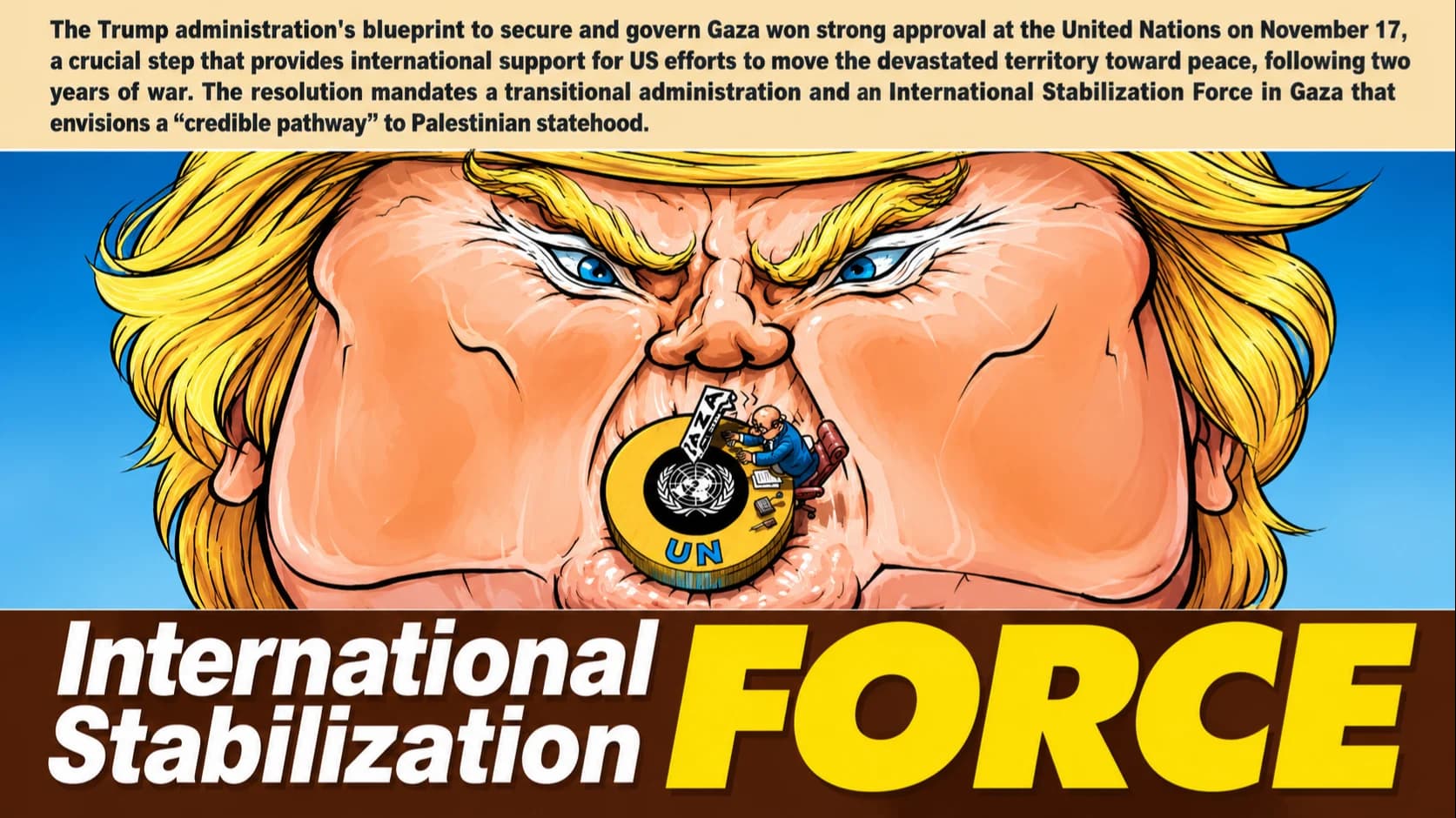
On November 17, the United Nations Security Council adopted Resolution 2803 (2025), endorsing the US-backed “Comprehensive Plan to End the Gaza Conflict,” establishing a new transitional Board of Peace and authorizing an International Stabilization Force (ISF) to oversee governance, reconstruction and security efforts in the Gaza Strip – The resolution received 13 votes in favor, with China and Russia abstaining. The resolution stipulates that the BoP and ISF's "presences authorized by this resolution shall remain authorized until Dec. 31, 2027, subject to further action by the Council, and (that) any further reauthorization of the ISF be in full cooperation and coordination with Egypt and Israel and other Member States continuing to work with the ISF.”
What is the International Stabilization Force?
The ISF has been envisioned as a multinational force that would deploy to Gaza to help train police, secure the borders, maintain security by helping demilitarize Gaza, protect civilians and humanitarian operations, including securing humanitarian corridors, among additional tasks as may be necessary in support of Trump’s Comprehensive Plan. In theory, this security body will work with Israel and Egypt to “demilitarize” the Gaza Strip and will reportedly train a Palestinian police force.
ISF's envisioned character
As per the proposed peace plan, the ISF will play its significant role in fulfilling three basic objectives:
1. Security & Disarmament
The ISF would work to stabilize the security situation in Gaza, allowing for a phased withdrawal of Israeli Defence Forces (IDF) from cleared areas. In this regard, a primary objective would be to disarm non-state armed groups by destroying and preventing the reconstruction of military and terror infrastructure, including tunnels and weapons production facilities. In order to ensure ceasefire compliance, the force would monitor and enforce the ceasefire agreement, responding to violations and working to prevent a return to conflict. Further, the ISF would help secure Gaza's border areas to prevent the smuggling of weapons and other munitions.
Challenges:
Deploying 20,000 foreign soldiers in dense urban terrain with multiple armed actors, potentially new local forces and the Israeli army) creates an “intolerable risk” for the force. Here, a key point of contention is whether the ISF will be tasked with the permanent decommissioning of weapons from non-state armed groups, a high-risk operation that some countries are unwilling to undertake because of unclear specifics about “Force Protection and Rules of Engagement''. Obviously, the force needs clear rules of engagement and robust protection against threats, including IEDs and armed conflict. Yet, another important area is to maintain internal security and law and order while addressing the challenge of a collapsed civilian police force and armed gangs, also securing aid convoys and maintaining public safety extremely difficult.
2. Humanitarian Aid and Reconstruction
1. The ISF would be responsible for civilian protection, a crucial function in a densely populated area that has suffered extensive damage.
2. It would secure humanitarian aid corridors and distribution centers to ensure aid reaches the population without diversion by armed groups;
3. The mission would assist in restoring vital services like electricity and water infrastructure to gain initial legitimacy and improve the quality of life for Gazans.
Challenges:
The ISF would operate amidst an ongoing humanitarian catastrophe, including famine conditions, widespread displacement and destroyed infrastructure. One of the biggest challenges is to regulate aid logistics without any obstruction amid the brewing constraints of damaged roads, unreliable supply lines, bureaucratic delays by Israeli authorities and violence against aid workers. Moreover, the ISF will have to repair the devastated civic amenities by restoring basic services like water, electricity, sanitation and medical facilities, which requires the entry of heavy machinery and essential materials often banned as “dual-use” by Israeli authorities.
3. Political Transition and Governance
The ISF will have to fill the post-Hamas security and governance vacuum, particularly preventing anarchy. Notably, training local forces, exclusively supporting a new, vetted Palestinian police force to gradually transfer internal security responsibilities to Palestinian institutions. The force would operate under the strategic guidance of a temporary, international transitional administration under a “Board of Peace “which would oversee reconstruction, economic development and preparations for the Palestinian Authority to eventually assume control.
Challenges:
The force requires consent from both Israel and the Palestinian Authority to be viable. However, Hamas strongly opposes demobilization and some potential troop-contributing nations are hesitant to participate in a mission that requires militarily disarming Hamas, preferring a more traditional peacekeeping role. The ISF must avoid being perceived as just another occupying force. Gaining local legitimacy requires a clear, time-bound mandate and a visible pathway to local, Palestinian governance and self-determination.
And ostensibly, the current situation risks creating a duality of governance where an Israeli-occupied zone thrives while other areas remain insecure and devastated. And, therefore, defining a transitional role for the Palestinian Authority and ensuring the force's efforts are linked to a future, functional Palestinian state are crucial political hurdles.
Who will contribute?
A number of nations have been cited as possible contributors to the ISF, including Egypt, Indonesia, Türkiye and Azerbaijan. But none has committed to sending troops yet, and Israel opposes Türkiye's participation in the force.
Challenges ahead
The Palestinian public's acceptance is far from certain. Without it, the Board of Peace risks becoming seen as a foreign occupation working on behalf of Israel, further thwarting their dream of self-determination and statehood. The plan gives Palestinians almost no voice in governing Gaza. Because of Israel's fierce opposition, it doesn't promise statehood, offering only a vague reference that it might one day be possible. It also gives only an ambiguous timetable for reconstruction to begin and for the Israeli military to withdraw from around 50% of the Gaza Strip that it still holds since the cease-fire began.
Conclusion
In essence, the UN-endorsed Gaza stabilization framework represents an ambitious yet highly contested attempt to reshape the political and security landscape of the Strip in the aftermath of years of devastation. By mandating a transitional administration, authorizing the ISF and linking future governance to an eventual—though uncertain—pathway toward Palestinian statehood, the resolution introduces a new architecture of international oversight. Yet the plan's central pillars—disarmament of Hamas, large-scale reconstruction and the establishment of technocratic governance—rest on assumptions that remain untested and, for now, politically fragile.
Historical precedents from Afghanistan to Lebanon underscore that stabilization forces deployed without a prior political settlement often inherit unmanageable risks and unclear objectives. Thus, while the resolution signals renewed international engagement and reflects Washington's desire to impose a post-war order, its success ultimately hinges on political legitimacy, meaningful Palestinian inclusion and a credible roadmap to self-determination.
The writer is an expert on International Law, and a CSS mentor.
