Print subscription includes a free wall-size coloured map.Special offer: Subscribe Now (Print) and Get Free Wall Size Coloured Map!Subscribe Now
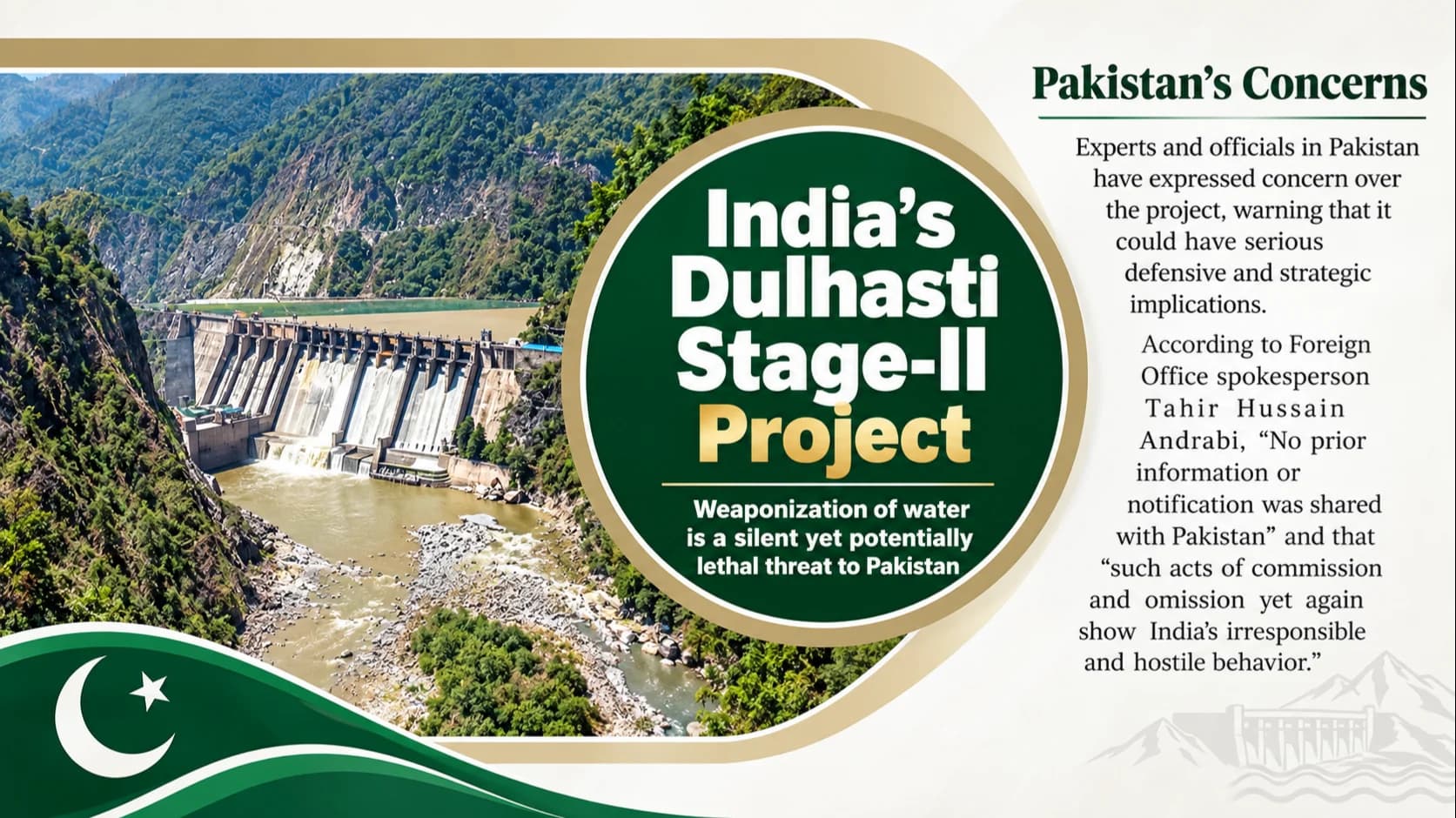
Summary. Weaponization of water is a silent yet potentially lethal threat to Pakistan
In clear violation of the Indus Waters Treaty of 1960, the Indian government recently approved the Dulhasti Stage II hydropower project on the Chenab River, a move that has raised serious concerns in Pakistan. The project, which will be constructed in the Indian-occupied territory of Jammu and Kashmir with an estimated cost of 327.745 billion Indian rupees, is expected to generate up to 260 megawatts of electricity. While Indian authorities describe the project as a technically compliant, run-of-the-river scheme aimed at strengthening energy security, Pakistan has responded with strong protests, saying that under the IWT, India cannot misuse its “restricted allowance for unilaterally building any hydroelectric projects on the western rivers.”
In December 2025, the Indian government approved the 260-megawatt Dulhasti Stage-II hydropower project on the Chenab River in Kishtwar district of Indian Illegally Occupied Jammu and Kashmir (IIOJK) – an action that goes beyond the routine disputes that have long surrounded the Indus Waters Treaty of 1960 (IWT). The move serves as another piece of evidence that India is blatantly undermining the IWT through water aggression, as the approval of the project is a direct attack on Pakistan's water rights.
It is a 260-megawatt hydropower project proposed on the Chenab River in the Kishtwar District of IIOJK.
The run-of-the-river project will be developed by India's state-owned company, NHPC Limited, and will utilize the existing infrastructure of the Dulhasti Stage I hydropower project, which has been operating since its commissioning in 2007.
The 390-megawatt Dulhasti Stage I facility, completed in 2007, operates under a run-of-the-river scheme.
Under the new phase, the same dam, reservoir and power intake systems will be used.
Under the plan, water will be diverted through a separate tunnel measuring 3,685 metres in length and 8.5 metres in diameter to form a horseshoe-shaped pondage for Stage-II.
The project includes a surge shaft, a pressure shaft and an underground powerhouse equipped with two generating units of 130 MW each, resulting in a total installed capacity of 260 MW for Stage-II.
It will add to the cascade of disputed hydropower projects on the Chenab River, which already includes operational plants (Dulhasti-I (390-MW, Kishtwar), Baglihar (890-MW, Ramban), Salal (Reasi)) and several under-construction projects (Ratle (850MW), Kiru (624 MW), Kwar (540 MW)).
Experts and officials in Pakistan have expressed concern over the project, warning that it could have serious defensive and strategic implications.
According to Foreign Office spokesperson Tahir Hussain Andrabi, “No prior information or notification was shared with Pakistan” and that “such acts of commission and omission yet again exemplify a complete disregard of international law and bilateral treaties.”
Analysts say the project undermines the spirit of the IWT, particularly in light of India's recent announcement regarding the unilateral suspension of the agreement. They caution that such projects could affect downstream water flows and further strain already tense relations between the two countries.
Former federal minister and PPP leader Sherry Rehman has been among the most vocal critics. Reacting to India's move, she described it as a “serious weaponization of the waters of the Chenab River”. “India's approval of the Dullhasti project on the Chenab River is a clear and grave violation of the IWT. Any unilateral action on disputed rivers directly undermines Pakistan's recognized water rights and poses serious threats to regional peace and stability,” she tweeted.
Analysts view New Delhi's decision as part of a broader strategy following the Pahalgam incident, which triggered cross-border clashes between the two nuclear-armed neighbors. Despite India's move, Pakistan has reaffirmed its commitment to the IWT, emphasizing that it will continue participating in Neutral Expert proceedings in good faith.
The Chenab River is one of the three “western rivers” — along with the Indus and Jhelum — whose waters were allocated primarily to Pakistan under the IWT, and any unilateral development on it is viewed as contrary to the Treaty's provisions.
The river is central to irrigation networks, hydropower generation and the livelihoods of millions downstream in Pakistan. Any interference by India has direct consequences for agriculture and energy security in Pakistan — the country is already grappling with climate stress and chronic water scarcity.
Beyond legal arguments, Pakistan has raised alarms about the sudden holding and release of water upstream, saying this has led to erratic inflows in rivers like the Chenab and Jhelum. These claims are framed as risks to food security and rural livelihoods, and Islamabad has warned that any attempt to significantly alter river flows could escalate tensions further.
The question environmentalists are posing focuses greatly on a primary concern related to climate change.
Water bodies are drying up rapidly. Chenab forms at the confluence of Chandra and Bhaga rivers in Lahaul and Spiti, Himachal Pradesh. According to the IWT, Chenab is a western river, allocated to Pakistan. India is permitted limited consumption use of Chenab.
From the Treaty's signing up to the year 2004-05, studies estimate that glacial volume in the Chenab basin has reduced by a whopping 33.3 percent.
This is what the South Asia Network on Dams, Rivers says: “For a river whose flows are made up of 50% meltwater when it leaves India at Akhnoor, this is shocking for both India and Pakistan”.
“Glaciers, the water stored in them, the slow release of this water in spring and summers is the key to water security of the entire Himalayan region. Around 60% irrigation in the Indus basin depends on glacial melt. As the glaciers are concentrated in the Indian Himalayas, their health and sustenance is crucial for both countries.”
Water has long been a source of cooperation as well as conflict, but rarely has it been so openly turned into a weapon as is now being witnessed on the Chenab River.
India's recent fast-tracking of massive hydropower projects, manipulating river flows and unilaterally declaring the IWT to be in abeyance represent a grave and dangerous escalation. This deliberate weaponization of water threatens not only Pakistan's water security but also the broader peace and stability of an already volatile region.
The IWT is the only international water-sharing agreement in the history of the subcontinent that has long been cited as an example of how two states can adhere to a regulatory framework on a highly sensitive issue such as water despite hostility, wars and intense political tensions. Unfortunately, over the past decade, India has effectively reduced this Treaty to a mere piece of paper. The approval of the Dulhasti Stage II hydropower project is the latest and most serious link in this chain. It represents not only a blatant violation of the IWT but also sets a dangerous precedent for the peace, stability and future of the entire region. This project is not merely an energy initiative; it is a strategic instrument through which Pakistan's share of water can be controlled, restricted, and used as a tool of pressure.
Under the IWT, the Chenab River is one of the three western rivers allocated to Pakistan. The construction of any project on this river that has the capacity to regulate water flow, storage or release directly contradicts both the spirit and the provisions of the treaty. The Dulhasti Stage II project has a power generation capacity of 260 megawatts; however, its design, structural features and operational controls raise serious concerns for Pakistan. The issue of Pakistan's water rights is not confined to the state level alone—it is directly linked to the daily lives, livelihoods and survival of millions of citizens.
The writer is a student at the University of Narowal.
Topics