Print subscription includes a free wall-size coloured map.Special offer: Subscribe Now (Print) and Get Free Wall Size Coloured Map!Subscribe Now
Summary. A Governance challange for developing states
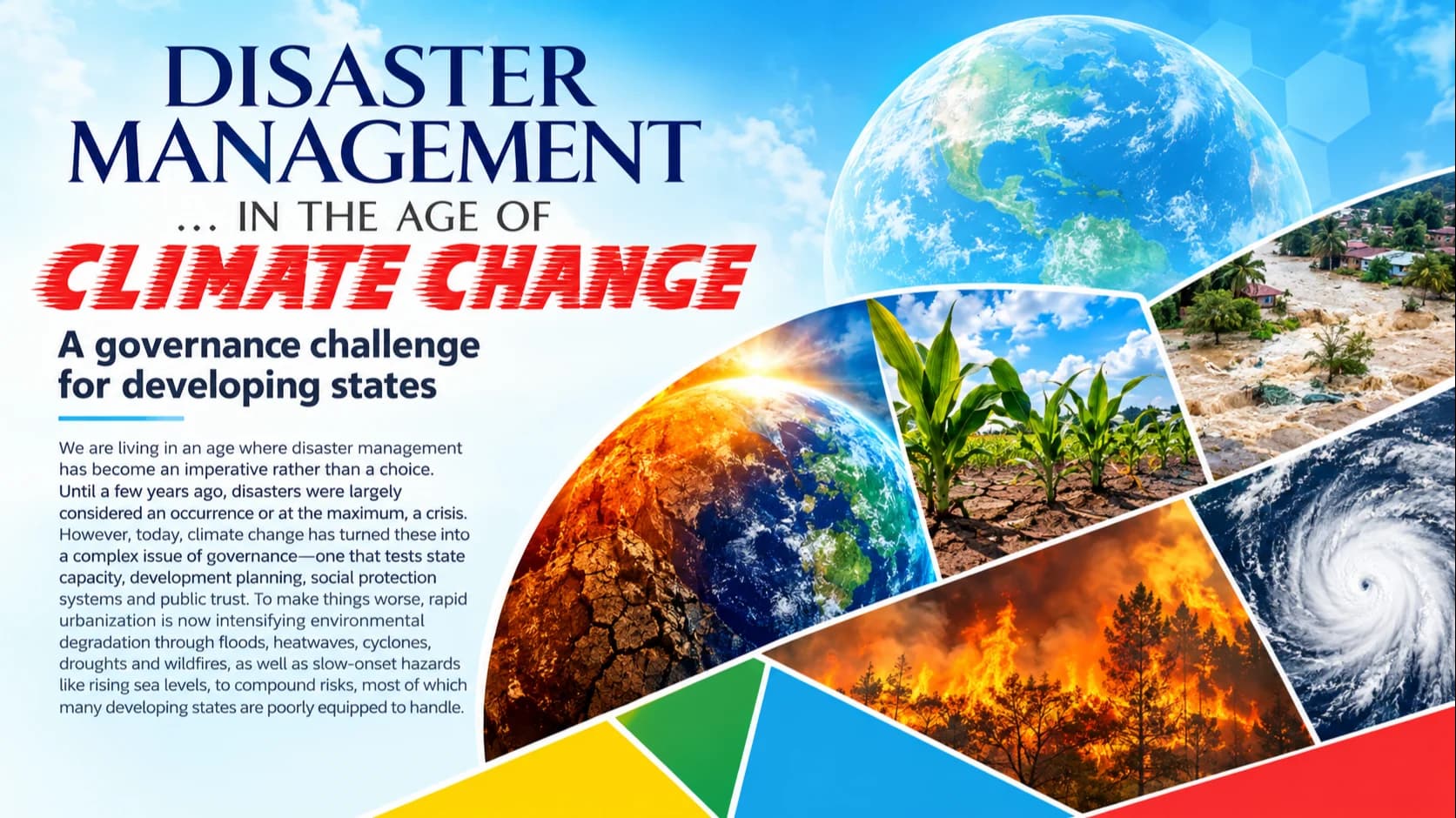
We are living in an age where disaster management has become an imperative rather than a choice. Until a few years ago, disasters were largely considered an occurrence or at the maximum, a crisis. However, today, climate change has turned these into a complex issue of governance – one that tests state capacity, development planning, social protection systems and public trust. To make things worse, rapid urbanization is now intensifying environmental degradation through floods, heatwaves, cyclones, droughts and wildfires, as well as slow-onset hazards like rising sea levels, to compound risks, most of which many developing states are poorly equipped to handle.
The era of climate change has elevated disaster management to an entirely new threshold. What used to be perceived as isolated and temporary crises have now become regular, systemic shocks that reveal underlying structural vulnerabilities in governance, development planning and institutional capacity. Climate change has turned into a chronic issue faced by state institutions, especially in the developing states, where quick urbanization, environmental destruction, population explosion and the shortage of fiscal space converge, as well as more and more severe climate extremes arising. In this regard, disaster management is no longer a sector or a technical issue; it is now a fundamental imperative of governance, which has a direct impact on economic stability, social cohesion and political legitimacy.
The magnitude of climate-related disasters in the world emphasizes the fact that disaster governance should be reconfigured. Over the last few years, the hazards associated with climate and weather, including floods, storms, heatwaves, droughts and wildfires, have caused gigantic losses across the globe. During 2024 alone, climate-induced disasters led to economic damages of more than US$320 billion, besides affecting more than 160 million people and causing more than 16,000 fatalities worldwide. Annual disaster losses, which ranged between $70 billion and $80 billion from 1970 until 2000, have now surged to an estimated US$2.29 trillion when indirect and long-term impacts are factored in. Indirect costs include the wider social and ecosystem losses that come as a result of natural catastrophes. Earthquakes, floods, storms, droughts and heatwaves made up 95 percent of direct costs in the past two decades, according to the “Global Assessment Report (GAR) 2025: Resilience Pays: Financing and Investing for our Future”, released by the UN Office for Disaster Risk Reduction (UNDRR).
The human cost is still strongly concentrated in the developing world despite improvements in forecasting technologies and mechanisms of disaster responses. Almost nine out of every 10 deaths associated with disasters happen in low- and middle-income countries, as they are characterized by ingrained disparities in infrastructure, preparedness and access to resources. These statistics highlight an important fact: susceptibility to disasters is not only conditioned by natural factors but is also influenced by the quality of governance, development priorities and social disparity.
Another myth propagated in popular media is that climate change is the cause of disasters. As a matter of fact, it is a risk multiplier. It enhances risks in that it raises temperatures, changes rainfall patterns, raises sea levels and intensifies extreme weather events. Whether these hazards would culminate in disastrous events is highly dependent on the choices made by those tasked with governance. A heatwave becomes fatal when cities are not built with cooling systems and prior warning systems about health, as well as social support for the vulnerable groups. The floods will be disastrous when population growth in the floodplains is not zoned and building codes not implemented in a real sense. Such disaster risk, in this sense, is a social and politically constructed risk. The location of the populace, the growth of cities, the focus of the infrastructures and the distribution of resources determine the exposure and protection of people. Climate change also reveals and intensifies these underlying governance failures, transforming predictable hazards into massive humanitarian and economic disasters.
For developing states, climate-related disasters are not simply incidents of a humanitarian nature anymore; they are becoming macroeconomic shocks. Frequent floods, droughts and heatwaves interfere with agricultural output, damage infrastructure, lower labour efficiency and raise public funding. Such states are compelled to divert funds from their long-term developmental plans, like education, health and infrastructure, to relief efforts and reconstruction. The result is a vicious cycle: low fiscal space hinders prevention and resilience investment, which makes a country susceptible to disasters in the future. The repetition of shocks over time undermines the gains in development, further impoverishes people and makes them more reliant on aid. There is also a loss of public trust because governments never seem ready to address anticipated risks, which destabilizes institutional legitimacy and social cohesiveness.
Pakistan offers a vivid example of how the intersection of climatic change and governance takes place. The country is one of the most climate-sensitive nations globally, even though its contribution to world greenhouse gas emissions is minimal. The 2022 catastrophic floods impacted more than 33 million individuals and resulted in damages and losses amounting to US$30 billion and made it one of the most destructive climate events in the history of the country. Whole communities were displaced, farms were destroyed and essential infrastructure was severely damaged. The pattern did not end there.
In 2025, another devastating monsoon season hit over one million people, flooded hundreds of thousands of hectares of agricultural land and further aggravated an already struggling economy. As per careful estimates, climate disasters cost Pakistan as much as 1-2 percent of GDP each year.
Such disasters cannot be attributed to extreme weather only. The laxity in land-use control, urban settlement in floodplains, deforestation, inadequate urban drainage and bad implementation of building codes have continuously made heavy rainfall a huge human calamity. These risks are only intensified by climate change, but the extent of loss depends on governance failures.
Fragmented governance is one of the greatest problems in disaster management among the developing states. Disaster risk reduction (DRR) cuts across several sectors, such as climate policy, water management, agriculture, housing, health, education, finance and local government, but there is a tendency to work across silos. Lack of coordination compromises early warning systems and evacuation, and gives rise to ineffective or inequitable relief allocation.
The early warning systems represent the progress and the continuity of inequality. Although the global coverage has increased over the recent years, quality, reach and last-mile communication are uneven. Unless they are in vulnerable communities, in local languages and backed by evacuation planning and social protection actions, they will never have a tangible impact. The issue is not the lack of technology but rather poor institutional connections between the forecasting and decision-making and action at the community level.
Climate-induced disasters are gradually becoming a significant factor behind displacement. In 2024, the internal displacement of people on the basis of disasters was at an all-time high of 45 million worldwide, interfering with education, health services and labour markets. In most developing nations, displaced people are exposed to a period of uncertainty by low reconstruction rates, insecure conditions of returning home and poor livelihood prospects. In the absence of strong social protection systems, disasters increase the existing inequalities. Affected women, children, old people, disabled and informal workers are disproportionately affected. Disasters increase social exclusion and mistrust in official institutions when relief and recovery efforts do not consider such differentiated vulnerabilities.
The problem of climate-related disasters is not in trying to make nature a slave but in improving governance. The development planning should incorporate disaster risk reduction by means of climate-sensitive zoning policies, strict implementation of building codes and risk-sensitive investment in infrastructure. Preventive measures are not as politicized as emergency response; however, they are much more cost-effective in the long run. The local governments should be empowered, because disasters are local by nature, and responses to a disaster nearly all the time take place at the local level. Preparedness and response can be greatly enhanced by decentralized power, sufficient financial resources, trained human resources and availability of hazard information. Early warning systems should be transformed into early action whereby alerts will result in an early evacuation, protection of livelihoods and minimizing the exposure. The recovery after the disaster must be seen as the chance to rebuild it better. Reconstruction has the capacity of mitigating risk in the future through the enhancement of infrastructure, dignified resettlement of the most at-risk settlements and investing in natural solutions like wetland rehabilitation and watershed control. Public confidence is also regained through open and transparent recovery procedures.
Disaster management is no longer a peripheral or technical policy field in the era of climate change. It is a major issue of governance that will determine the development patterns, economic stability, and human security in the developing world. As the world continues to lose trillions and displacement numbers continue to increase on an annual basis, the imperative is clear. The developing states, although they contribute a minimum to climate change, unfairly share the consequences. It is simple to understand the decision such states make. They might be caught in a vortex of relief and reconstruction, or they need to establish robust governance structures that are risk aware, that safeguard the weak and that incorporate disaster management into the development agenda. Resilience is no longer part of the optional set; rather, it has become a mandate for sustainable development and political stability in an age of accelerating climate change.
Topics