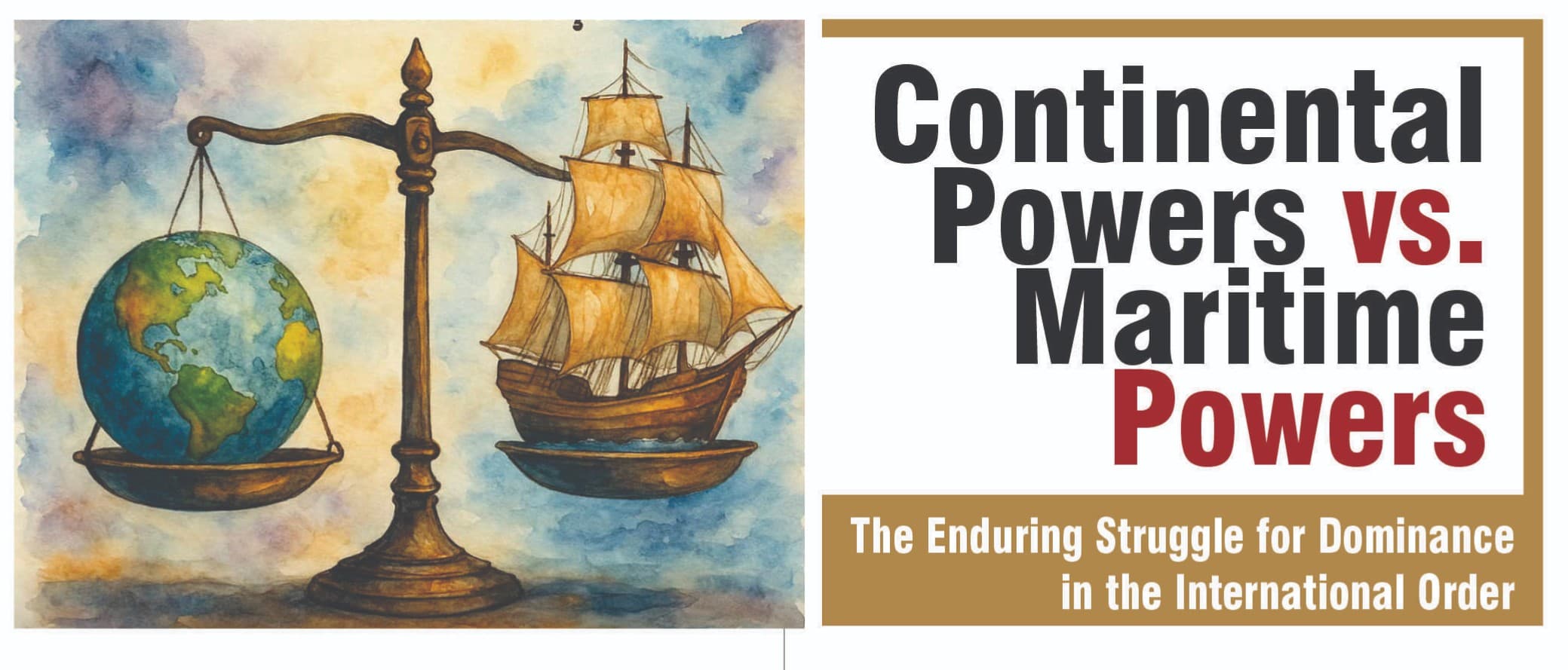
Since the emergence of the nation-state system, countries have been switching from one form of governance to another. Some countries, which were once communist, are now democratic, and some previously liberal states are now realists, proving the axiom right that change is the only constant in geopolitics. This change may take years or even decades, but it will surely occur. In this vein, the instant piece will discuss two types of states in global politics: continental powers and maritime powers. Both types of states, from ancient times to the present era, have been involved in intense competition to set the rules of international order.
Continental Power and Maritime Power
Continental and maritime powers are considered the two sides of the same coin, but they are entirely different from each other.
a. Continental Power
A continental power is a state which believes that a piece of land is everything. Thus, they intimidate their neighbours and other less-powerful countries near them. The central motto of a continental power is to exert severe economic, political and military pressure to acquire more land and establish a lasting hegemony over small powers. So, the currency of power for the continental hegemons is none other than land. They can take every possible step to grab more territory from their bordering states. For instance, Russia, under Vladimir Putin, the most powerful president in its recent history, is hell-bent on achieving more territory. This was the principal reason for invading its neighbouring country, Ukraine, in February 2022. Besides Russia, the notable continental powers in the existing fractured world order are India, China, Israel, North Korea, Iran and the Kingdom of Saudi Arabia, which not only want to acquire more land but also aspire to maintain an extensive supremacy over others' lands.
b. Maritime Power
Contrary to a continental power, a maritime power's central focus is on the sea. Such a power believes that sea routes are essential to trade with other countries. Unlike the continental powers, maritime states see their neighbours not as enemies, but as trading partners. They neither threaten them nor enforce any kind of brute pressure upon them to foist their own rules. Maritime powers prefer wealth over territory. Therefore, they often avoid military adventurism for a mere piece of land, which can cause far-reaching repercussions for them. There are many maritime powers in these turbulent times of geopolitics. France, Japan, the United Kingdom, and Germany are the prominent ones.
Historical Background of Both Types Powers
Since the creation of the nation-state system with the Treaty of Westphalia in 1648, both the continental and maritime powers have been competing. The fight between territory and wealth has existed side by side throughout human history.
The maritime power dates back to ancient Athenians, whose empire depended on obtaining more wealth via trading with neighbouring kingdoms.
As far as the continental power is concerned, it is even older than its competitor. In the Stone Age, when humans were divided into distinct groups, they used to capture each other's land and other areas of influence. In this way, the continental power gradually came into its true form as witnessed today.
Coming back to the modern history of the states, Great Britain was a major maritime power, while France, under Napoleon Bonaparte, was a huge continental power. Napoleon's France intended to conquer almost the whole of Europe. Owing to this terrible approach, the continent witnessed several ghastly wars. To counter the growing clout of France, the UK, with the help of its wealth that it had accumulated through sea trade and its royal navy, was successful in defeating the Napoleonic army at Trafalgar.
Case Study
If we critically analyze both powers through the lens of dominance, we find the maritime power leading. The continental power, as discussed earlier, caused tremendous uncertainty, which ultimately led to chaos and suffering. For instance, Japan was a continental power before World War II. For the sake of influence, it not only invaded other less powerful states but also indulged in multiple conflicts against the great powers of that time. This approach turned into a nightmare for Japan, as it lost millions of its people, wealth, territory, international reputation and other advancements it had made in technology. Afterwards, under the Western-led world order, Japan became a maritime power following international law and prioritizing wealth over land. The world witnessed then as to how a devastated country emerged to be one of the greatest economies.
Continental and Maritime Powers at Present
In the current turbulent times of geopolitics, the maritime states feel threatened by the continental ones. To intensify their power in global politics, the continental states are trying their utmost to pressure weak and dependent maritime countries. What is most surprising is that the United States, once a great maritime power, is increasingly becoming a continental country under the most unpredictable president in its history, Donald J. Trump. His Donroe Doctrine means excessively intimidating US neighbours and other countries for its nefarious interests. From capturing Venezuela's president and controlling its crucial resources like oil to imposing sweeping tariffs on other states, Trump is hell-bent on eliminating the global order the US had helped create. Hence, as per the scholars of International Relations, all the great powers are becoming continental states.
A Relevant Example
Modern strategic competition between the United States and China reflects a longstanding historical pattern between maritime and continental powers. Their rivalry spans five key areas: differing political systems, clashing ideologies, competing economic models, informational distrust and growing military tensions. At stake are not merely national interests but rival visions of global order. The United States champions the liberal rules-based international order established after World War II, grounded in the primacy of law, free trade, collective defense and democratic governance. This order aligns with the maritime identity of the US and its Western allies, whose prosperity depends on open commerce and secure sea lanes protected by superior naval and air power. However, this system faces mounting pressure from China's resurgence as a continental power. Prioritizing territorial integrity and political control, China is sceptical of Western liberal democracy and seeks to reshape the international system along lines reminiscent of Tianxia—“all under heaven”—a hierarchical model rooted in ancient Chinese philosophy. Historically centered on China as the dominant hub with tributary states orbiting around it, Tianxia emphasizes cultural and political hierarchy, rewarding compliance and loyalty. A China-led system would fundamentally challenge and potentially supplant US-led global hegemony.
Conclusion
As mentioned above, both powers play an instrumental role in global affairs. For continentals, power, land, hegemony and other pressure tactics are everything. Likewise, the maritime powers prefer wealth, human development and sea trade over other matters of geopolitics. By the same token, these powers closely resemble the two well-known theories of international relations: realism and liberalism. Continental power is closely associated with realism, whereas maritime power is directly related to liberalism.
The writer is a Larkana-based law student,
having a keen interest in
International Relations. He can be reached at shehzadbroheee@gmail.com