Jahangir's World Times (JWT): Please tell us about your educational background.
Mukarram Abbas (MA): I belong to district Sheikhupura. I completed my O- and A-Levels from Beaconhouse School System. I hold a bachelor's degree in Business Administration from Lahore School of Economics which sharpened my understanding of management and governance.
JWT: How long did it take you to prepare for Enforcement Officer (PRA) exam?
MA: It took me around four months. My strategy was a focused study plan, revision of core subjects, solving past papers and consistent self-assessment. Furthermore, adopting the WTI self-note–making technique significantly enhanced my ability to adapt to the changing trends of the PPSC exams.
JWT: What were your principal sources?
MA: My principal resources were JWT magazine especially for current affairs MCQs and updated national and international events, as well as PPSC past papers and self-prepared subject-wise capsule.:
JWT: How was JWT magazine helpful during your preparations?
MA: The magazine was instrumental in my preparation. Its well-organized current affairs coverage, analytical articles and Exam Pack section not only kept me informed but also helped me develop a multidimensional understanding of issues. More than a study resource, it served as a trusted guide that refined my analytical abilities, improved my decision-making skills, and reinforced my confidence for public service.:
JWT: How was your experience at the World Times Institute?
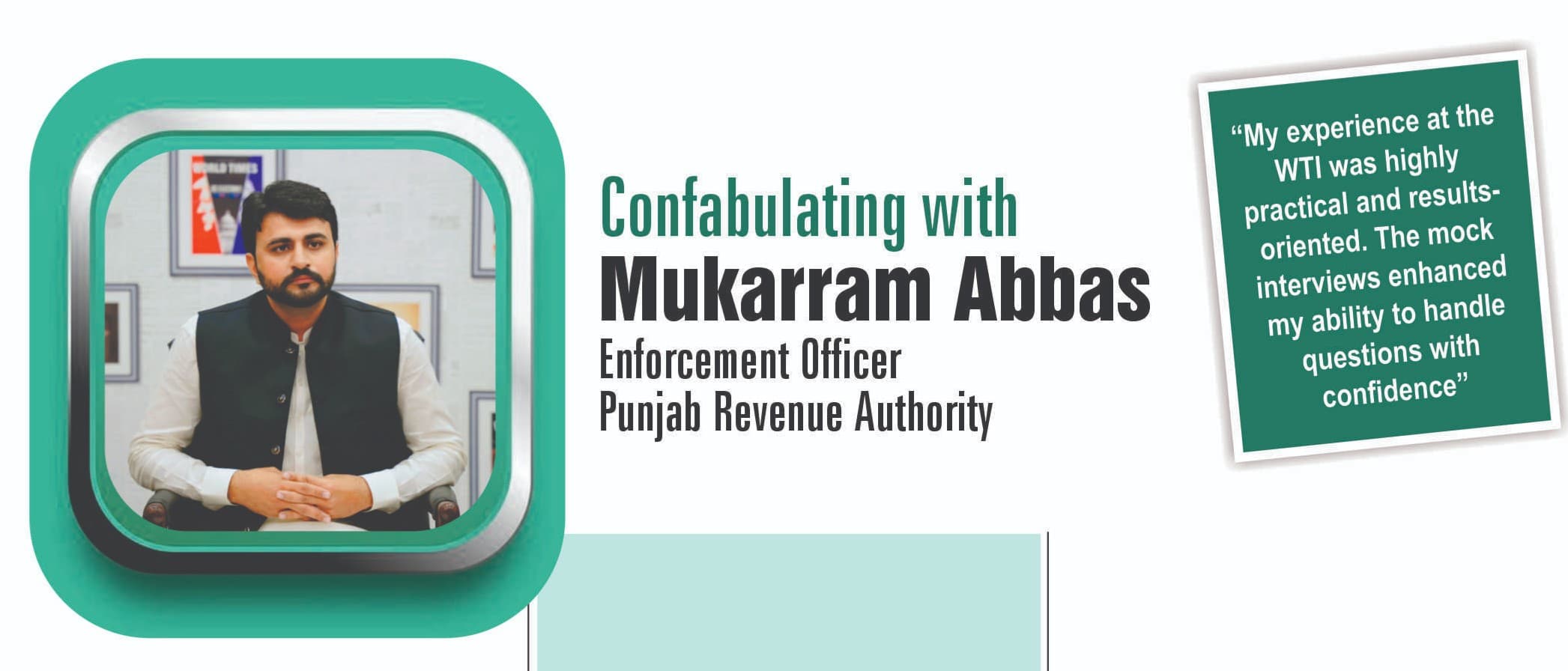
MA: My experience at the WTI was highly practical and results-oriented. I sought structured guidance and support in time management, which WTI effectively provided. The mock interviews enhanced my ability to handle questions with confidence.
JWT: How should the new aspirants start preparations for the various one-paper exams?
MA: New aspirants should start with a clear, goal-oriented direction. They need to understand the nature of the exam analyze the syllabus and subject dimensions, follow past papers’ trends, and know the structure of each paper.
JWT: What areas should they focus on?
MA: Although it depends on the post you are applying for, most aspirants tend to neglect Current Affairs, Computer Studies and General Science. I believe that focusing on these areas can be a major game-changer in one-paper exams.
JWT: What is, in your opinion, an ideal timetable for a solid preparation?
MA: For the preparation of one-paper exams, an effective timetable must be pragmatic, targeted and closely aligned with past trends. Your daily schedule should include reading newspaper, past papers practice and self-assessment to track progress.
JWT: What strategy should the in-job aspirants adopt as they have scant time at their disposal?:
MA: In-job aspirants should follow a structured yet flexible schedule to maximize efficiency. The key to success is consistency, targeted focus and regular revision.
JWT: How did you handle the interview pressure while before the panel?
MA: I managed the pressure by remaining calm and composed, with the WTI mock interview sessions playing a crucial role in my preparation. Additionally, being a good presenter during my stay at LSE further enhanced my ability to think clearly under stress and maintain focus. While before the panel, I made a conscious effort to listen attentively to each question, maintain appropriate body language and eye contact, and approach the interview as an opportunity to demonstrate my knowledge and analytical skills.
JWT: On the basis of your experience, what tips you would give to the prospective aspirants?
MA: “Consistency is the foundation of virtue,” said Francis Bacon. And, this truly reflects the mindset every aspirant should adopt. Based on my experience, success in any competitive exam stems from consistent, focused and disciplined preparation. I also highly recommend attending WTI mock interviews before the final interview with the panel. Every small step and every hour of focused study brings you closer to your goal.