Print subscription includes a free wall-size coloured map.Special offer: Subscribe Now (Print) and Get Free Wall Size Coloured Map!Subscribe Now
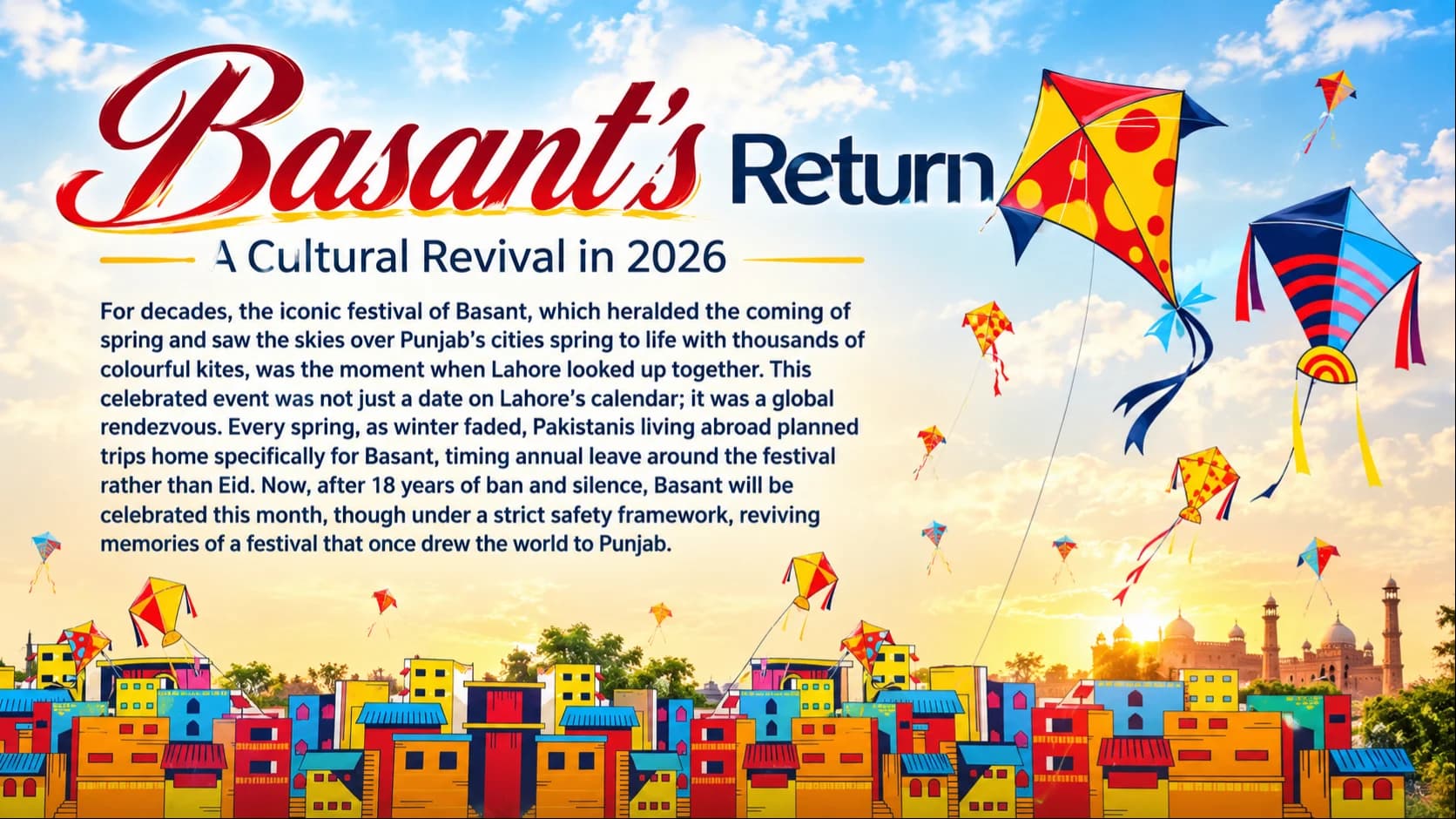
Summary. Basant's Return - A Cultural Revival in 2026
For decades, the iconic festival of Basant, which heralded the coming of spring and saw the skies over Punjab's cities spring to life with thousands of colourful kites, was the moment when Lahore looked up together. This celebrated event was not just a date on Lahore's calendar; it was a global rendezvous. Every spring, as winter faded, Pakistanis living abroad planned trips home specifically for Basant, timing annual leave around the festival rather than Eid. Now, after 18 years of ban and silence, Basant will be celebrated this month, though under a strict safety framework, reviving memories of a festival that once drew the world to Punjab.
Every spring, Lahore's rooftops filled with families, music drifted through the old city, and the sky turned into a moving mosaic of colour as kites danced in the air. More than a festival, Basant, which was Punjab's largest cultural celebration, is deeply woven especially into Lahore's identity. Now, after an 18-year hiatus, Lahoris will be delighted to see hundreds of coloured kites crowding the sky.
Basant, the iconic spring festival of Punjab, has long occupied a cherished place in Pakistan's cultural memory. For decades, it symbolized the arrival of spring, renewal and collective joy as communities gathered on rooftops to fly kites against Lahore's golden sky. After nearly twenty-five years of restrictions due to safety concerns, Basant is returning, though under a strictly regulated framework.
The Government of the Punjab has officially announced that Basant will be celebrated from February 6 to 8, 2026, exclusively within the Lahore district. This marks the first sanctioned celebration since the early 2000s. The revival is not merely the reinstatement of a festival; it represents cultural restoration, economic revitalization and the symbolic reclaiming of Lahore's identity.
In Lahore, Basant is deeply intertwined with the city's cultural evolution. Although celebrated across the subcontinent as a festival, Basant became most strongly associated – or nearly synonymous – with Lahore. Here it was regarded as the "king of festivals," with preparations beginning weeks in advance.
Markets would be adorned with colorful kites, and the city would glow with illuminated kites. Rooftops would teem with families, and the skies would come alive with kites of all shapes and sizes, echoing with the cries of "Bo kata!"
Basant was not only a cultural highlight but also a major economic driver, creating jobs for kite makers, sellers and other businesses. The government also benefited from increased revenue during the festivities.
The festival's growing popularity in the late 1990s and early 2000s brought serious challenges. A few years prior to its ban, people from all over the world had started visiting Lahore during the festival to observe the enthusiasm and passion of Lahoris. The major tragedy happened when kite-flying enthusiasts demanded the thread makers to make sharper threads by coating them with crushed glass. Then, also, the trend of aerial firing started being followed by the majority of the citizens. Both the deadly threads and bullets combined caused a number of deaths in the city, as a result of which the government banned the festival in Lahore in 2007.
The ban created a profound cultural void. Lahore's skies fell silent, and a tradition that had connected generations disappeared.
The suspension of Basant had severe economic consequences. Thousands of artisans, kite-makers, string manufacturers and small traders lost their livelihoods. Rooftop cafés, event organizers and hospitality businesses that depended on Basant tourism suffered significant declines. Entire cottage industries linked to kite-making traditions collapsed, leaving behind economic hardship and cultural stagnation.
Seen in this context, the revival of Basant is not only a cultural decision but also an economic intervention aimed at restoring livelihoods and reviving local industries.
The turning point came with the promulgation of the Punjab Kite Flying Ordinance 2025, which provides a comprehensive framework for the safe revival of Basant. The ordinance mandates strict controls on materials, registration and public safety.
All kite-related businesses— manufacturers, sellers, traders and associations—must register through the eBiz Punjab portal, providing valid CNICs, business addresses and fee receipts. Registration is valid for one year, ensuring traceability and accountability while preventing the production and sale of hazardous materials.
The framework imposes a strict ban on nylon, plastic and metal wire strings, as well as on spinning wheels (charkhi). Only traditional “Pana”-style rope is permitted. Kite and string sizes are regulated, and motorcycles are required to have safety wires installed to prevent injuries from stray strings.
Violations carry severe penalties, including three to five years' imprisonment and fines of up to Rs2 million, underscoring the government's zero-tolerance approach. These measures reflect lessons learned from past tragedies and signal a commitment to responsible celebration.
Basant celebrations will be tightly regulated in both time and space. Kite flying is permitted only from February 6 to 8, 2026, and only within Lahore.
Standard Operating Procedures have been issued for district administration, police, kite-flying associations and citizens, clearly outlining responsibilities and safety protocols to ensure effective monitoring and enforcement.
The announcement of Basant has sparked widespread enthusiasm across Pakistan and among the global diaspora. For Lahoris, it represents the restoration of the city's cultural soul after years of what many described as “cultural silence.”
The festival's return is expected to rejuvenate artistic expression and revive traditions that had faded over time.
Historically, Basant attracted large numbers of overseas Pakistanis, particularly from the Gulf, Europe, and North America. With its return, travel agencies, airlines, hotels, and guest houses are anticipating a surge in bookings.
The economic impact is expected to be substantial, with millions of rupees flowing into local businesses, artisans, and service providers. Basant 2026 thus stands as both a cultural milestone and an economic opportunity for Lahore and Punjab.
Beyond celebration, Basant's return carries deep symbolic weight. It represents resilience, cultural pride and the reclaiming of a cherished heritage. Its revival demonstrates that tradition can coexist with modern safety standards through thoughtful regulation and community engagement. After years of silence, Lahore's skies will once again be filled with colour and life—marking not just the return of a festival, but the beginning of a new cultural chapter.
Basant 2026 is more than a festival; it is a cultural renaissance. The government's decision to revive it under a comprehensive safety framework reflects a balance between heritage preservation and public well-being. The festival promises to restore joy to Lahore's streets, stimulate economic activity, and reconnect communities with a tradition that defined generations.
The writer is a PhD in English (Literature). He can be reached at hbz77@yahoo.com
Topics

The writer is a PhD in English (Literature).