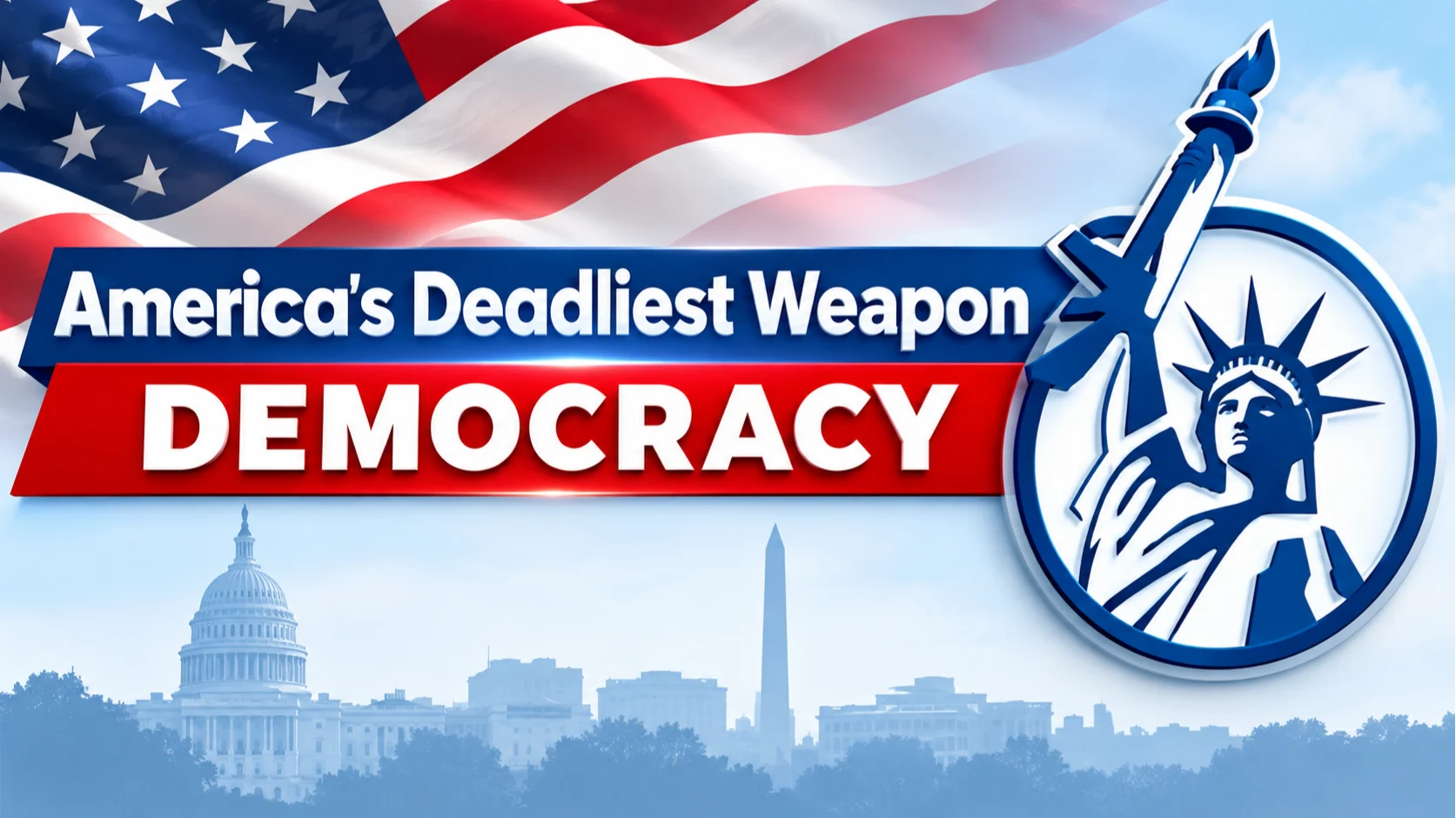
For too long, democracy has been a tool of US hegemony. While claiming to safeguard and protect "democracy," the successive US administrations have been Americanizing the concept of "democracy," drawing ideological lines, inciting division and creating confrontation – all aimed at maintaining its global hegemony. As William Blum, a writer on US foreign policy, points out in his book 'America's Deadliest Export: Democracy', “Washington's ambition for world domination is driven not by the cause of a deeper democracy or freedom, a more just world, ending poverty or violence or a more liveable planet, but rather by economics and ideology.”
Democracy has been the favourite buzzword for America. The US has a historical record of invading countries in the name of securing democracy. Every operation starts the same way – a warning about democracy under threat and a promise of stability. Then, the country collapses. There is a long history of how America used democracy as a pretext to attack the sovereign countries, depose the rulers and install puppet governments. Cold War historians estimate that more than 70 regime-change operations have been linked to the United States alone.
Here are some examples:
In Iran in 1953, an elected prime minister was removed not by the will of voters but because oil had been nationalized and foreign profits were at risk.
A year later in Guatemala, land reforms angered a powerful US corporation. Overnight, democracy was re-labelled as communism, and the government did not survive this rebranding.
The Congo in 1960 followed a similar path. Patrice Lumumba won an election, but independence without external permission proved fatal.
In Cuba in 1961, a failed CIA-backed invasion did not deliver democracy; instead, it pushed the world to the brink of nuclear war.
South Vietnam in 1963 saw a US-backed coup that ended with the assassination of the president. What followed was not freedom but prolonged instability and chaos.
In Brazil, Indonesia and Chile—across different continents—the same script played out. In Indonesia alone, an estimated half a million people were killed. Democracy, it was claimed, was saved, though the population was not.
During the later stages of the Cold War, the methods evolved but the consequences remained. In Afghanistan, weapons were supplied in the name of freedom. Decades later, those same conditions gave rise to the Taliban and al-Qaeda. In Iraq, in 2003, claims of weapons of mass destruction—later proven nonexistent—were used to justify an invasion that dismantled the state. Iraq never truly recovered, and ISIS emerged to fill the vacuum left behind.
Libya, Syria and Ukraine reflect variations of the same pattern. The justifications differ, but the outcomes look strikingly similar: regime change comes first, while reconstruction never fully arrives.
Even in recent years, patterns have not disappeared.
The recent state of affairs in Venezuela is an evident example of what happens when a government doesn't comply with America's imperialist goonism. Democracy, again, has been used as a pretext to depose the government of a sovereign country. However, the real motives were to flex muscles over Venezuela's oil wealth and deter China from using the country's oil wealth.
The core objective behind all these heinous actions by the US is to protect multifaceted geopolitical, geo-economic, strategic, military and corporate interests. However, such actions are in a shameful breach of international law – the US considers itself above it. Therefore, there is a long list of the countries in Asia, Africa and Latin America where the United States has fuelled conflicts, engineered regime changes and destabilized the region in the name of protecting democracy. However, the entire game is of interest. It is the same United States which is happy with the monarchs and autocrats when its interests are duly served.
Hence, the actions of the United States aren't about democracy. Democracy is the language, but the main objective is the power.
Zain has done an MA in Political Science and is a CSS written qualifier, having keen interest in International Relations. He can be reached at jessarzain92@gmail.com)