
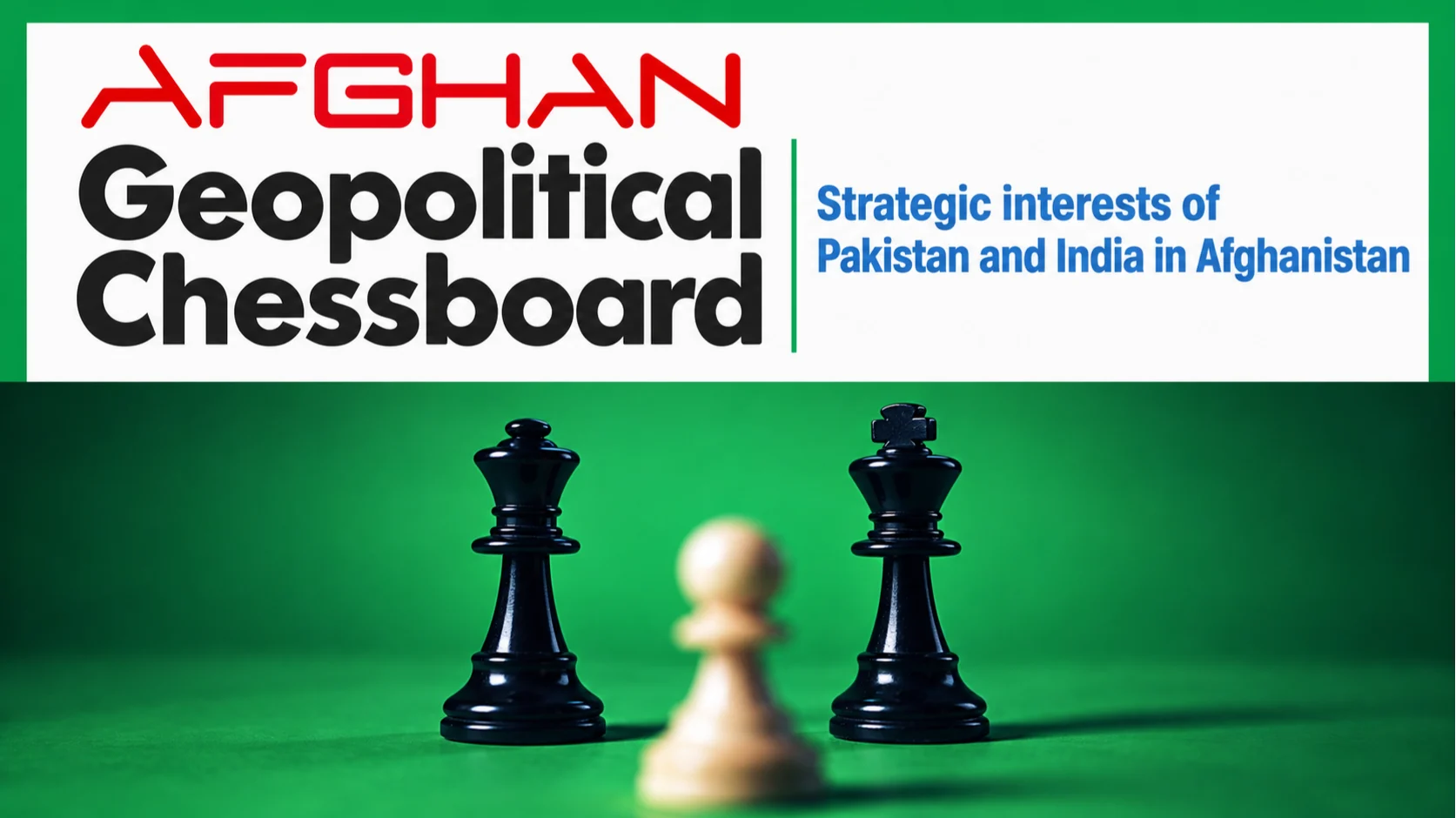


In international relations, every country has some strategic interests – long-term goals and aims that a country pursues to secure and enhance its security, economic prosperity and global and regional influence. For this purpose, nations build alliances and cooperate or compete with other countries. When the strategic interests of two or more countries coincide, they cooperate and make alliances to secure them. However, when their interests contradict, they compete to checkmate each other. The latter scenario aptly depicts the tussle between Pakistan and India. Being archrivals, both have competing interests and each side explores new avenues to secure its strategic interests and have an upper hand over the other. One such avenue is Afghanistan where both Pakistan and India are heavily involved to secure their respective strategic interests.
Pakistan's strategic interests
From the anti-Soviet jihad to the 1990s civil war, Pakistan's footprint in Afghanistan is old and deep. Pakistan has also played a crucial role in shaping contemporary Afghanistan, and it is recognized that no sustainable solution to Afghanistan's problems is possible without Pakistan's involvement. Moreover, it is also true that the future of both countries is intertwined, given their shared history, geography and ethnic ties. In addition, the country is the gateway for Pakistan to Central Asia, Middle East and beyond. So, it is all natural that Pakistan has strategic interests in Afghanistan.
First among Pakistan's strategic interests in Afghanistan is its national security. A chaotic and volatile situation in Afghanistan has created an environment where anti-Pakistan terror outfits, like TTP, BLA and IS-KP, have safe havens from where they orchestrate terrorist activities inside Pakistan. Pakistan wants the Afghan government to expel these groups from its soil. A stable and terror-free Afghanistan is in the interest of the whole region, including Pakistan.
Economic connectivity and access to natural resources like gas, oil, minerals, etc. are also strategic interests of Pakistan in Afghanistan. Besides its rich natural resources, Afghanistan also provides a connecting link between Pakistan and energy-rich Central Asian countries. The TAPI (Turkmenistan-Afghanistan-Pakistan-India) gas pipeline and CASA-1000 (Central Asia-South Asia) electricity transmission projects are such examples. The Trans-Afghan Railway Project is also being undertaken for economic connectivity, which runs from Uzbekistan to Pakistan through Afghanistan.
Another strand of Pakistan's strategic interests in Afghanistan is to achieve regional influence and leverage. Pakistan has always maneuvered to have a say in Afghanistan-related decisions and policies. It was Pakistan that brought the Afghan Taliban to the negotiation table in the Doha Accord (2020), which culminated in the US's withdrawal and revival of the Afghan Taliban in 2021. Similarly, Pakistan was a signatory to the Geneva Accord (1988), which ensured the Soviet departure from Afghanistan. Pakistan wants to maintain and enhance that leverage.
Moreover, to counter India's hegemonic designs in the region, Pakistan has always tried to have a friendly government in Afghanistan. In this regard, Pakistan supported the Afghan jihad against the USSR in the 1980s. It also supported the Afghan Taliban in the 1990s and was among the few countries that recognized their government. Likewise, after 9/11, Pakistan sided with the US in the War on Terror to not allow any space for India. Pakistan also mediated the US's withdrawal from Afghanistan and the revival of the Afghan Taliban in 2021.
India's interests
India's principal interest in Afghanistan is to acquire leverage for its anti-Pakistan agenda. As it aspired to become an influential regional power, India found a favorable environment during the presence of the US-led International Security Assistance Force (ISAF) and the installation of an anti-Taliban coalition government there. India used this space to increase its standing as a regional power. It engaged the Afghan government politically, diplomatically and economically through enhanced cooperation, exchange of mutual visits, military training and massive investment in rehabilitation and development projects.
Concurrently, India pursued an anti-Pakistan strategy in Afghanistan by provoking border dispute and stirring ideological differences between the two Muslim neighbors by exploiting the US presence in the region and the rule of anti-Taliban forces. Furthermore, to keep Pakistan embroiled in a perpetual war against terrorism, India has patronized several terror outfits which launch harrowing attacks inside Pakistan. And Pakistan has, on several occasions, provided the proof of Indian backing and patronage of anti-Pakistan terror groups inside Afghanistan.
Nowadays, in further pursuance of its anti-Pakistan agenda, India, which hitherto considered the Afghan Taliban 'savages', is cosying up with them. India has offered Chabahar Port in Iran to facilitate Afghanistan's international trade that would reduce its reliance on Pakistan's ports. It is noteworthy here that the de facto foreign minister of the Taliban was in India when the recent border skirmishes between Pakistan and Afghanistan broke out. This clearly depicts India's interests in Afghanistan.
Economic interests and access to natural resources also play an important part in India's strategic interests in Afghanistan. India has heavily invested in various infrastructure projects and the mining sector in Afghanistan. It is passionately eyeing the rich natural resources of Afghanistan and CARs. India is utilizing Iran’s Chabahar Port, India's gateway to Central Asia, for economic gains in the region, including Afghanistan.
Finally, another strategic interest of India in Afghanistan is maintaining and enhancing its regional influence. India sees itself as a regional hegemon and is doing everything to secure that position. Therefore, it has extended its tentacles into Afghanistan.
Clash of interests
Although both Pakistan and India advocate for a stable and prosperous Afghanistan, their strategic interests often clash. Both want to have a friendly Afghan government that could safeguard their respective vested interests. This has often led both sides to support competing Afghan factions. In this regard, when Pakistan supported the Afghan Taliban in the 1990s, India vigorously supported the Northern Alliance, an anti-Taliban faction. Now, as the Afghan Taliban are entering into the Indian sphere of influence, Pakistan has approached the Northern Alliance.
Similarly, the economic interests of Pakistan and India in Afghanistan also contradict. Pakistan offers a transit route for the international trade of Afghanistan with other countries, while India, as mentioned above, has asked Afghanistan to use Chabahar Port to counter Pakistan's ports of Karachi and Gwadar. Due to enmity with Pakistan, India has also withdrawn from the TAPI gas pipeline.
Conclusion
Being archenemies, India and Pakistan compete to counter each other's influence in almost every arena in the international realm, including the Afghan theater. The revival of the Afghan Taliban in 2021 has renewed their struggles to secure their strategic interests in the war-torn country. However, it is now an open secret that a stable and peaceful Afghanistan is in the best interest of both Pakistan and India. Therefore, both sides should shun their mutual differences to bring normalcy to Afghanistan. Instead of a zero-sum game in the Afghan theater, both sides should play a positive-sum game. Let's hope for the best.
The writer is currently serving as an educator in the KP government. He can be reached at: faridullah165@gmail.com