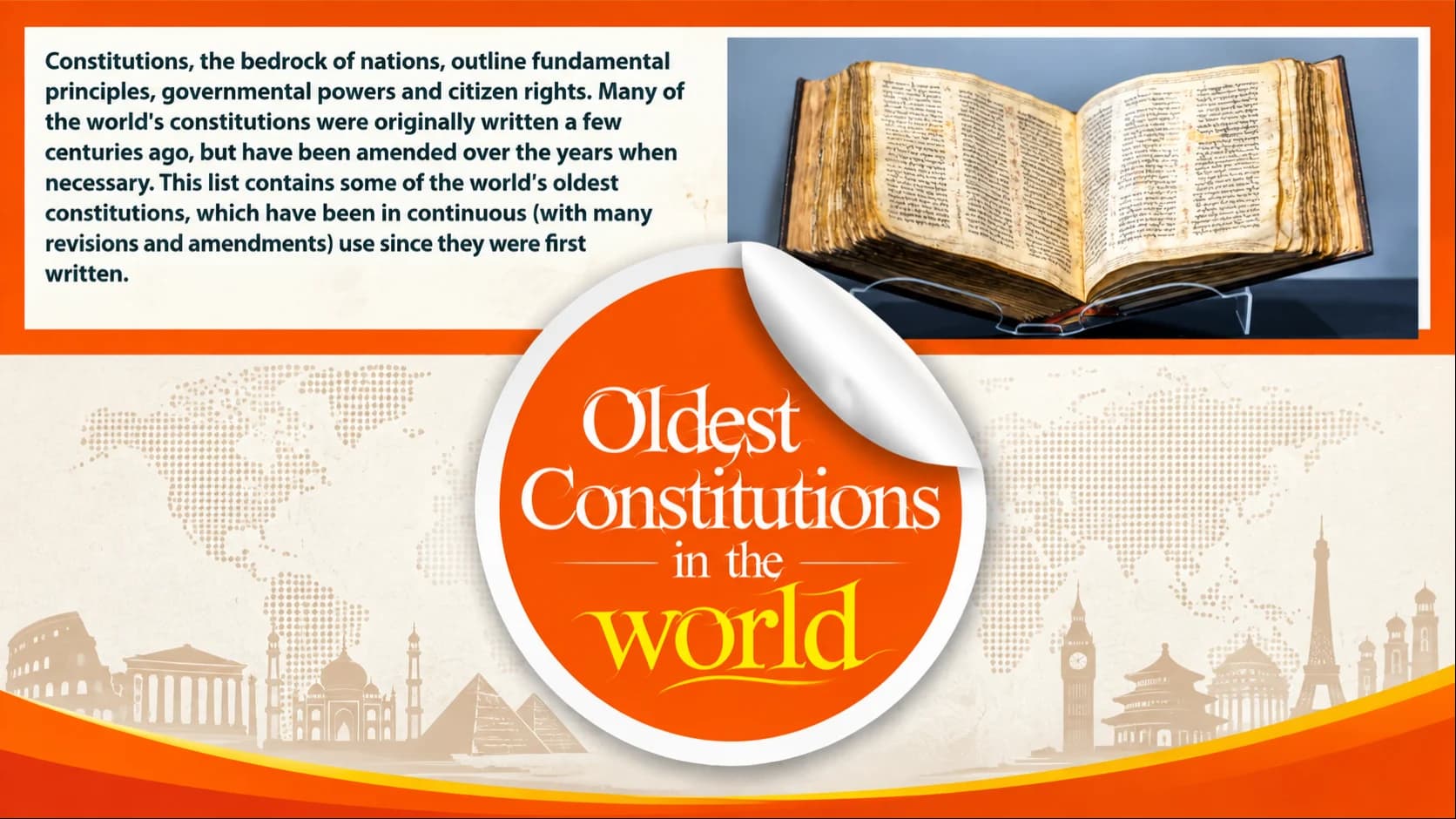
Constitutions, the bedrock of nations, outline fundamental principles, governmental powers and citizen rights. Many of the world's constitutions were originally written a few centuries ago, but have been amended over the years when necessary. This list contains some of the world's oldest constitutions, which have been in continuous (with many revisions and amendments) use since they were first written.
1. Constitution of San Marino
The Constitution of San Marino, dating back to the year 1600, holds the distinction of being one of the oldest written constitutions still in use today. The document outlines the organization of its government, the rights of its citizens and the principles that guide this ancient microstate.
2. United States Constitution
The United States Constitution, ratified on June 21, 1788, remains a cornerstone of democratic governance. Crafted during the American Revolutionary era, it established the framework for the federal government, delineated the separation of powers, and enshrined individual rights. Notably, the Bill of Rights, added in 1791, guarantees fundamental freedoms such as freedom of speech, religion and due process.
3. Constitution of the Republic of Poland
May 3, 1791, marked a historic milestone in Europe's constitutional history with the ratification of Poland's groundbreaking Constitution. Designed to bolster the monarchy while ensuring the rights of nobility and citizens, Poland's Constitution, unfortunately, faced premature demise due to external pressures and the subsequent partitioning of the nation.
4. Constitution of Norway
The Constitution of Norway, adopted on May 17, 1814, emerged during a period of political upheaval. This constitution established a constitutional monarchy, parliamentary system and fundamental rights for Norwegian citizens. It remains a symbol of national identity and pride.
5. Constitution of the Kingdom of the Netherlands
The Dutch Constitution, with origins around 1814/1815, reflects the tumultuous Napoleonic era. It laid the groundwork for the constitutional monarchy of the Netherlands, emphasizing individual liberties, separation of powers and parliamentary democracy. Notably, the Dutch monarch's powers are significantly limited by the constitution.
6. Constitution of Belgium
Belgium's Constitution, adopted in 1831, emerged from the country's struggle for independence from the Netherlands. It established Belgium as a constitutional monarchy with a bicameral parliament. The constitution emphasizes linguistic and regional diversity, reflecting the complexities of a multilingual nation.
7. Constitution of Luxembourg
Luxembourg's Constitution, dating back to October 17, 1868, provides a blueprint for this small European nation. Consisting of 121 articles divided into 13 chapters, this constitution balances the powers of the Grand Duke, the government, and the Chamber of Deputies.
8. Swiss Federal Constitution
Switzerland's Federal Constitution, adopted in 1848, transformed the loose confederation of cantons into a federal state. The original constitution was amended in 1866 and fully revised in 1874. The final amend-ments came in the 1990s and were approved in 1999, including articles on fundamental rights and the removal of some provisions.
9. Constitutional Act of the Kingdom of Denmark
The Kingdom of Denmark is both a monarchy and democracy. As a constitutional monarchy, the power of the monarch is limited by the Constitutional Act of the Kingdom of Denmark, which dates back to 1849. It is the most important piece of legislation in Denmark, and all other laws must comply with it.
10. Constitution of Canada
The cornerstone of Canada's legal framework, the Constitution Act of 1867, was initially enacted as the British North America Act. This pivotal legislation marked the country's birth, uniting British colonies in North America into a single self-governing entity. While Canada remains a member of the British Commonwealth, its constitution blends the Westminster system with federalism. The original document, establishing courts, legislatures, and a senate, continues to shape the nation's governance.