Print subscription includes a free wall-size coloured map.Special offer: Subscribe Now (Print) and Get Free Wall Size Coloured Map!Subscribe Now
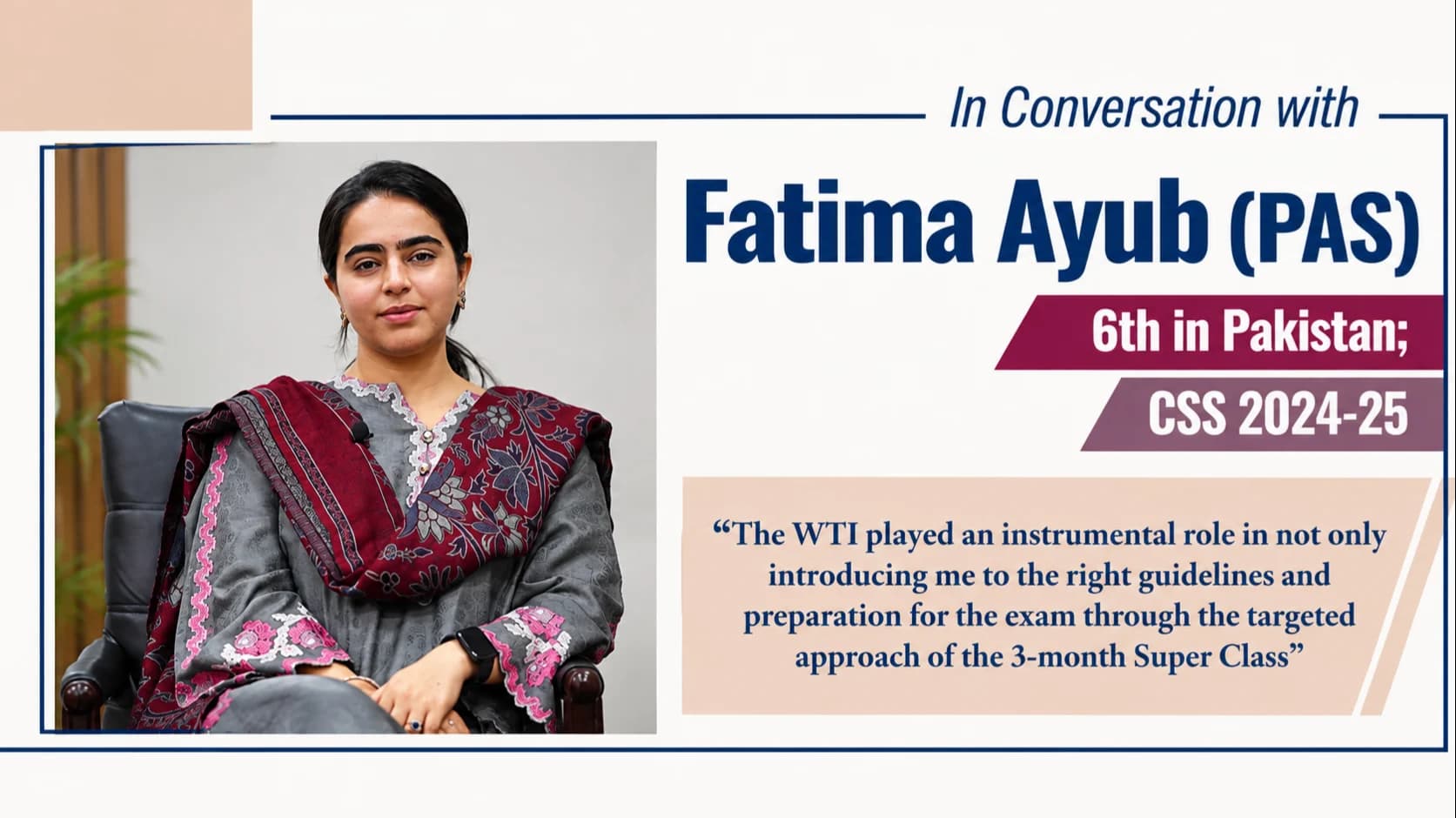
Summary. “The WTI played an instrumental role in not only introducing me to the right guidelines and preparation for the exam through the targeted approach of the 3-month Super Class”
Jahangir's World Times (JWT): First of all, please tell us about your educational background.
Fatima Ayub (FA): I did O-levels from Convent of Jesus and Mary, Lahore, and then went on to pursue my A-levels at Lahore Grammar School. I subsequently earned an LLB degree with Honours at the University of London. Following a few years in think tanks and academia, I joined King's College London for an advanced MA in National Security Studies.
JWT: What feature of the Pakistan Administrative Service attracted you most?
FA: Personally, I had watched my father in his role as a PAS/DMG officer and was aware from a young age of the tangible impact of administrative policymaking done right. All my interests over the years have always aligned with what PAS offered as a profession: day-to-day administrative problem-solving, public welfare and a strong desire and intention to work closely with and for the people of the country.
JWT: How was your experience at the World Times Institute?
FA: The WTI played an instrumental role in not only introducing me to the right guidelines for preparation for the exam through the targeted approach of the 3-month Super Class, but more importantly, my time there gave me invaluable mentors for life, and friends whose support and encouragement helped me refine my approach to the exam. Sir Adeel Niaz merits a special mention here.
JWT: What was the significance of newspaper reading in your preparation? How did staying updated with current affairs shape your success?
FA: Staying updated with global, regional or local events is critical not only to success in the exam, but also in achieving a well-roundedness that the Civil Service demands. I chose to read the digital editions of newspapers, which I could easily access anytime. I would also seek out the interviews of renowned analysts, in the week of the exam, to inform and refine my approach to answering the various dimensions of any question in the exam.
JWT: What was your overall strategy for cracking the CSS exam?
FA: I followed a two-pronged strategy: (1) Think like the examiner; and (2) Write like an analyst. The former entails making the answer legible, to the point of answering exactly what is demanded, and ensuring the answer itself is vast in covering the length and breadth of the topic. More importantly, however, the second strategy gets you high marks.
JWT: Generally, compulsory subjects are considered low-scoring; what was your strategy to get through these very papers?
FA: The pattern for the CSS exam over the years has shifted to demanding a more well-rounded, worldly answer rather than a simple pros/cons approach. Focus on the ability to think critically rather than following a bookish approach and to apply the concepts you have learned over the years to real life.
JWT: What was your approach to time management?
FA: As somebody who writes fast and tends to write a lot, I did underestimate the importance of time management. Every question offers the same 20 marks as the others. Doing well in three questions and missing the fourth adversely impacts your entire final marks, regardless of how well you may have attempted the exam.
JWT: What was the importance of revision in your strategy?
FA: I was unable to revise thoroughly due to the shortage of time, so my strategy remained in ensuring that any new concept, stat or key aspect of a topic I did learn was jotted down in 2-3 lines. I read these liners on the exam day.
JWT: How did you structure your Essay, and what was your strategy for Précis and Composition paper?
FA: In my opinion, the outline of the essay is the key. It's the first impression the examiner gets about your arguments, the relevant case studies or examples you will be giving to support your stance. Choose the Essay topic wisely and write sufficient points on all aspects of that. Use grammatically correct English and well-structured paragraphs. In the end, give a solid future outlook to do well. For the Précis paper, do not place greater emphasis on the précis question only, as other questions also carry solid, meaningful marks.
JWT: How should new aspirants start preparing for the CSS exam?
FA: Commit to the exam, as a first step. Develop a solid foundation in Pakistan Affairs and Current Affairs. Choose optionals wisely based on what you enjoy and how well you will be able to differentiate your answers from others. Download recent past papers, and begin mapping out rough answers.
JWT: What areas should the new aspirants focus on while preparing for the CSS exam?
FA: Stay true to yourself. You know your own strengths and weaknesses innately, and you must build your own strategy of preparing for the exam, which is unique to your educational background and your particular habits. Make your own timeline and begin to tackle every subject using its past paper resources. Make your study approach targeted and focused on the kind of questions being asked over the years.
JWT: Should there be some word limit kept in mind while writing answers?
FA: For the purposes of time management, the general advice is to balance each answer out by offering 6-8 sides.
My Interview Experience
My interview lasted around 50 minutes – perhaps, the longest conducted from my cohort. I thoroughly enjoyed my long discussion with each panel member who appeared engaged with my reasoning and continued to ask follow-up questions, till the conversation ultimately gave way to a participatory discussion, rather than just a Q&A session. I was grilled on my professional career, many concepts of defense studies, certain token questions, e.g. on national security, intelligence failures, Pakistan's political trajectories, war on terror; and several controversial areas that I tried to tackle by balancing my answers with adeptness and presenting my opinion as a Pakistani citizen, rather than rehearsed answers as a candidate appearing for a job interview.
Topics