Print subscription includes a free wall-size coloured map.Special offer: Subscribe Now (Print) and Get Free Wall Size Coloured Map!Subscribe Now
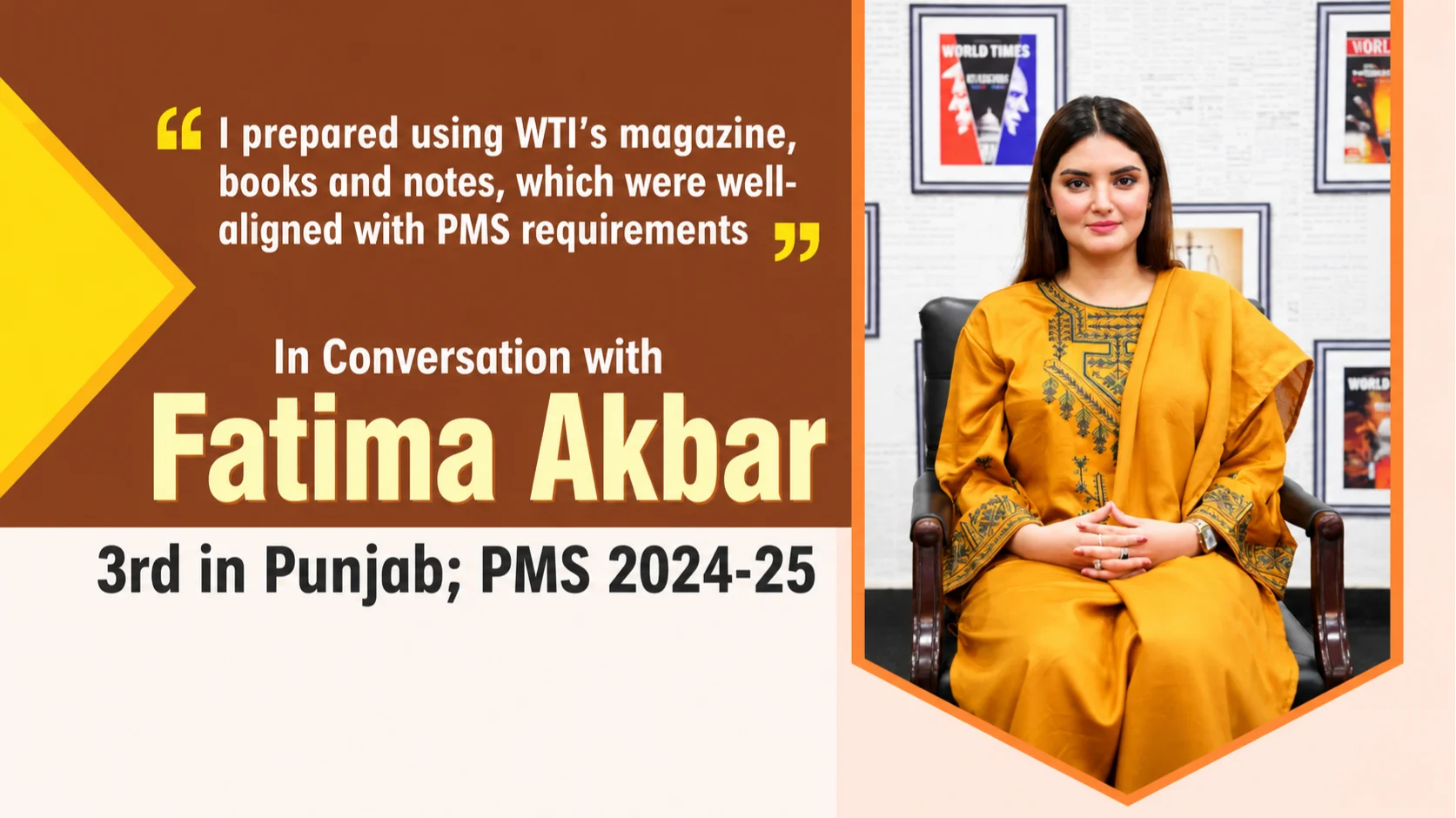
Summary. I prepared using WTI's magazine, books and notes, which were well-aligned with PMS requirements
Jahangir's World Times (JWT): First of all, please tell something about your educational background.
Fatima Akbar (FA): My secondary and intermediate education is from Sialkot. Later, I did my BS (Hons) and MPhil from the University of Gujrat.
JWT: How was your experience at the World Times Institute (WTI) for the preparation for the PMS exam?
FA: WTI was extremely helpful in my PMS preparation, as it provided a complete academic platform. I prepared using their magazines, books and notes, which were well-aligned with PMS requirements. The guidance and mentorship I received there helped me refine my exam strategy.
JWT: What was the significance of newspaper reading in your preparation? How did staying updated with current affairs shape your success?
FA: Newspaper reading played a vital role in my preparation, as it helped me stay consistently updated with national and international developments. It strengthened my analytical thinking and improved my ability to connect current affairs with static subjects. Regular reading also enhanced my vocabulary, expression and understanding of issues from multiple perspectives.
JWT: What was your overall strategy for cracking the PMS exam?
FA: My strategy was based on early planning, smart subject handling and continuous self-assessment. I prepared concise notes for both the compulsory and optional subjects. It helped me develop conceptual clarity and ensured effective revision. Alongside this, I regularly practised essay outlines to improve structure, coherence and relevance. Most importantly, I identified my weaknesses at an early stage and worked on them consistently.
JWT: What was your approach to time management throughout the preparation process? How did you balance multiple subjects and cover the vast syllabus?
FA: It was based on realistic planning and consistency. I prepared 2-3 subjects simultaneously to avoid monotony and maintain continuity across the syllabus. Alongside new topics, I ensured regular revision of previously studied material, which helped in long-term retention and reduced last-minute pressure. I never started a single day without any schedule.
JWT: What, in your opinion, is the key to getting through compulsory papers of the PMS exam?
FA: The key is to analyze the past papers in detail, prepare the topics smartly per the exam requirements and focusing on key areas rather than trying to cover everything. For the General Knowledge paper, the best strategy is to prepare the different components of the exam, i.e. general science, Pakistan geography, world geography, current affairs, IT, etc. and then solve maximum past papers.
JWT: How should answers be written to get maximum marks in the written part of the PMS exam?
FA: Rather than just focusing on the number of pages, aspirants should focus more on the quality of the content and the presentation skills. A well-curated answer with good presentation is the key. Stay relevant and to the point in your answer, give self-explanatory headings and subheadings, add flowcharts, graphs and other visual information, where needed.
JWT: How did you structure your Essay?
FA: I followed a simple structure – a comprehensive outline with case studies and examples – met the word limit too by giving quality content in the given time. I suggest taking the stance and proving it through credible information and examples rather than just talking through one's hat.
JWT: Since you have scored excellent marks in Précis and Composition paper and Social Work, what was your strategy for these?
FA: For the Précis paper, I focused on all the components, giving them equal time and attention. For Social Work, my strategy was not to rely on any single source; I prepared my own notes from different research articles, solved all the past papers and tackled the questions exactly according to the requirements of examiner.
JWT: Should there be some word limit kept in mind while writing answers?
FA: Yes, the answer should not be less than 6 pages and not more than 10 pages. Focus on quality rather than quantity.
JWT: Is it better to attempt optional papers in Urdu or one should go with English only?
FA: I attempted in English, so I think it is better to go with English.
JWT: As interviewers usually grill the interview candidates, how did you manage the situation?
FA: During the interview, I remained confident, calm and grounded, even when the panel posed challenging and probing questions. I responded thoughtfully, stayed composed under pressure and avoided unnecessary arguments. Maintaining a respectful and polite attitude toward the panel helped me to present my views clearly and leave a positive impression.
My Interview Experience
My overall experience was very good and engaging, with a healthy and insightful interaction with the panel. Although I was grilled at certain points, I took it in a constructive spirit and remained composed. I stayed confident, positive and focused, which prevented any demotivation. Most importantly I did not present any crammed answers and said what exactly I had on my mind. This approach helped me respond thoughtfully and maintain a balanced and respectful interaction throughout the interview.
My advice for fresh aspirants
Work hard, do your best and then put your trust in Allah Almighty. Half-hearted efforts are never rewarded. Do not spend too much time in useless activities, stay true to your parents, yourself and your dreams.
My Tips on
Selection of optional subjects
Go through the syllabus first – a thorough review of syllabus is crucial for selection of a subject. Then analyze the past papers and keep in view your own intellectual inclination.
Notes-making
Notes making should be relevant and exam-oriented. Past papers are the bible for PMS aspirants; hence, notes should be perfectly aligned to the requirements of the exam after thorough analysis of past trends. They should be concise and not too lengthy.
Revision
After completing a couple of topics, revise them to reinforce the concepts. Stick to your revision schedule and never compromise on it. After revision, go for as many mock exams as you can till the finals
Topics