Print subscription includes a free wall-size coloured map.Special offer: Subscribe Now (Print) and Get Free Wall Size Coloured Map!Subscribe Now
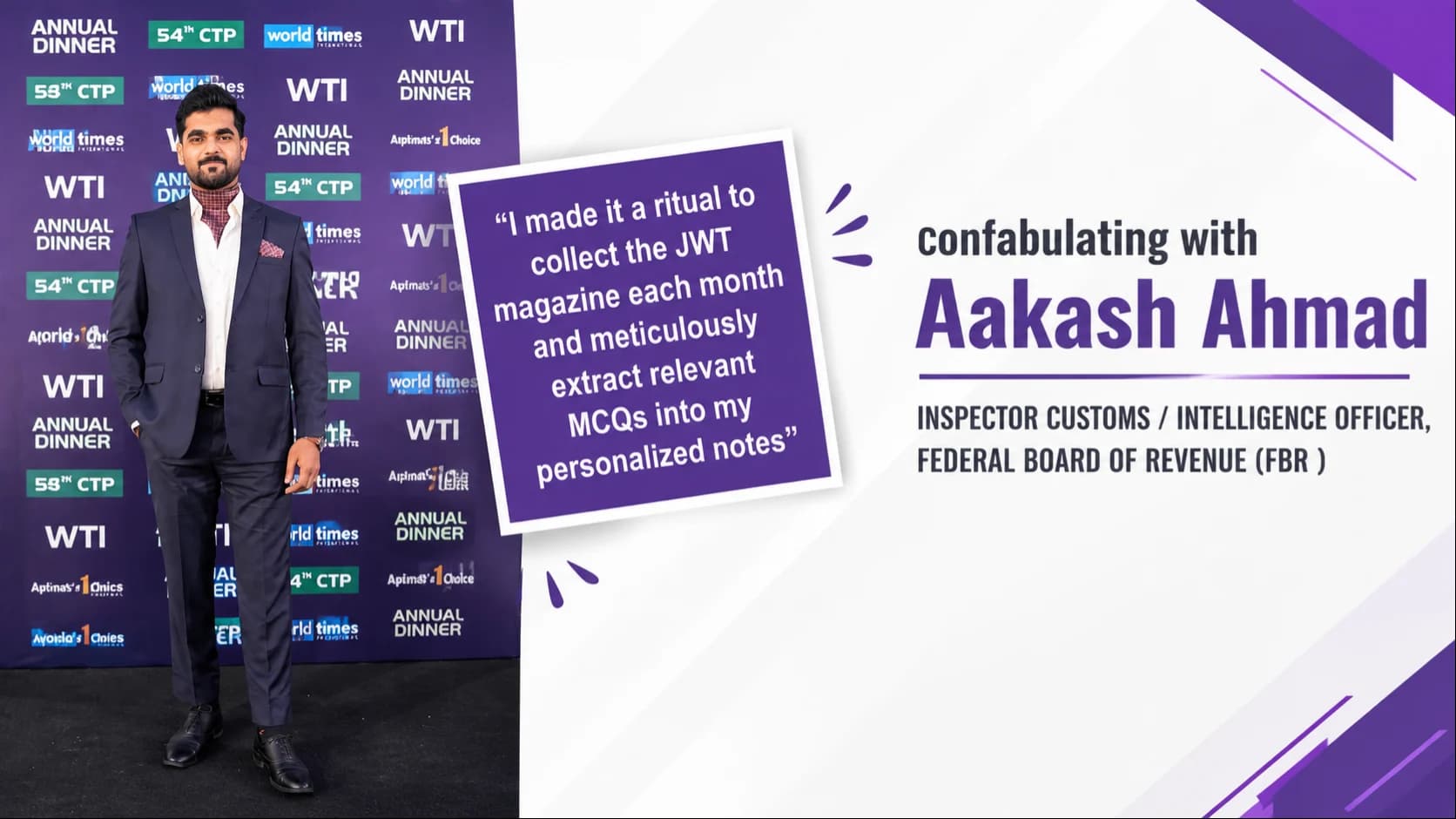
Summary. “I made it a ritual to collect the JWT magazine each month and meticulously extract relevant MCQs into my personalized notes”
Jahangir's World Times (JWT): Please tell us about your educational background.
Aakash Ahmad (AA): I earned my Bachelor's degree in Computer Science from the UET, Lahore, in 2021, followed by a Master's in the same discipline in 2025.
JWT: How long did it take you to prepare for Inspector Customs/ Intelligence Officer exam?
AA: It took approximately eight months of dedicated effort to successfully transition from the rigid logic of my UET education to the more nuanced demands of the humanities. This period served as a vital phase of intellectual tuning that persisted until I attained a state of quiet confidence in both my analytical abilities and my command over current affairs.
JWT: What were your sources for the preparation for this exam?
AA: I preferred a streamlined approach whereby I consulted 'The Big Book FPSC Papers' as a primary guide for understanding the exam trends. For current affairs, I used to go through Jahangir's World Times magazine.
JWT: How was JWT magazine helpful during your preparations?
AA: Truly instrumental! I made it a ritual to collect the magazine each month and meticulously extract relevant MCQs into my personalized notes. Specifically, organization of national and international MCQs in the magazine helped me a lot.
JWT: How was your experience at the World Times Institute?
AA: It was excellent, as it helped me find quality fellows. Beyond the study material, the WTI provided an environment conducive to growth. The mock interviews, in particular, were a turning point; the feedback from seasoned mentors helped me polish my communication skills and gave me the quiet confidence needed for the final interview.
JWT: How should the new aspirants start preparations for the various one-paper exams?
AA: First, dissect the syllabus and have a look at the last five years' papers. Understand the weightage of sections like English, Math and Islamic Studies. Find your weak areas and study accordingly.
JWT: What areas should they focus on?
AA: A balanced focus is essential, though the specific areas of emphasis will naturally vary for each aspirant. Generally speaking, they should prioritize English proficiency, current affairs and basic arithmetic.
JWT: What is, in your opinion, an ideal timetable for a sound preparation?
AA: There is no magic number of hours to ensure success. However, I believe in a quality-over-quantity approach, generally recommending 6 to 8 hours of deep work, a state where your phone is tucked away and your mind is fully present in the task at hand.
JWT: What strategy should the in-job aspirants adopt as they have scant time at their disposal?:
AA: In-job aspirants should become a time thief, skilfully reclaiming their golden hours, those quiet, undistracted windows before the workday begins or late at night. While weekdays are for maintaining momentum, weekends must be treated as the cornerstone of your preparation. Use these days for deep-dive sessions, or better yet, for visiting a mentor to seek evaluations and constructive feedback.
JWT: How did you handle the interview pressure while before the panel?
AA: I approached the interview with a powerful internal mantra
I reminded myself that I was the most qualified candidate for the role, which allowed me to project a sense of calm and polite confidence.
JWT: On the basis of your experience, what tips you would give to the prospective aspirants?
AA: If I were to offer a single piece of strategic advice to those embarking on this path, it would be keep your sources limited. You do not need to consume every book on a topic to crack the exam instead, choose one or two high-quality resources and prioritize timely, repetitive revision to ensure maximum memory retention.
Topics