Print subscription includes a free wall-size coloured map.Special offer: Subscribe Now (Print) and Get Free Wall Size Coloured Map!Subscribe Now
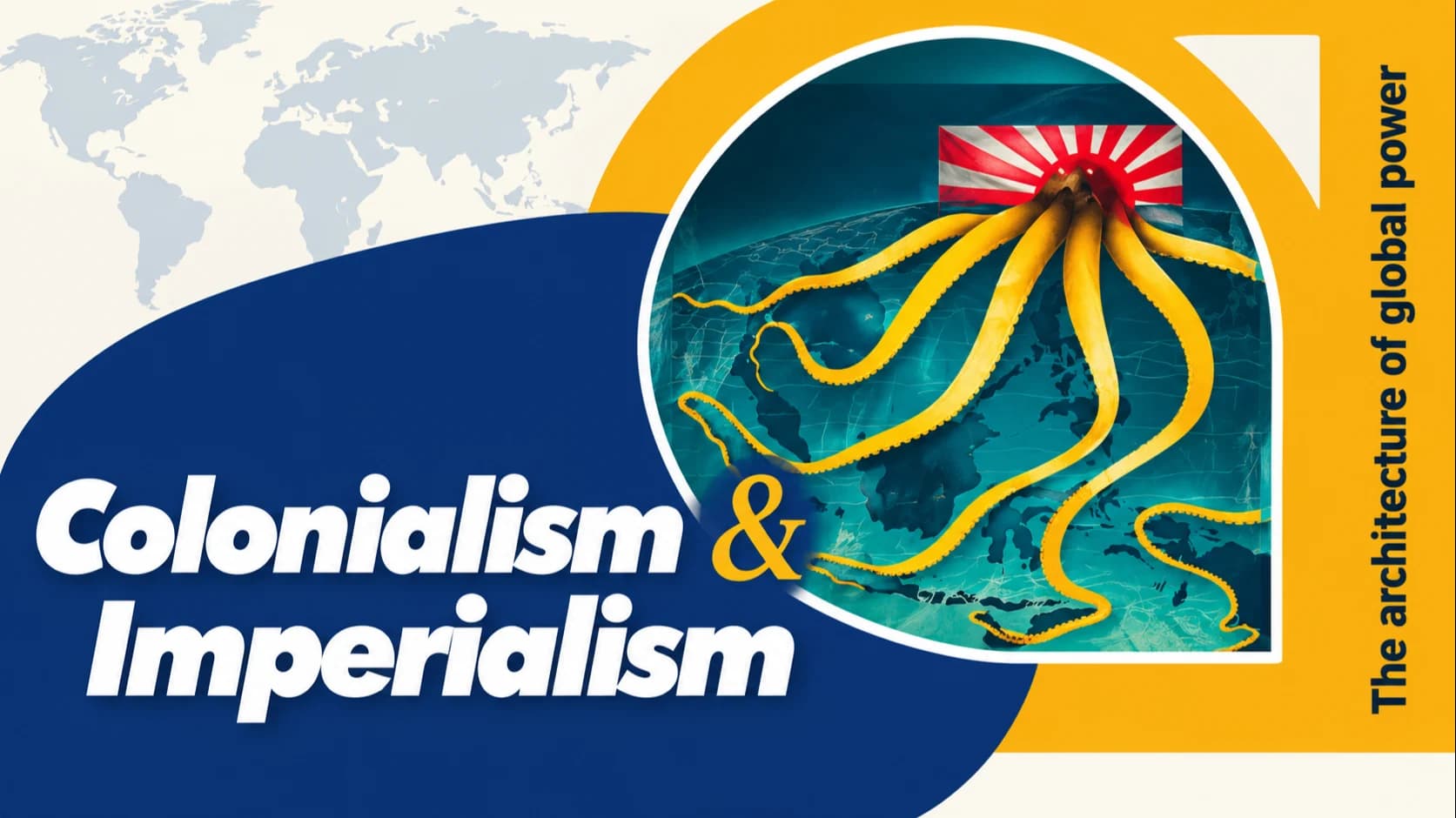
Summary. The architecture of global power
When power learned to cross oceans, it also learned to justify itself. Cannons arrived first; arguments followed close behind. From the 16th century onward, European expansion did not merely redraw maps; it reordered economies, cultures and hierarchies of knowledge. To understand this long arc of domination, two concepts are indispensable: colonialism and imperialism. They are related but not synonymous.
Colonialism denotes the direct political control and occupation of one territory by another, usually accompanied by settlement, administrative domination and systematic economic extraction. It is empire made tangible. Frantz Fanon captured its essence starkly: “Colonialism is not a thinking machine, nor a body endowed with reasoning faculties. It is violence in its natural state.”
Imperialism basically means being the big boss in charge, like having the ultimate power or being the ruler. The word comes from the Latin word “imperium.” A good example of imperialism is when the Americas were taken over by different countries from the 15th to the 19th centuries. Also, during the late 19th and early 20th centuries, the United States, Japan and some European countries became really big and powerful. However, this whole imperialistic thing hasn't always been good. It messed up a lot of indigenous societies and cultures throughout history.
1. Formal territorial control: Sovereignty of the colonised society is extinguished or subordinated.
2. Administrative domination: Colonial bureaucracies replace indigenous institutions.
3. Economic drain & restructuring: Colonies become suppliers of raw materials and consumers of finished goods.
4. Cultural & epistemic control: Language, education and history are reshaped to legitimise rule.
5. Demographic transformation (selective): Settler colonies altered population structures permanently.
1. Indirect control: Influence exercised through trade, finance, diplomacy or military threat.
2. Economic penetration: Unequal treaties, monopolies and debt dependence.
3. Strategic expansion: Control of sea lanes, choke points and spheres of influence.
4. Ideological rationalisation: “Civilising mission”, Social Darwinism, later “development” and “security.”
5. Adaptability: Rule through local elites rather than direct governance. Vladimir Lenin described imperialism as: “The highest stage of capitalism,” where finance capital and monopoly drive expansion beyond national borders.
a. British India
Colonialism: Direct rule, revenue extraction, administrative overhaul.
Imperialism: India integrated into a global imperial economy serving British industry.
b. China
China was not colonized wholesale, yet it suffered deep imperial domination — opium trade, treaty ports, extraterritoriality. This illustrates imperialism without classic colonialism.
c. Africa after 1885
The Scramble for Africa marked high colonialism. But the driving force was imperial: industrial demand, strategic rivalry and capital surplus.
d. US & the 20th century
Rarely colonial, profoundly imperial. From Latin America to West Asia, influence operated through markets, military bases and institutions rather than governors and flags.
Colonialism dismantled empires; imperialism rebranded itself. In the contemporary world, domination often flows through:
Global financial institutions
Technology and data control
Trade regimes and intellectual property
Colonialism was empire with maps and magistrates. Imperialism is empire with balance sheets and discourse. One ruled bodies; the other governs systems. Together, they structured the modern world — and provoked resistance that reshaped history.
The writer is a student at UMT, Lahore.
Topics
The writer is a student at UMT, Lahore.